Showing posts with label HIIT workout. Show all posts

Saturday, 15 August 2015

40 Min Cardio HIIT Workout Butt, Thighs, Abs: Ultimate Workout for Bel...


Workout Details

I'm typing this write up pre-filming, but I already know this one is going to be brutal. The only thing that gets you through a tough workout like this one is reminding yourself of how effective it is if you just keep pushing. This HIIT workout is very effective at fat burning, but it's also fantastic for reshaping and firming the butt and thighs, and toning the abs. You wont get more than 2 active intervals in before you realize how much lower body work is in this routine - there's a hidden squat or lunge in almost all of these exercises and your butt and thigh muscles are going to be screaming by the time you're done with this!
It's impossible to spot reduce fat from anywhere on the body, but one of the best things to reduce overall body fat and stubborn belly fat is with cardio of varying intensities and time spans. You probably already knew that, but this is not your ordinary cardio workout. In fact, this bodyweight HIIT and cardio workout will put your typical treadmill, elliptical, or group fitness cardio to shame.
If you do it right (with proper form and at an intensity that challenges you personally) you're going to struggle your way through this workout video - and that's a good thing. Assuming that you are at least a moderately experienced exerciser who is capable of reading, and listening to your own body's messages, I don't want to you to work your way comfortably through this routine; I want you to push yourself - move as fast as you possibly can, concentrate on going for a full range of motion with each rep, and do your best to make it through each active interval with minimal extra rest. With that said, keep in mind that you should never push yourself to the point of losing your stomach during a workout. In contrast to what you see on television regarding exercise; the end goal during a good workout isn't to vomit. Stop before you reach that point - it usually only takes a very quick rest before you can catch your breath, regain your composure, and start again. As you get more and more fit, you will require shorter and fewer rests along the way.


Why this is a fat burning powerhouse: High intensity interval training (HIIT) is short, intense, unsustainable bursts of physical activity, paired with intervals of quick rests. We're using a traditional Tabata workout timing structure in this particular video; 20 seconds on, 10 off. In a nutshell, this training style causes a sort of metabolic disturbance, resulting in the body burning calories at a higher rate - up to 48-72 hours later, some research indicates. In addition to the research-backed, tried and tested fat burning HIIT in this video, we also have a burnout bodyweight cardio workout after the more intense part of the routine; this will not only drive up the total calories and fat burned for the workout, but also help increase your endurance and stamina. I've thrown in some intervals of core work that focus specifically on the abs, obliques, and lower back, just to wake up those muscles (once you're at a healthy bodyweight, those muscles may even start to make an appearance).

Saturday, 25 July 2015

BodyRock HiitMax | Workout 1 - Full Body Skipping

In this post you have some prep for you to complete & it has also
included diet advice, a shopping list to help stay on track, equipment
alternatives if you need them & some daily motivation to get you
pumped.

Wednesday, 6 May 2015

Know the Exact Definition of Circuit Training Workouts for Women

Circuit training workouts for women comprises short weight-bearing exercises and women needs to carry medium weights and perform many repetitions to achieve great results. 
 
 Circuit training workouts for women are composed of short weight-bearing exercises that require women to use medium weights and do many repetitions to attain great results. Each of the designed exercises is immediately followed by another set of routine that targets a different muscle group, which is also performed at a different station having 9 to 12 exercises that will make up a complete circuit. Circuit training workouts for women allow the exerciser to avoid waiting her muscles to rest between sets by changing muscle groups. The routine will allow the exerciser’s heart rate up all throughout the workout. 

Over the past years, circuit training exercises for women has become popular because of its great results for both weight loss and general self-esteem. These workouts are designed specifically for maximum flexibility by allowing women to create a resistance circuit by using free weights, exercise machines, resistance bands and even their own weight. The nine to twelve stations that complete the circuit focuses on all the major groups such as: legs, arms, chest, arms, back and abs. The workouts that complete the circuit can be performed in any order as long as the woman switches her muscle group between each exercise she performs and she does not take breaks. Some other circuit training workouts for women includes added routines that are effective in burning calories, which are usually jogging and jumping k jacks. These added calorie-burning burst is incorporated in 15- to 30-second cardio circuits that will allow a woman to attain great results. 

Since a lot of muscles are being used in every circuit, circuit training workouts for women usually have cross-training workout that will give less strain on the joints, making the workouts to have smaller chance of injury that the traditional weightlifting exercises. The program’s adherence rate is also good because it will not bore the exerciser as it has quick changes in the routine. 

However, all workouts have limitations and circuit training for workouts for women is not an effective way of building bulk muscles or increasing someone’s strength because of its design where more repetitions are done with lighter weight. That is why such program is not advisable for weightlifters who aim to increase their strength and muscles. 

 
In addition, people who wish to try these circuit training workouts and are not informed of weightlifting are more likely to injure themselves during the program than performing several programs of traditional weight lifting. An instructor will also find it difficult to emphasize form because of the quick changes between the exercises. 

In the United States, where such program is very popular for women because of its flexibility, circuit training workouts for women can be found in such titles: Muscle WorkFree Articles, Body Sculpt and Burn and Firm. 

Source Along Parker | AF 
 

Wednesday, 29 April 2015

How You Can Get Your Body In Its Best Shape Ever With HIIT Fitness...

Hit Fitness is a growing fitness trend in Fitness, HIIT or High Intensity Training Fitness, is a fitness system built around a unique combination of science and sport.


Hit Fitness , or High Intensity Training, is a fitness system built around a unique combination of science and sport.
Hit Fitness is definably an "alternative" way to personal fitness, but it is a method that is worthy of a look.


What Will I Really Be Doing In HIT Fitness?
Hit Fitness combines a unique combination of typical fitness along with sporting elements, such as the practice of Fencing or Kenpo.
Some of the activities that are included in Hit Fitness include:
*Fencing
*Kenpo
*Self-Defense
*Personal Fitness
*Other Sporting Activities
The types of activities that you participate in depends on the type of Hit Fitness Spokane program that you join.
Different instructors of the Hit Fitness way have different methods. Regardless of the methods that your fitness coach uses to teach you Hit Fitness, you will experience a unique exercise technique that will benefit your body more than a traditional fitness plan can accomplish.

Hit Fitness Sporting Events
Participating in sporting events in the Hit Fitness program is a big part of your training. Not only will these sporting events help you to achieve your fitness goals at a faster pace, but several of the sports can be used later in life, even after you complete your fitness goals.
Sounds Fun. What Does Hit Fitness Spokane Concentrate On? Well, the Hit Fitness program is quite the unusual exercise system. The Hit Fitness program focuses on the following aspects of the fitness world:
Anaerobic Threshold Balance Body Composition Strength VO2 Max (maximal oxygen consumption)
Hit Fitness Anaerobic Threshold
A basic definition of the Hit Fitness Anaerobic Threshold is that it occurs when muscles "burn" glucose without the use of Oxygen. Anaerobic Threshold is ideal for those who need that short extra burst in their life. On the flip side, Anaerobic Threshold would not be ideal for a distance runner.

Hit Fitness Balance
Another important part of the Hit Fitness way is the aspect of balance. A majority of people who participate in the Hit Fitness exercise plan are athletes. These people require a great amount of agility and balance to succeed at what they do best. By having great balance, you can even increase the efficiency of your Spokane workout.

Hit Fitness Body Composition
Hit Fitness Body Composition is a way of describing the percentage of bone, fat, and muscle in your body. The Hit Fitness Spokane system puts a lot of attention on the aspect of body composition, as it is vital to balance the mass percentages of bone, fat, and muscle in ones body.
Hit Fitness Strength
Hit Fitness works with your overall body strength. Since the Spokane Hit Fitness way of exercise revolves around sporting activities, it is important to have strength as it will give you the opportunity to push your body to the next level.
 
Hit Fitness VO2 Max

What is VO2 Max? Basically, VO2 Max is another meaning for the maximal amount of oxygen consumption. It plays a very important role in Hit Fitness as your VO2 Max directly determines how physically fit you are. Each person has a different VO2 Max. The max can be included over time through Hit Fitness Spokane WA exercises.
So, is Hit Fitness Right For You?

... If you are athletic, then you should definably consider the Hit Fitness way of exercise. If you are interested in starting on a Hit Fitness exercise planComputer Technology Articles, you should speak to your local fitness coach today to see if such a program is offered.

Source Zach Hunt AF 

Sunday, 5 April 2015

HIIT Cardio Workout to Get Your Body Sculpted!


does muscle burn fatGetting into tip top physical shape and health requires exercise and clean-eating.  But we all know that within those two areas there are infinite workout and eating plans out on the market.  One particularly effective tried-and-true workout regimen is the High Intensity Interval (HIIT) cardio workout.  It integrates short bursts of energy with maximum power as opposed to steady state cardio for long periods of time.  This type of high intensity, rest, then repeat style of training will produce a total body renovation.
If this sounds great to you, try our 30-day body renovation now! Summer is right around the corner, so there is no better time than now.

The Body’s Energy Systems Taxed During HIIT
Oh, how I love science.  Here’s a brief introduction into the three energy systems that go on alert during a HIIT cardio workout.
1) High Energy Phosphate System
The high energy phosphate system provides energy for muscles in the initial 15 seconds of high intensity activity. ATP (quick burst of energy) will be activated during this system. This is ideal because this system is linked to metabolic changes to burn fat.
2) Anaerobic Glycolytic System
Second, the Anaerobic Glycolytic System relies primarily on anaerobic metabolism for the energy required to perform intensive exercise of greater than 12-15 seconds and less than 3 minutes duration. This system will be another way to overload your muscles, as you will be firing those muscle fibers so fast, you are going to recruit the fast twitch fibers and evidently you’re going to cause muscle damage which leads to muscle growth (aka tight buns!).
3) Aerobic Oxidative System
The third system is the Aerobic Oxidative System which consists primarily of exercises that are performed at an intensity lower than that of the anaerobic threshold. Meaning that you will not get any lactic acid (burning sensation) production when you’re in this system and it will be mainly a brisk to fast pace walk or light jogs to keep your heart rate elevated (wikipedia.org).

HIIT Workouts to Get You Sculpted!
  • Boxing
Boxing is one of the best workouts ever.  If you’re one of the few who don’t believe me, chances are you haven’t tried it.  This HIIT workout is not only a highly effective fat burning, muscle building workout, it can be an amazing stress reliever. Hitting a punching bag is a great upper body workout and tailors well for those that have lower body injuries or limitations. One recommendation I will make is to not do a heavy upper body workout following this workout or the day after. Make sure to have an off day or lower body day. Your shoulders and arms will feel like mush and you will inhibit adequate recovery time.
Do:
  • 10 minutes of jump rope for a warm up
  • 5 rounds of 10-30 second all out (everything you’ve got beating the crap out of that bag)
  • 2-4 minutes of jump roping in between rounds
  • 10 minute brisk walk to cool down

  • Drags
Drags are very effective for the athlete, power lifter, or down-right die hard who wants to get in tip top shape. Dragging a weighted sled by using a harness tied to your waist allows you to activate the core to work harder as well as your glutes and hams. The harness also forces you to keep a straight, stiff spine throughout the exercise, regardless of how tired you get. Rounding the back at anytime will immediately look and feel very awkward, giving instant feedback to straighten out or stop and rest. The great thing about sled dragging is it can have a carryover effect to many things, such as: Football, athletes learning how to explode when moving. Powerlifting, sled dragging strengthens your posterior chain and that can help with deadlifting. Track and field, overloading your waist and sprinting with weights can lead to more explosive movements when you train without them. If you aren’t sled dragging, then you are missing out on superior strength gains and conditioning.
Do:
  • 10 minute brisk walk or slow paced jog for warm up
  • 5 intervals of 10-30 seconds all out sled dragging and 2-3 minute brisk walk in between intervals
  • 10 minutes brisk walk to cool down
For a complete course incorporating HIIT, learn more here!
  • Kettlebell Swings
Believe it or not but kettlebells are starting to be increasingly popular. Specifically kettlebell swings have become a great HIIT cardio workout to activate your glutes and hamstrings. A study in the Journal of Strength and Conditioning found as the movement progressed from the bottom of the swing to the top of the swing, back muscle activation peaked first at around 50% of MVC (maximal voluntary contraction), followed by abdominal/oblique activation at around 20-30% of MVC, followed by gluteal muscle activation at around 75% of MVC. As you can see kettlebell swings stimulate your glutes, strengthen your back muscles, engage your core muscles and help strengthen the hip and knees. Muscle activation ramps up during a half-second interval in the concentric phase (top of the swing) and then transitions to almost complete relaxation during much of the eccentric phase (coming down with the swing). So every time you are swinging that kettlebell you are firing muscle fibers and this could lead to overall muscle growth. If you’ve never tried kettlebells for HIIT then your booty and hamies are in for a long day! Make sure to be wise when you choose the weight, you aren’t going for a 1 rep max, pick a comfortable weight that you can swing and use good form to really activate all the muscles.
Do:
  • 5 minute moderate jump rope for warm up or 10 minute brisk walk/jog
  • 5 sets of 10-30 second intervals (all out swings) and 45-60 seconds of rest in between intervals
  • 5 minutes of moderate jump rope or 10 minute brisk walk/jog to cool down
  • Rope Training
Heavy rope training was originally developed for specific combat sports such as Football and Mixed Martial Arts; it is now becoming very popular for conditioning work and HIIT cardio. If you’re looking for a new twist to your fitness routine or if you’re one of those that complain about other HIIT cardio workouts being too demanding on your legs the day after a leg session, then this is what you’re looking for. Along with increasing your strength, power, and endurance, the constant motion of rope battling will give you a hell of a workout. Some common movements include waves, slams, throws, spirals, and whips. These all involve swinging your arms up and down (or side to side) for timed intervals. With each of these exercises, you want to create a solid base by planting your feet in a shoulder width stance and stabilizing your core, think of an athletic stance. You’ll quickly discover that these exercises engage not just your arms and shoulders, but your whole body.
Do:
  • 5 minute moderate jump rope for warm up
  • 3-5 sets of 10-30 second intervals (waves, slams, throws, spirals, whips) and 45-60 seconds of rest in between intervals
  • 5 minutes of moderate jump rope to cool down
Hungry for more? More body weight exercises found here!
  • Sprints
Sprints are in almost every athletic training program and/or bootcamp workout. This HIIT workout targets the lower body not only in sculpting nice legs but developing powerfully strong legs.  Just look at sprinters legs compared to a long distance runners legs. Obviously the sprinter has more muscle mass on their legs because they’re activating fast twitch muscle fibers and creating muscle damage which leads to muscle growth. If you don’t believe me, go do sprints and you’ll see how sore you are the next day, it’ll feel almost the same as if you did an intense leg workout and that’s because you activated and broke down those muscle fibers.
Do:
  • 10 minute brisk walk
  • 5 sets of 10-30 second intervals (all out, everything you’ve got) and 1-4 minutes of rest in between intervals
  • 10 minute brisk walk to cool down

 Source

Tuesday, 31 March 2015

How to Beat Flabby Arm Jiggle

Just because you're holding excess body fat on your arms doesn't mean you can't get rid of it. Altering your exercise regimen and making a few simple dietary changes can help you beat arm jiggle.

Add 30 Minutes of Aerobic Exercise

If you're not doing cardiovascular exercise on a regular basis, it's time to start. Aim for 30 to 60 minutes of cardiovascular exercise most days of the week to beat arm jiggle and burn fat all over your body. A study published in 2012 in the American Journal of Physiology found that study participants lost about the same amount of body fat whether they participated in 30 or 60 minutes of aerobic exercise daily.

Participate in Interval Training

Adding interval training to your workout regimen may result in significant arm-fat loss. A study published in 2011 in the Journal of Obesity found that high-intensity interval training, which is alternating short stints of high-intensity exercise with recovery bouts at lower intensities for just 20 minutes, three days weekly is an effective fat-loss strategy.

Perform Upper-Body Resistance Exercises


While it's difficult to reduce body fat in just one area of your body, participating in upper-body resistance training on a regular basis reduces arm fat, according to a study published in 2007 in Medicine and Science in Sports and Exercise. Work each muscle group two to three days weekly, and perform two to four sets of 8 to 20 repetitions for each exercise, suggests the American College of Sports Medicine.

Upper body exercises that help you beat arm jiggle and work your biceps, triceps, shoulders and upper back include arm curls, triceps extensions, triceps kickbacks, push-ups, chest press, shoulder press, front raises, lateral raises, bent-over deltoid raises, bent-over rows and upright rows.

Make Subtle Dietary Changes

Lowering your overall caloric intake, cutting out extra sugar, and boosting dietary protein are subtle dietary changes you can make to help beat arm jiggle. A study published in 2011 in The Journal of Nutrition found that study subjects who exercised regularly, ate slightly fewer calories than usual, and consumed 30 percent of their total calories from protein, including protein from calcium-rich dairy foods, lost more weight and body fat and maintained more lean muscle than participants who consumed lower amounts of protein.

Foods to include in a fat-loss diet include those rich in protein, such as low-fat milk, low-fat cottage cheese, plain Greek yogurt, reduced-fat cheese, lean poultry, seafood, egg whites, soy products, nuts, seeds and legumes. Pick plenty of fiber-rich vegetables, such as leafy greens, broccoli, cucumbers, tomatoes, asparagus, peppers and green beans. Choose whole grains like quinoa, brown rice, oatmeal, and whole-grain couscous instead of white bread, white rice, crackers, commercial baked goods and other sweets.

Considerations if You Have Loose Skin

If you've lost a considerable amount of weight, have reached your goal weight, and your arm jiggle is due to loose, saggy skin, talk with your doctor about ways to get rid of it. In some cases, people with significant weight losses require skin removal surgery to get rid of excess skin caused by extreme weight loss.

source

Sunday, 1 February 2015

Full Body Tabata Workout

resized (2 of 2) 

TABATAS! My absolute most favorite workout. These can be done anywhere at any time with basically any equipment. The concept seems simple, even easy, but I guarantee by the last set of each exercise you will be feeling that amazing burn that gets you the results you oh so desire!

Concept is simple – set your timer to 8 sets of 20 seconds of high intensity workouts with 10 seconds of rest between each set.


For example for the first exercise:

1sec – 20sec high intensity mountain climbers

21 – 30 rest (try to keep moving a bit so you do not cramp uo)

31 – 50 high intensity mountain climbers

51 – 60 rest

…. Keep this going until you have 8 of each exercise complete and then do it all over for the next exercise until you are through all eight of them. Recover for about a minute between exercises.


Exercise 1: Mountain climbers

Begin in high plank position. Alternate bringing your knees up to chest in a rapid motion.
resized (1 of 29)
Exercise 2: Tricep push-up
Perform push-up with hands directly under shoulders and arms sliding next to your sides. Hand positioning is slightly narrower than regular push-ups.
resized (10 of 29) resized (11 of 29)
Exercise 3: High Knees
Run with knees high in one spot maintaining a straight back and strong core. Can place hands out and make sure top of knees touch hands on each stride.
resized (14 of 29) resized (15 of 29)
Exercise 4: Bicycle Sit-ups
Lie on back in sit-ups position. Place hands just behind head or on temple and bring opposite elbow to opposite knee in a controlled motion, switch sides. Ensure you are not pulling up your neck towards knee, motion should come from the abs.
resized (16 of 29) resized (17 of 29)
Exercise 5: Push-up Jack
Start in high plank position. Perform a push-up. On the down motion hop your feet out into a wide position while maintaining straight back form. When straightening arms to push back up, hop feet back in.
resized (19 of 29) resized (20 of 29) resized (21 of 29)
Exercise 6: Plié Squat
Stand with feet slightly wider than shoulders with toes pointing out. Squat down keeping your butt tucked in and back straight until legs form a 90 degree angle. Push up through heels to starting position while squeezing your butt.
workoutoutdoors (23 of 29)
workoutoutdoors (24 of 29)
Exercise 7: Crab Taps
Begin in crab walk position. Lift arm and opposite leg up and tap together. Return to start position and alternate using other arm and leg.
resized (27 of 29) resized (28 of 29) resized (29 of 29)
Exercise 8: Reverse Lunge with Hop
Perform a reverse lunge and when you go to return to starting position hop straight up on the front leg. Switch legs and repeat
resized (5 of 29) resized (6 of 29)
You can add difficulty to any of the above moves by adding weights, a weighted vest, etc. Just ensure that you are going at a high intensity for the 20 seconds. However, more important than speed is FORM so ensure that this is kept constant and strong throughout the entire exercise in order to get the most benefit and prevent injury.

Source 

Saturday, 31 January 2015

20-Minute Calorie-Burning HIIT Workout


With the holiday season in full swing and the hustle to get end-of-the-year projects complete, it’s easy to stray from our regular exercise habits. Who has time for exercise when we are shopping for presents, cooking for family, running errands, traveling and attending parties? You. You have time for exercise. If your regular routine of going to the gym is getting trumped by this busy time of the year, try a high-intensity interval training (HIIT) workout that offers both fitness and calorie-burning benefits. Plus, you’ll work up a good stress-reducing sweat in a short amount of time.
High-intensity interval training features alternating bouts of all-out high-intensity exercise effort and short rest periods for a specific number of sets. These short, intense bursts of activity give you an incredible aerobic, anaerobic, strength and power workout all rolled into one. During a HIIT workout, your body metabolizes fat for fuel and after your workout your body will tap into fat stores for the energy. This makes HIIT one of the best ways to maximize caloric burn in a short amount of time. All you need is 15 to 30 minutes to reap all of these benefits of a HIIT workout.
No fitness equipment necessary for this 20-minute HIIT workout, but make sure you have water close by and a timer to keep track of the work/rest exercise intervals.
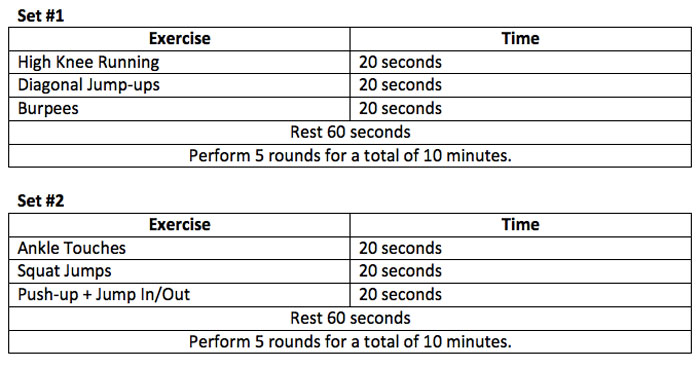
This workout includes two sets of three exercises repeated four times in row. Each exercise in the set is performed for 20 seconds followed by a one-minute rest. When set #1 is complete, move on to set #2.
HIIT workout
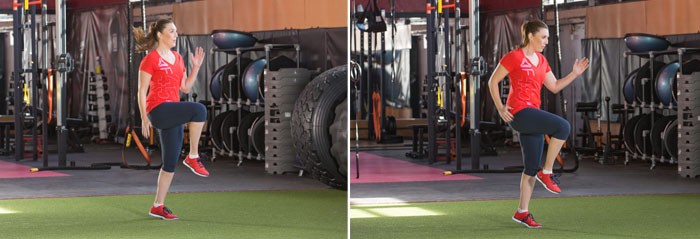
High Knee Running: Run in place, bringing your knees up toward your chest and pumping the arms as quickly as you can.
High knee running
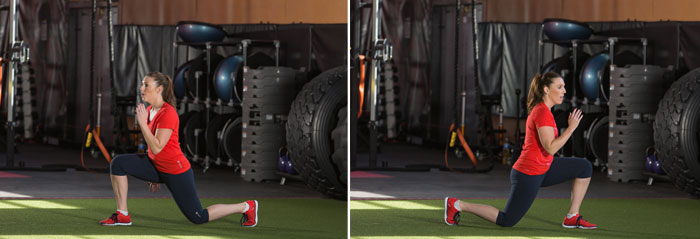
Diagonal Jump-ups: Begin in lunge position, with your right foot forward and your body turned toward the upper-right-hand corner. Push through both feet, jump up and land in a lunge position with the left foot forward and your torso facing the upper-left-hand corner.
diagonal jump ups
Burpees: Squat and place both hands down on the floor. Jump or walk back to high-plank position and perform one push up. Jump or walk your feet back to the squat position and immediately jump up with arms overhead.
burpee
burpee
burpee
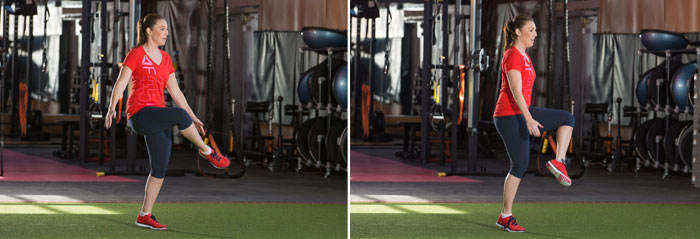
Ankle Touches: Run in place, turning your knees slightly outward, bringing the inside of the leg up toward the chest and reaching your hands to touch the inside of your ankles.
ankle touches
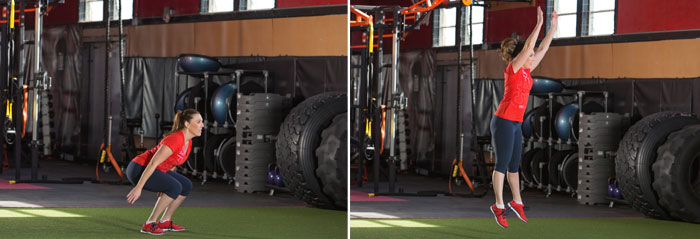
Squat Jumps: Lower down into a squat, swinging your arms back behind you. Immediately jump up, swinging your arms up toward the ceiling.
squat jumps
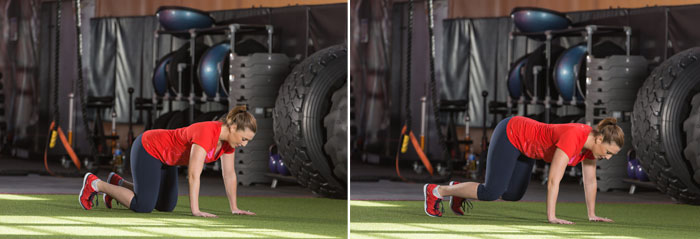
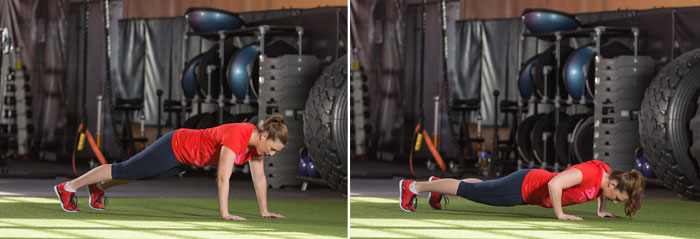
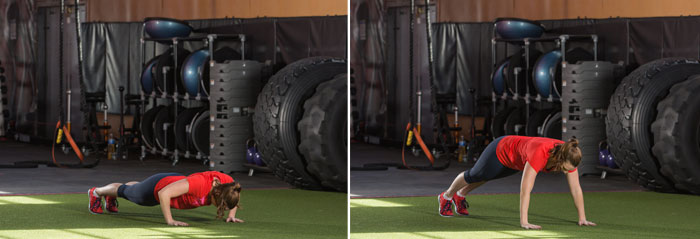
Push-up + Jump In/Out: Begin in quadruped position, with your hips over the knees and shoulders over the hands. Curl up onto the toes and lift the knees slightly off the floor. Jump or walk the legs back into high plank and perform one push up. Jump or walk the legs back into the elevated quadruped position.
push up
push up

Source

Wednesday, 21 January 2015

Kick(box) the Fat Off with This 30 Minute Uptempo Home Cardio Workout

kickbox cardio workout
One of the best way to continue stripping away that fat and getting yourself closer to the body of your dreams is incorporating different types of cardio exercise to your overall fitness program.  We often get so hung up on HIIT cardio, that we forget that are actually other ways of burning calories out there – who would have thought?  After all, HIIT cardio is great, but if that’s all you’re doing, it can get a little repetitive, I admit. Not only that, when you perform the same type of exercise day in, day out, your body grows more efficient at completing that type of work.
So if you’ve been hitting the HIIT sprints hard in an effort to burn fat and lose some weight, it may be time to reconsider that plan.  Most people know this is true for strength training, but far fewer realize your body will grow accustomed to the type of cardio you’ve been doing.  Just like switching up your exercises, weights, and reps/sets, you’ve absolutely got to switch up the way in which you’re doing your cardio.  Today, we give you a great 30 minute cardio kickbox class, led by one of our favorite trainers, Gwen.

Why Cardio Kickbox Will Help You Burn Fat

This fat burning workout is fantastic for helping cut calories fast, while building and sculpting lean muscle in your legs, core, and upper body.  The plyometric nature of many of the punch/kick combos is going to provide a nice break from routine for many of you.  If incorporated into your plan regularly, this break from routine should be enough to help you get past that plateau you’ve been on, and turn back on your inner fat burning machine.
Today’s class is especially perfect, because it can easily be doubled and turned into almost an hour’s worth of uptempo cardiovascular work, simply by running through the entire routine twice, circuit style.  Gwen makes sure to hit all the major areas of your body while seamlessly flowing through this routine, making it one of the most popular kickboxing classes we offer.
So instead of checking out the group fitness class schedule at your gym, give yourself a little break, and pop this video on your computer or TV.  Led just the way you’d find a kickboxing class led in a gym or studio, Gwen’s cardio kickbox class is going to tear you up, cut your fat, and leave you one hot, sweaty, mess.

A Cardio Workout for Bad Joints

Kickboxing is also especially great for those of you with bad joints, living in apartments with less than understanding downstairs neighbors, or pretty much anyone who otherwise don’t want to run or jump.  The routine is uptempo enough to push your heart rate into the calorie killing zone, but doesn’t require any of the standard running/jumping that traditional cardio often incorporates.
So for the many of you who often ask for cardio/fat burning workouts that can be done without excessive pounding on your ankles, knees, hips…..cardio kickboxing with Gwen is the answer.  Just match Gwen’s pace, mirror her movements, and try to limit your rest breaks, and you’re pretty much guaranteeing yourself one amazing workout!
So take 30 minutes (or an hour if you’re especially motivated) and hit up this cardio kickbox class.  Burn calories, workout from home today, have some fun…this is what exercise SHOULD be all about.  If you’ve got any questions, comments, or suggestions for additional classes you’d like to see, feel free to leave a comment or give us a holler on the website.  And if this class isn’t enough to wear you out, feel free to browse through the rest of our free OnDemand fitness classes – with hundreds to choose from, you’ll be covered no matter what your workout style is!

Source

Sunday, 23 November 2014

Preparing for Your First Bikini Competition

Soy will have to wait.

My bestie and I were catching up over peppermint tea and dark chocolate (we were chatting on facebook, but a girl can dream) when she mentioned that she wanted to compete in her first bikini competition and asked me to help her out, I gladly agreed. So, I put my metaphorical internet surfing goggles on, cracked my knuckles, and started typing.
As I started collecting information to give to my friend, my good decisions birdie popped up in my head and suggested I make a blog post about preparing for competition. That way, I get to help not just a friend out, but hopefully other people too!
So, without further ado, here it is! The Bikini Competition Guide – A Compilation of Other Peoples Information
Are You Ready for the Prep?
First things first, before you decide to begin your journey to the stage, you need to consider all of the things that go into competing: cost, time, energy, sacrifice, and much more.
Things you’ll need to buy:
  • Bikini
  • Hair and makeup on competition day
  • Spray tan
  • Nails
  • Shoes
  • Registration and competition fees
  • Travel/lodging fees
Another thing to consider are the sacrifices that must be made for success. You’ll have to miss important events, sometimes even holiday celebrations. You will need to push yourself when all you want to do is give up – no one can make this happen for you. You will have to pass up on social events when you think that you might be tempted to go off your diet – and learning to be honest with yourself in this way is one of the most important parts of your training.
I’m not trying to scare you out of competing, I am trying to get you to be realistic. And you don’t need to have it all together at the start. Competition prep is a learning process, and those qualities that will help you succeed are developed just like your muscles are. So, let’s get started then!
The Basics
Here are a list of the basic tips that will make your prep and time on stage go more smoothly. Dualfit.com strongly urged paying the extra money to get a coach. They have experience, will help to keep you accountable, and will help you if the road gets bumpy.
Candice Perfect, with a very appropriate last name, was featured on Fitbodyhype, and her suggestions for new competitors were to practice posing and walking in your heels, pay the extra money to have a professional apply your spray tan, and get a custom bikini that fits your body.
Natalia Muntean has a great competition prep guide on her website that is definitely worth checking out. In this guide, she said this, regarding the look that bikini competitors need to aim for: “Nice and round shoulders, toned arms, flat stomach with 4-pack showing, no hard abs muscles, very firm glutes and sculpted legs. That being said, you still need to maintain a very feminine figure. Therefore – no dry veiny skin, no dehydrated look and no exhaustion on your face.
So, in summary:
  • Pay the extra price for a coach.
  • Practice your posing and walking – be confident on stage.
  • Get a custom bikini and professional spray tan.
  • Aim for a muscular, feminine look that is not dehydrated or tired.
The Timeline
Stephanie, from Beautiful to the Core posted a great bikini competition prep guide, which was very informative. If you have the time, you should check out her blog and see all of her great advice!
Stephanie’s prep timeline looks like this:
  • 12 weeks out (W/O): No more cheat meals, intense training begins, drink 2 gallons of water per day.
  • 8 W/O: Begin to practice posing and start tanning 2x per week.
  • 4 W/O: Cut diet down, reduce carbs and consume lots of greens and fish, schedule hair and makeup, and a photo shoot if you want to document your sick bod.
  • 2 W/O: whiten teeth, cut diet if needed
  • 6 days out: Get your nails done, increase sodium for days 6/5/4, decrease carbs, and have your last leg workout.
  • 3 days out: Cut to 1.5 gallons water, go back to a normal sodium intake, exfoliate, get a bikini wax, and nair your entire body (arms too!).
  • 2 days out: Cut to 1 gallon water, lower sodium, and REST!
  • The day before: Cut to 1/2 gallon water, cut all sodium, carb load, deep condition hair, exfoliate, shave before your spray tan, DON’T use deodorant, and get first round of spray tan.
  • Competition day: No deodorant, touch up spray tan, glue suit after meeting, pump up 15 minutes before stage, only take sips of water as needed, have a few sips of wine before heading on stage.
Stephanie also posted a great competition day packing list, it has a lot of things that you would not even think about but would really miss should you not have them with you!

packing-list-1024x1024
The Training
Training comes second in competition prep only to diet. I am sure I do not have to lecture you on the importance of your workouts, so I will skip that and get right to the good stuff.
Bikini competitors need to be muscular while keeping their femininity. But, when you begin to cut your calories and diet down as competition day draws near, you need to make sure you have enough muscle on you so that you can afford to lose some to diet and cardio.
The Weights:
If you are starting at 12 weeks out and are already in relatively good shape, build muscle with 8 to 10 reps. Drop sets are great for developing muscle and definition, along with supersets and triple sets. If you are starting well before 12 weeks out, at 20-24 weeks for example, you can afford to drop the reps down a bit more to build more muscle mass. Try 5-8 reps for your big muscle movements, squat, deadlift, bench press, and overhead press, and 8-10 reps for your accessory exercises.
As you start to get closer to competition day, increase to 12-15 reps, and 15-20 reps. You want to focus on building lean and long muscles once you have a good base from your lower rep workouts. Keep up with your supersets, drop-sets, tri-sets. To really burn fat, you can incorporate active rest into your workouts. For example, instead of resting the traditional way between sets, do 30 seconds of jumping jacks, mountain climbers, or rope skipping between each set instead. This will keep your heart rate up and increase your calorie burn.
The Cardio:
Cardio is a crucial tool in your fat loss tool box. Before you reach 12 weeks out, do 20-30 minutes of steady state cardio 2-3 times per week. Experiment with HIIT (high intensity interval training) so that when the time comes, you will be able to do it multiple days per week without trouble. For your HIIT, start with a 1/2 work/rest ratio, like this: 30 seconds sprinting, 1 minute rest. Repeat for 20 minutes. When this gets easy, lower your work/rest ratio as you like, and increase the duration of the workout.
At 12 weeks out, you want to start doing cardio at least 4 days per week. Keep doing your HIIT workouts and steady state workouts, and increase the duration to at least 30 minutes per session. When you start to cut (4-6 weeks out), increase your cardio to 50-75 minutes per day. You can do a combination of HIIT and steady state cardio to keep it less boring. Try doing AM/PM workouts as well if you don’t want to spend a lot of time at the gym. Incline walking, sprints on the bike or treadmill, and plyometrics workouts, are all great forms of cardio for fat loss.
So, in summary:
  • Before 12 weeks out: 5-8 reps for large muscle group exercises (deadlift, squat, bench press, overhead press), 8-10 reps for accessory exercises. Cardio 2-3 days per week, begin to do HIIT for 20 minutes a few days per week to get used to it.
  • 12 weeks out: 8-10 reps and 10-12 reps for large muscle group exercises and accessory exercises, respectively. Experiment with drop-sets, supersets, and tri-sets. Increase cardio to 30 minutes, 3-5 times per week. Increase intensity and frequency of HIIT.
  • 6 weeks out: 12-15 reps and 15-20 reps for large muscle group exercises and accessory exercises, respectively. Focus on building lean and long muscles, and stay flexible. Increase cardio to 50-60 minutes per day. Increase frequency of HIIT and decrease frequency of steady state cardio.
  • 4 weeks out: 15-20 reps. Increase cardio to 60-75 minutes per day, half HIIT and half steady state cardio like incline treadmill walking.
  • 6 days out: light upper body work, last leg workout before show.
  • The day of: use light dumbbells 5-10 lbs to pump muscles 15-20 minutes before you step on stage.
The Diet
Diet is the most important determinant in your success on stage in terms of your body. Good training is nothing without good diet. Before you start to cut, the diet is simple: clean. Make sure you are getting adequate fat (0.5xbodyweight in pounds), protein (1-1.5xbodyweight in pounds), and carbs (1-1.2xbodyweight in pounds).
Before 12 weeks out, if you are bulking to build muscle, you need to eat more calories than you need to maintain your weight. Check out an awesome formula for calculating your daily needs here. Once you’ve calculated your daily needs, add 500 calories to that. That is how many calories you will be eating while bulking.
At 12 weeks out, you want to start to diet down. Decrease your calories by 100 or so every couple of days until you eventually get to a level that is 500 calories less than your calculated daily needs. At 4 weeks out, you are going to really start to diet down. I would suggest carb cycling during this time for best results: 1 day high carb, 3 days low carb, repeat. As mentioned earlier by Stephanie from Beautiful to the Core, during 4 weeks, fish and veggies are going to be a staple in your diet, along with egg whites, whey protein, and peanut butter.
Check out this website for some great bikini competition diet tips.
And that’s all she wrote, folks! Seriously, its 12:30 AM, I need to go to bed. Competing for the first time can be scary, but it is well worth it. Stick to your guns, stay motivated any what that you can, and don’t be afraid to lean on others when you are struggling. And most importantly, don’t forget to enjoy yourself and be proud of all that you have accomplished. Good luck!

Source

Tuesday, 18 November 2014

8 Benefits of High-Intensity Interval Training (HIIT)

And why it needs to be part of your regular workout routine

High-intensity interval training (HIIT) describes any workout that alternates between intense bursts of activity and fixed periods of less-intense activity or even complete rest. For example, a good starter workout is running as fast as you can for 1 minute and then walking for 2 minutes. Repeat that 3-minute interval five times for a 15-minute, fat-blasting workout. It sounds too simple to be effective, but science doesn't stretch the truth. Read on for eight proven benefits of HIIT:
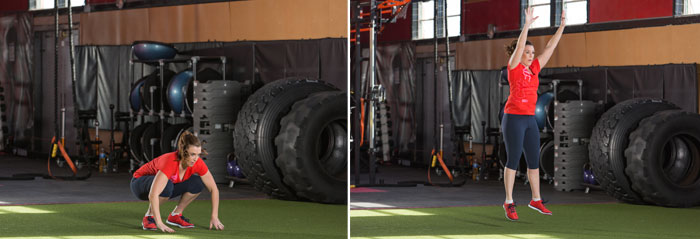
Super-efficient HIIT is the ideal workout for a busy schedule—whether you want to squeeze in a workout during your lunch break or to get in shape for a fast-approaching event. Research shows you can achieve more progress in a mere 15 minutes of interval training (done three times a week) than the girl jogging on the treadmill for an hour. (Watch and try this video of a 10-minute fat-blasting cardio routine that burns more calories than a half hour on the treadmill!) And according to a 2011 study presented at the American College of Sports Medicine Annual Meeting, just 2 weeks of high-intensity intervals improves your aerobic capacity as much as 6 to 8 weeks of endurance training.
That's not even the best part! Using the Tabata training method, you can complete an effective HIIT workout in just 4 minutes.
 Burn More Fat
Not only do you burn more calories during a HIIT workout, but the effect of all that intense exertion kicks your body's repair cycle into hyperdrive. That means you burn more fat and calories in the 24 hours after a HIIT workout than you do after, say, a steady-pace run.


Healthier Heart

Most people aren't used to pushing into the anaerobic zone (that lovely place where you can't breathe and you feel like your heart is trying to jump out of your chest). But in this case, extreme training produces extreme results. One 2006 study found that after 8 weeks of doing HIIT workouts, subjects could bicycle twice as long as they could before the study, while maintaining the same pace.


No Equipment Necessary

Running, biking, jump roping, and rowing all work great for HIIT, but you don't need any equipment to get it done. High knees, fast feet, or anything plyometric like jumping lunges work just as well to get your heart rate up fast. In fact, some equipment like dumbbells can make HIIT less effective because you want the focus to be on pushing your heart to its max, not your biceps.

Lose Weight, Not Muscle

Anyone who has been on a diet knows that it's hard to not lose muscle mass along with fat. While steady state cardio seems to encourage muscle loss, studies show that both weight training and HIIT workouts allow dieters to preserve their hard-earned muscles while ensuring most of the weight lost comes from fat stores. Win/win!


Increase Metabolism

In addition to increased fat burning and more muscle preserved, HIIT stimulates production of your human growth hormone (HGH) by up to 450 percent during the 24 hours after you finish your workout. This is great news since HGH is not only responsible for increased caloric burn but also slows down the aging process, making you younger both inside and out!

Do It Anywhere

You can do it in a boat, you can do it with a goat. You can do it here or there, you can do it anywhere! Dr. Seuss would have loved HIIT. Since it's such a simple concept—go at maximum effort for a short period of time followed by a recovery period and repeat—you can adapt it to whatever time and space constraints you have.


Challenging
This is not a workout you can do while reading a magazine or chatting with your friend. Because it's so short, you will be working hard the whole time. The trade-off is this format offers seasoned exercisers a new challenge and new exercisers a quick way to see results. You may be in pain, you may be sucking wind, but you definitely won't be bored!
 Source