Showing posts with label build muscle. Show all posts

Friday, 25 September 2015

How To Get Nice Muscle Tone And Build An Attractive Muscular Body

Most people know that they need to lift weight build muscles. However many just want to have nice muscle tone and an attractive but not too muscular body as they do not want big muscles. So they just lift light weights with high repetitions. Well, it is not going to work. To have nice muscle tone, you will have to build some muscles right? So you will have to lift heavy to force your muscles to grow. Once you are satisfied with the size of your muscles, you will then need to cut your body fats for your muscles to show up well and that means nice muscle tone.
You need to have a solid commitment and knowledge to get nice muscle tone and build an attractive muscular body. Here are some muscle building tips. Before you commence weight training, remember to warm up and as well as doing some stretching exercises.

•Train Muscle With Free Weights
Machines will have its uses, but for a start, concentrate on free weights. That means work almost exclusively with barbells and dumb bells. Free weights recruit many stabilizing muscles for balance and control. That means you will work a lot more muscle parts other than the intended ones. That will give rise to little bumps, striations and definitions all over your body instead of one huge lump of muscle on your intended muscle. Because of the extra stimulant created, your muscles grow faster too. Why else do you think all professional body builders almost exclusively use free weights?

•Train With Compound Exercises
Incorporate as many compound exercises as possible to your routines. Compound exercises are exercises that involve 2 or more joint movements. Because they utilize more joints, which means greater muscle mass are involved. Greater muscle mass means heavier weights. Heavier weights mean encouragement of greater muscle growth. More muscle growth means more tone to your muscles.
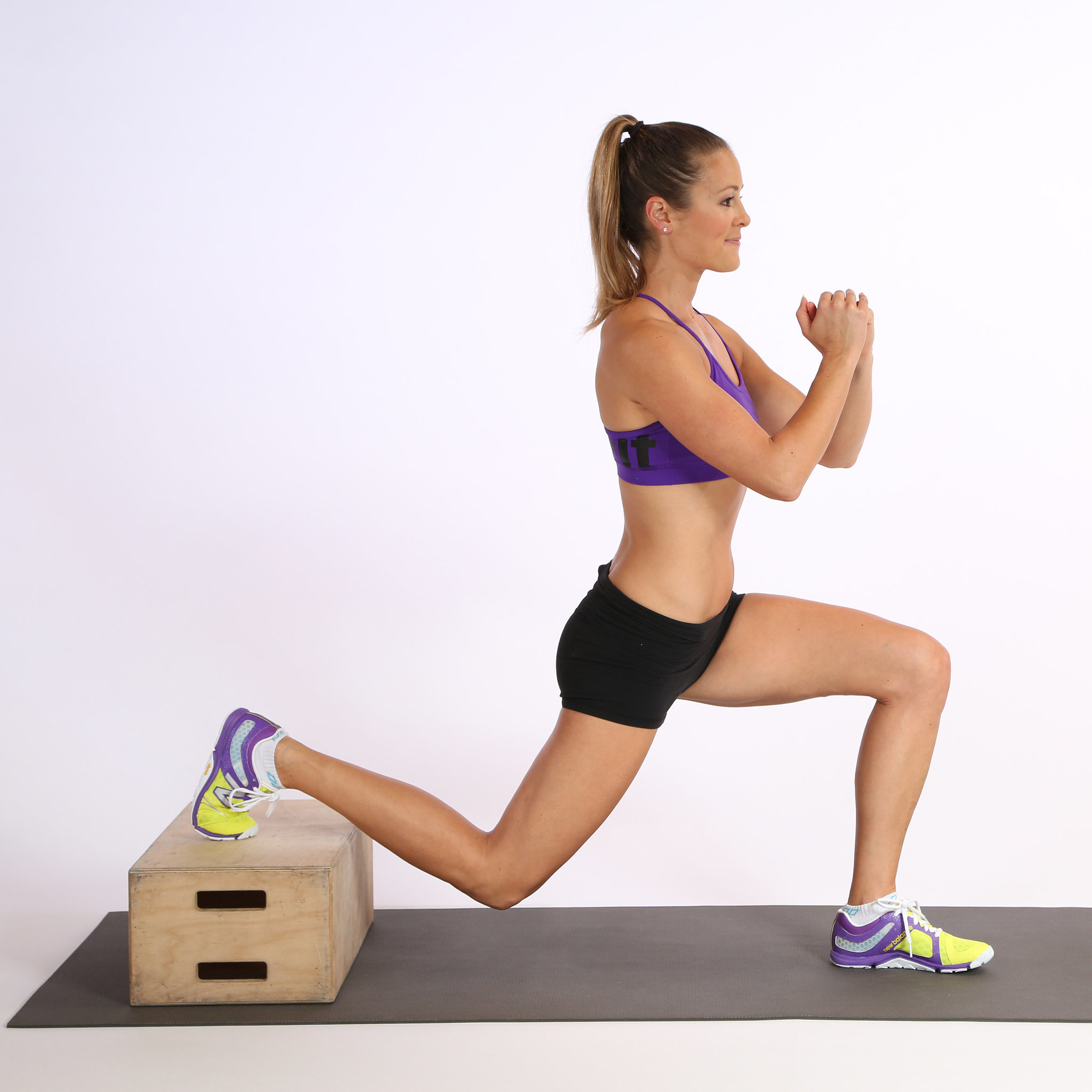
Some excellent compound exercises are the Squat, Deadlift, Chin ups, Dips, Bench press, Barbell Press, Lunges, Bent-Over Barbell Row...etc.

•Train Intensively But Do Not Over train
You must train intensively for your muscle to grow. Try to do more reps or add more weight than the previous session or else your muscles will think (actually muscles don't think, they adapt), "Ah... we've done that. Nothing new, so no need to grow bigger and stronger." That being the case, you will wreck your chances of attaining an attractive muscular body.
Because of this, it is important that every time you train hard, you give your body time to recover as it has suffered strains and actually sustained many small scarring. Contrary to popular belief, your muscles grow when you rest, especially when you sleep and not in the gym. So sleep at least 8 hours a day. Also, do not train everyday or work the same muscle group more than once or twice a week. If your training was vigorous enough, do no more than an hour per session.
Try not to do cardio work on the same day as your weight lifting work. In fact, during the muscle building phase, you should do less cardio work as aerobic exercises burn muscles. You can increase your cardio work at cutting body fat phase, so as to lose body fat in order for your muscle tone to show up nicely.

•Technique And Form
This is the most neglected fundamental of bodybuilding. Everywhere, everyday, you will see people using wrong forms and techniques. This not only compromises your growth, it will also make you susceptible to injuries... sometimes even permanently putting you out of the gym.
Wrong form occurs usually when people try to lift weights that are too heavy, whether out of vanity or ignorance. As a guide, always lift with strict focus on the muscle you intend to build for that exercise. Feel it contract and extend. Lift the weights deliberately and slowly. Never ever swing your weights up especially when doing bicep curls or the military press.

•To Build Muscles Fast You Must Perform Lower Body Exercises!
This is what most people don't realize. Your lower body makes up 60-70% of your musculature. If you don't train them, not only will you look spider-legged, your entire body will not grow as quickly and as large. Don't think that you can hide those skinny limbs in pants! Most people do not train their legs because squats, dead lifts and lunges can be very grueling exercises. But it is precisely because of such intensity that you will produce more growth hormones when you sleep and overall muscular development is stimulated. Your body shape will also be more balanced and therefore more attractive.
Do read up more to understand how your muscles work and then work on it so that in no time you will be a proud owner of a well tone attractive muscular body.

Source 

Sunday, 23 August 2015

40-Minute Metabolism Boosting Workout | Class FitSugar

This full-body workout will get your heart rate up while building
metabolism-boosting muscle. Plus it's fun! Grab a set of dumbbells
between five and 10 pounds, press play, and get ready to sweat.

Friday, 14 August 2015

10 Ways to Get the Best Fitness Workout Routine

When it comes to a holistically hale and hearty life, fitness is definitely one of the watchwords! If you do not feel fit and healthy, you simply can't feel happy from within! I'm sure none would disagree. Each one of us must make sure that we take out some time from our hectic schedules to pursue a fitness workout routine. Let's take a look at some of the ways we could aim for a fitter self!

1. The best exercise for abs: side plank.
You should lie down on your left side with your elbow below your shoulder and your legs stacked. Then the right hand should be placed on your left shoulder or on your right hip. Once you have braced your abs and lifted your hips off the floor, hold on for as long as you can. Switch sides and repeat.


2. Standing dumbbell fly: For broader shoulders
A dumbbell should be held in each hand by your sides. Without shrugging, the upper body should be used to swing the weights up by a few inches. The arms and torso should form an upside down V shape. It will contribute hugely to your fitness healthy lifestyle!

3. Towel Cable Row: For great arms!
A towel is to be hooked to a cable pulley, following which you should stand in front of it, set up to do a row, while holding an end of the towel in each hand. Then the shoulder blades should be squeezed together and the towel rowed to your rib cage.

4. Pec Minor Dip: One of the best workout routines for chest
Once you've suspended your body over parallel bars, let your shoulder blades come together as you lower your body towards the floor. Make sure your elbows are locked while doing this. Thereafter, your shoulders should be spread and your body pushed upward again. There, can you feel your pecs working? Even with slight movement, it can do a lot to improve the overall size and shape of your chest.

5. Deadlifts for back muscles.
Begin with a low squat position and grab the bar with an overhand grip. Then your torso should be raised once you've sat back on your hips, pushed through your heels, and ascended upward. Throughout the motion, a tight core and straight back should be maintained.

6. The kettlebell complex: Most effective functional fitness workout
This will work wonders for you if you are short of time, or looking for a quick workout involving minimal stuff. All you need for this is a kettlebell and 20 minutes!

7. Bulgarian split squat: one of the best leg workouts
Hold a dumbbell in each hand once you stand lunge-length in front of a bench. Then the top of your left foot should be rested on the bench behind you. Your body should be lowered until your rear knee nearly touches the floor and your front thigh is parallel to the floor.

8. TRX Atomic Pushup: An excellent time-crunch move
Begin with your feet in a TRX suspension trainer or on a sliding surface. Follow this up with a pushup and then your knees should be pulled to your chest and then pushed back.

9. Squat with Ball: The best workout routine for toned thighs
Once you place an exercise ball between the wall and the curve of your lower back, stand with your feet apart by shoulder-width. Follow this up with bending your knees and lowering 5 to 10 inches. Make sure your shoulders are level and your hips square. This position should be retained for 3 seconds and then repeated.

10. K-Tread: Workout even while you're swimming, for a fitness healthy lifestyle!
In the deep end of the water, tread on it, making small circles with cupped hands and the right leg should be lifted straight in front of you, bringing it at hip level. Reach for the toes of left leg towards bottom of pool. Following this, the legs should be switched quickly, bringing right leg down as the left leg is raised, and hold on to this position for 5 seconds. This should be continued for 30 seconds, altering sides.

Happy workout, folks!

Tuesday, 28 July 2015

Monday, 27 July 2015

The Benefits of TRX Suspension Training

To the untrained eye TRX suspension straps may look like a limited form of training. However, in the right hands (or ankles, arms......) they become an all over body workout! The TRX works via gravity assisted moves and gravity resistive moves - with the only weights involved be that of your body. There are hundreds of different exercises which can be performed using the straps, ranging from those suitable for beginners through to the most elite of athlete.

Below are just a few of the many benefits TRX suspension training can offer:
a) TRX suspension training can take place virtually anywhere, is extremely portable and requires only limited space.
You don't need a fancy gym or fitness centre to train with TRX. All that is required is a beam or other suitable prop for attaching the suspension traps to. That makes TRX ideal for outdoor training, and given it's lightweight and size it is an easy piece of equipment to take on your travels - giving you no excuse for your training to suffer! It is also very fast to set-up in any location.
b) TRX suspension training is an effective total body workout.
There are numerous suspension exercises and workouts which target all the body parts to varying degrees of intensity. Many of the exercises stimulate multi-muscle groups at different levels, making quick but effective workouts possible.
c) TRX is suitable for people of all age, sex or fitness level.
TRX suspension training is for everyone and anyone. From people in their 80's to teens, the difficulty, intensity and weight exerted can be tailored around the user via the thousands of exercises.
d) The equipment is relatively inexpensive.
To recreate the range of movements and muscles worked using traditional gym equipment would be very costly. The suspension straps can be used to work every muscle group meaning they are an all -in- one fitness solution. Each TRX comes with a DVD demonstrating some of the very best exercises, along with numerous extras.
e) Combine cardio and strength training into one workout / exercise.
Given the nature of TRX suspension training it can be utilized to combine strength training and cardio in the same exercise. This has benefits in regards to time saving, and means that even a short workout can have a bigger impact.
f) Increase Sports Performance.

TRX can be used to generate and build superb muscular balance, mobility, joint stability, and core strength - which will most certainly help you perform better in all sports and physical activities.
If you haven't tried TRX suspension training yet, maybe it's time you do!

Saturday, 11 July 2015

Jillian Michaels: Banish Fat Boost Metabolism Cardio Circuit 7

Jillian Michaels Banish Fat Boost Metabolism Cardio Circuit 7 pushes
your fat-burning potential to the next level with intense plyometric
exercises that will build muscle, slim your waistline, and melt away
those unwanted pounds. Join America's Toughest Trainer, Jillian Michaels
in this effective total-body toning workout that will transform your
body and get you results fast!

Sunday, 28 June 2015

The Fit Way to a Woman’s Health

Fitness, muscle-building and gym workouts have gone beyond the traditional all-male club. With the hype over fitness and health and a healthy lifestyle, women have joined the club as well. However, men and women have different fitness needs.

Women’s fitness and exercise needs are focused on the muscles of the upper back. Most of their exercise work-outs are also designed for the stomach muscles, especially those who have just given birth. At the same time, exercises for women are usually designed for weight loss. And while men tend to focus on muscle building whereas women work on toning their muscles, strength training is important for both.

Here are a few things to make you women out there go out and start building up your muscle strength.

Make the performance of your usual tasks easier with a physically strong body. Chores will be easier, lifting your kids, the grocery or the laundry will be a piece of cake. Consequently, it will reduce possible strain on the muscles and injury. Training can increase a woman’s strength by 30 to 50 percent.

Lose fat at the same time. A strength training done 2 to 3 times a week for a span of two months can result to two pounds of muscles and would mean a reduction of 3.5 pounds of fat. The more muscles and less fat, the faster is the metabolism, which ultimately means your body burns calories faster than normal.

Fight osteoporosis. Weight training increases spinal bone mineral density which means lesser chances of the risk of osteoporosis.

Fight heart disease and diabetes. Weight improvement improves cardiovascular health by lowering the bad cholesterol and blood pressure. It also improves glucose use in the body by 23 percent which reduces the risk of diabetes.

The road to a healthier you. Not only does it promote a healthier body, but it also develops a healthier attitude and a healthier heart. Women who engage in regular strength training are more confident, with a more positive outlook in life.

So how do you get started?

For those who lead very busy lifestyles, hitting the gym and starting on a regular fitness plan may seem the perfect way to keep fit. But for most, starting out on a regular walking exercise is the way to go. Start at a manageable rate. A 10 to 15 minute walk is a good way to start. Prior to a workout, make sure to stretch your major muscles. Work your muscles on the front of your thighs. Stretch your shoulder muscles by standing straight and rolling the shoulders backward in a circular motion. And of course, don’t forget to observe proper nutrition. Load up on water to prevent dehydration. Consume carbohydrates before starting on your work-out.

For those with joint and bone diseases, swimming may prove to be a less stressful activity for your muscles.

But the most important is, make time for your exercise. If you can’t hit the gym or start on a regular workout plan, make sure that your day is filled with enough physical activity that keeps you going and always on the go. Women’s fitness is the key to your beauty!

Brigi G | Fitness Inspired Formula

Sunday, 14 June 2015

Seven Exercises For A Hot Upper Body

Why Women Store Fat
If you've been grabbing the extra fat in your thighs and triceps and wondering where it came from, your hormones could hold the answer. Yup, that's right. Hormones. Estrogen could be responsible for packing the fat cells in the back of your arms and thighs.
Estrogen also plays an important role in building muscle mass, preventing heart disease, bone breakdown, and may even stimulate bone formation. We simply need the right level of estrogen to look and feel great.
If our estrogen levels get too high, we can suffer from a number of negative side effects including cyclical headaches, anxiety, breast tenderness, water retention, irregular bleeding, and weight gain. Unfortunately, a blood test is the only way to know what your hormone levels are but there are other ways to keep your estrogen under control. Increasing the amount of exercise you perform daily can significantly lower estrogen levels.

Total Body Fat Loss Is Key
Isolated movements such as tricep exercises can help build muscle, increase strength, and boost your metabolism. But, spot training isn't enough. If you want results, you need to do the right combination of exercises and lose fat from all over your body before worrying about those so called "problem areas".
To burn fat, your exercise program requires three basic elements:
Cardio Exercise -- Your fitness program should have the right combination of slow cardio and intense interval training.
Strength Training -- Your workout week should also include 3-5 days of strength training per week. It's impossible for a female to bulk up, unless she is intentionally doing so. This part of your fitness routine will tone your muscles, build up your strength, and increase your metabolism. You'll burn fat more efficiently and use the fat you take in through your diet more wisely.
Proper Nutrition -- Without proper nutrition you won't lose fat. Knowing what to eat and when to it it is crucial to achieving your goals.

Exercises To Get That Hot Upper Body
Tricep Dip -- This strength exercise targets your triceps, but it also works your anterior delts, pecs, and rhomboids. The triceps consist of three heads that run from your humerus and scapula to your forearm: the lateral, medial, and long head. The lateral head is found on the top of your arm. The medial head comes down your midline, and the long head runs along the bottom of your arm. These heads allow you to straighten your elbow, and they also work in conjunction with your latissimus dorsi to bring your arm toward your body.
To perform a tricep dip:
1. Position yourself in front of a bench, chair, dip bar, or a set of rings with your hands shoulder width apart.
2. With your legs bent and your feet hip-width apart, elevate yourself so your arms are straight and your elbows slightly bent. (This will keep the tension on your triceps, instead of the joints in your elbows.)
3. Keeping your back close to the support, lower your upper body to the floor by slowly bending your elbows into a 90-degree angle.
4. Continue the movement until you reach the bottom, before pushing yourself back into the starting position. Just be sure to avoid bending your neck or moving your ears close to your shoulders.

Strong, Sensuous Shoulders

If you want a hot upper body, you'll need to work your shoulders.

These usually aren't what women consider sexy, but they are vital! They're the start of the hourglass figure we fight so hard to achieve. But strong shoulders will give you more than just good looks.
When you're exercising your shoulders, you're helping fight the natural ageing process by keeping them strong and building bone density. You're also decreasing your chance of suffering a shoulder injury. Sadly, unlike males, women aren't born with naturally shapely shoulders, so we have to work at it.
Lateral Raises
To really give your delts a workout, try an exercise like the cable lateral raise. This movement focuses on your lateral delt, but it actually works all three.
To perform a lateral raise:
1. Stand with your feet shoulder-width apart and a dumbbell in each hand.
2. Slowly raise them level with your shoulders while keeping your hands in front of your hips and your wrists facing each other. Pause before returning your arms to the start position.
Lats and Traps
When you work your back, you're actually working the latissimus dorsi muscles, or "lats". They start at the top of the humerus and fan down your back to the vertebrae and pelvic girdle.
Your lats make it possible for you to lean back or sit straight. They give your body some stability, but they also allow you to pull your arm toward your pelvis and bring your body toward your arm (like during a chin-up, for example).
Your trapezius muscles, or "traps", run along your spinal column, from the base of the skull to your middle to lower back. Their function? To pull up, down, and towards the centre of your body. They also make it possible for you to shrug your shoulders, lower your shoulder blades,
and bring them together.
Pull-Ups
To get your traps and lats into shape, try pull-ups as a simple way to work a lot of muscles. In addition to working your lats and pectoralis major, pull-ups also work your posterior delts, traps, rhomboid, and your levator scapulae, as well as your teres major, pectoralis minor, and serratus anterior muscles. The biceps, rectus abdominis, erector spinae, transverse abdominis, and obliques are also involved.
To get started, try a standard chin-up. To perform one of these, use an underhand grip to pull your chest toward the bar. Once you've reached the top, hold the position. Then, lower your body into a dead hang.
When you're ready to move beyond a chin-up, switch to a pull-up by using an overhand grip. Then, there are several other variations you can try, including pulsating at the top of the movement or hanging onto the bar for as long as you can.

Importance of Chest Exercises

If you want to have a sexy upper body, you need to focus on the balance between your joints, tendons, target muscles, and their opposing muscles. Referred to as the planes of motion, this balance is a vital component for any quality exercise program. And if you want a strong upper body and back, you'll need to work your pectoral muscles.
The planes of motion is based on the fact that, even though you're working the target muscle (the agonist), you need to be working the opposite muscle (the antagonist) the same amount. If you're doing squats to work your quads, you'll also want to do exercises that work your hamstrings, calves, glutes, and lower back to avoid an imbalance. Hence, the need for chest exercises.
Your pectoral major muscles, or pecs, run from the humerus to the sternum and rib cage. And they work with your back muscles to pull your arm toward your body. Alone, they allow you to pull your arm forward.
Cable Flys
1. Step forward with your chest out and stomach tight to put resistance on your pecs.
2. Bend your elbow slightly and pull the cables toward each other in front of you by straightening your arms. Think of it like there's a stability ball on your chest and you're pulling the cables around the ball.
3. Once you've reached the top of the movement, pause, and return to the starting position.

Sexy Six-Pack Abs
Everyone wants the gorgeous ¬‚at stomach and the famous six-pack. But these stunning 'bumps' aren't separate muscles. They're two muscles called your 'rectus abdominis', and they're found between your ribs and pubic bone, joined in the centre by the linea alba.
It's these muscles that move the trunk of your body, ¬‚ex your spine during movements such as a crunch, and bring your pelvis to your ribcage during leg-hip raises or posterior pelvic tilts. They do more than just help you move, however.
Your rectus abdominis helps

 Source

Sunday, 26 April 2015

The Difference in Female Bodybuilding, Figure Competitions, Bikini Contests, and Women's Physique

If you are new to the sport of figure competitions and women's physique contests you may have seen those glamorous figure models on the cover of magazines and on websites.
If you ever had the desire or goal to look like one of these figure models and sport the look of fabulous and sexy muscle, then here are a few quick and easy tips and guidelines to help you decide on your new fitness journey.

Female Bodybuilding - The whole women's fitness movement began with female bodybuilding contests, the first legit one starting in 1978. From then on the women became more and more competitive, working harder to gain more muscle and decrease body fat. Female bodybuilders had perfected the sport by the late 1990's and competition was so great that only the best of the best could survive on stage with a chance of going pro.
 

 Figure Competitions - The popular figure competition is a spawn off of female bodybuilding. It was introduced in 2001 to allow women to compete who didn't want to obtain a great amount of muscle. Figure competitions opened the door so that almost any woman can compete with a chance at placing. However, as the years passed, the figure competitors, too, became more competitive, getting more and more muscular and defined. This division also became somewhat secluded where only the best of the best could place well and become pro.

Bikini Contests - As the figure competitions grew in popularity, so did the competitors muscle, which opened a door to another new division to allows more women to compete on stage without having to build muscle. This new category is the bikini contest. The bikini competitors don't need to display any muscle or definition. They simply have to look good in a bikini and pose according to the guidelines.
 

 Women's Physique Contest - The women's physique contest was introduced in 2010, another new division for women. Basically, the women's physique contest is a lighter version of female bodybuilding. While the women are allowed to have muscle, NPC guidelines state that they can't have striated in muscle detail. Also, there is no lat spread, front and back biceps poses are executed with open hands, and feet must be placed to the side on the front and back poses rather than flat-footed. Also, the side chest pose is executed with arms extended.

To decide with fitness category you would like to compete in it is a good idea to read more on each and attend a competition so you can see the classes and how the women look on stage.


Source Karen Sessions Ezine

Sunday, 19 April 2015

How Often Should I Work Out: Advice For All Disciplines

Exercise frequency is high on every person’s list who wants to further his or her state of fitness. Everyone’s ideal is a frequency that is neither too easy (progress comes slowly) nor too intense (the body is pushed beyond its limits). For the average, serious exercise enthusiast, I have all the advice you need to know below, but anyone with aspirations to win the Boston Marathon should exercise with a trainer. But anyone who wants to lead a healthier, lasting lifestyle should check out this Fit for Life class that focuses on the science of exercise and how to make exercise a permanent addition to your life.

The Old Adage

The old adage, which still rings pretty true, is, “Exercise 30 minutes a day, five days a week.” If you do that, your health will improve, no doubt about it. The problem with the old adage is that it doesn’t specify exercise type, intensity, which days of the week, progression, rest, etc. When you add all these variables to the equation, “30 minutes a day, five days a week” doesn’t sound as cut-and-dry as it used to.

New Studies And What To Make Of Them

In the past few years, the consensus on how frequently to exercise has shifted. Focus used to weigh heavily on days-of-the-week exercised. In other words, emphasis used to be placed on how many days a week you exercised instead of the total amount of time spent exercising. It was thought that exercising two days for thirty minutes each was better than exercising one day for, say, two hours.
New details, well documented in this Women’s Health Magazine article, show that you might be better off working harder and longer a few days a week instead of shorter and easier five to six days a week. The new consensus is that the more minutes you spend working out every week, the better (up until a reasonable point, of course). Naturally, you wouldn’t want to cram ten hours of exercise into one day, but if you have more time one day to add an extra hour of exercise, you should definitely take advantage of the opportunity and log the minutes while you can.
Creative types don’t get much love when it comes to exercise, but that’s about to change. This incredibly awesome course specializes in a healthy creative lifestyle for artists to help you sustain your creative runs and adapt to healthier routines.

Body-Builder’s Dream

The debate over how much body builders should workout will never end, but almost everyone can agree on the effectiveness of the split workout routine. It is simply the best, most intense and safest way to challenge and exhaust a core group of muscles.
If you want to build muscle, the split-routine is the way to go. A classic split-routine follows the following schedule:
Mondays And Thursdays: Workout muscle groups that work together, that’s the key behind split-routines. So on Mondays and Thursdays, focus on your chest, triceps, abdomen and your lower body (although do not do either your quads or hamstrings, as those work opposite motions and one should be saved for Tuesdays and Fridays).
Tuesdays And Fridays: Now work your other muscles: biceps, back, the remainder of your lower body, etc.
This routine gives your body three full days of rest, which is crucial, but to take full advantage of it you need to exhaust your muscles. This means working out intensely for roughly 45 minutes to 1 hour during each session. If you want more great advice on how to bulk up and add muscle instead of fat, read this blog post on 10 tips on how to get big fast.

Cardio Lover

Anyone looking to burn fat or boost their cardio should try to work in at least four days of cardio-specific exercise each week. Runners, bikers, swimmers or other serious endurance athletes often exercise up to six days a week, but regardless of your routines and workout strategies, you should always take at least one day a week off from all forms of exercise. You won’t build muscle or burn fat if you don’t give your body time to repair muscles and recover from workouts. Personal experience how taught me that my body functions best with two full days of rest, but every person is different and certainly exercise isn’t the only factor (age, diet, lifestyle, sleep behavior, etc.). If you decide to go full throttle and limit yourself to one day of rest, make sure that once a month you give yourself a healthy break of several days to allow your body to fully (truly, fully) recover.
And as far as ideal diet is concerned, look no further. This five-star course goes beyond the diet hype and offers 6 science-driven steps to the permanent healthy living lifestyle. 

The Dangers Of Over-Exercising (A Word For Your Average Jack And Jill)

Exercise is almost always a good thing. This is a proven fact. When you exercise, your heart begins to pump more efficiently, oxygen flow increases, your immune system kicks into action, and your body even releases endorphins that make you happier. So yes, exercise is definitely a good thing.
But! It’s not impossible to over-do it, which is most common among the cardio-loving crowd. This WebMD article highlights in detail the major dangers involved in pushing yourself to – or beyond – the limit. The big picture here is that if you’re into exercise for health, you don’t need to kill yourself. Pushing yourself too far can damage your heart. Further, the article also notes that people who exercised only moderately had almost identical health benefits compared to those exercised with pointed intensity. If you want to lead the healthier lifestyle, exercise doing things you love and take a moment every now and then to make sure you aren’t taking things too far.

No Excuses

Any excuses you might have for not exercising are no longer valid, thanks to this perfectly-reviewed, no equipment home workout routine. That’s right, no equipment required and you even get advice on caloric intake. So: no excuses!

Source 

Wednesday, 18 March 2015

After Workout Nutrition for a Women's Fitness Diet

The foods we choose to refuel our body with post-exercise are vital to meeting our body's needs. Unfortunately, there is a lot of confusion surrounding women's fitness diet plans, leaving most of us unsure of what to eat and not eat after a workout.
 The important thing to remember is that nutrition needs clear, factual information, common sense, and diligence if you want to make your overall health better. If the other meals of the day are not executed properly, you won't achieve your workout goals.


What Happens When We Workout
Let's make some sense of this confusing topic by discussing why we workout. For me, (and I think I speak on behalf of MOST of the population), there are 3 main reasons to exercise:
1. Improve health
2. Improve body composition
3. Improve performance
If you want your fitness diet to contain the right nutrients your body needs after a workout, we need to focus on what our body experiences during exercise. During an intense workout, we break down muscle tissue, essentially damaging the tissues. This sounds bad, but this process is what actually makes us leaner, fitter, stronger and more muscular.
Essentially, a women's fitness diet needs to do 3 things:
1. Replenish glycogen
2. Stop protein breakdown
3. Promote protein synthesis
Muscle building occurs when our body reaches a positive protein balance during recovery by consuming the right type of nutrients after exercise triggers protein synthesis. Our body also depletes its carbohydrate levels during exercise, which need to be refilled. This means our body NEEDS protein and carbohydrates post-workout.
During and after exercise, our blood circulates more rapidly, especially through the muscles being trained. If we strategically put the nutrients it needs into our bloodstream at the right times, our bodies will be able to recover and replenish more efficiently.

After Workout Nutrition For A Women's Fitness Diet
This brings us to the "window" of opportunity, which occurs immediately after a workout. During this timeframe, our muscles are primed to accept the nutrients that can stimulate muscle repair and growth.
While protein synthesis lasts for up to 4 hours, our body will receive the most benefits from nutrients consumed within two hours of exercising. Wait too long to refuel your body, however, and you'll experience a decrease in glycogen storage and protein synthesis.

So What Should I Eat?
Let's recall what it is that we are trying to achieve with post-workout nutrition:
1. Replenish glycogen
2. Stop protein breakdown
3. Promote protein synthesis
This tells us we need carbohydrates to replenish our energy levels, and protein to prevent further breakdown and promote rebuilding.
Because our window is small, we need to consume quick digesting carbohydrates and quick digesting protein post-workout. Sources such as isolates, dextrose, or a recovery drink are best.
Whole foods digest slowly, which is why most fitness enthusiasts choose liquid post-workout over whole foods. If you do choose whole foods, opt for ones that are quick to absorb like fish and white rice. Just make sure to take advantage of the two-hour "window".

Post-Workout Protein Shakes and Protein Types
Post-workout shakes are not NEEDED, but they'll help with recovery and muscle building. Protein powder is convenient and cost-effective option. It's great for before and after your workouts, and also as a meal replacement. Because proteins have different uses, however, you'll need to select different types of protein supplementation for each one.
Soy protein comes directly from the only plant-based food to contain a complete protein: soybeans. However, it does have more fat and takes longer to absorb. On the bright side, it's excellent for supplying your muscles with a steady supply of protein throughout the day. It also contains isoflavones, which promote health cholesterol levels.
Hemp protein is derived from hemp seeds. It contains approximately 50% less protein than whey, but it does contain omega-3 fatty acids to boost heart health. This type of protein powder is best used for morning drinks and between meal snacks, rather than for post workout recovery. It's also a suitable alternative for those sensitive or intolerant to milk products.
Whey protein, from cow's milk, is a by-product left over when making cheese. It's 31% more effective at building muscle than soy, and is considerably more effective at stimulating protein synthesis compared to other proteins, but you need to be careful when buying.
Lower quality whey powder has high fat and dietary cholesterol levels. It's also the fastest-absorbing protein powder types, making it the best of the three for recovery, growth, and maintenance after workouts.

Post-Workout Nutrition For A Women s Fitness Diet -- Whey Protein
If you've looked around, you'll have noticed three types of whey protein supplements:
Whey Protein Isolate -- With almost no carbs, lactose, or fat content, this is the highest quality powder available. In fact, 90% or more of its weight will be protein. It is also the most efficient of the proteins -- 30-60% more efficient than concentrate.
Whey Protein Concentrate -- The cheapest whey supplement, concentrate is high in fat and lactose. It has the highest biological value, and is about 75% protein by weight.
Whey Protein Blends -- A mixture of concentrate and isolate, this provides you with a lower fat and lactose content, while still being affordable. Blends also have a great amino acid profile.
If you're looking for a post-workout protein shake, choose whey isolate for its protein synthesis (building) effect. It may be more expensive, but it rapidly releases amino acids into blood stream and gets into the blood quicker, which is exactly what you need immediately after a workout. It peaks after about 40 minutes, and lasts about an hour.
Micellar-Isolate Protein Powder is the highest quality form of protein powder.
Called a 'muscle-sparing' protein, casein releases much more slowly in the body, causing a steady release of amino acids into the blood, over a longer period of time.
A fast-digesting protein, such as white fish is a better pre-workout protein. And for breakfast, supplement with whey protein to combat the muscle breakdown that may occur due to the fasting that occurs while sleeping. Again, a better option here is a fast-digesting protein such as eggs.
Remember that what you eat and when you eat is just as important as the details of your specially designed workouts for women. Create a women's fitness diet that best suits you and meets the needs of your workout. You'll not only look better, and get improved results, but you'll feel better, too.

Source
 

Wednesday, 25 February 2015

Blast fat with a Super Combo Fat Loss Workout

super-combo-fat-loss-workoutI love working out but sometimes I don’t have a lot of time. I don’t want to blow off my workout, but often I have less than 45 minutes to get in and out of the gym. So what’s a busy personal trainer to do? Instead of skipping my workout altogether, I perform a 30 minute intense workout using exercise combos.
It’s actually pretty simple: I flow seamlessly from one exercise to the next without resting or changing the weight.
Because I don’t take a rest between one move and the next, these combo’s deliver an awesome strength AND cardiovascular workout. They have a little high-intensity interval training component built right into them.
Not only do I get my workout done faster, but I also burn some major calories. And, I don’t just do this when I’m short on time. This workout can be a fully-functional 60 minute program just by increasing the weight, reps and sets.
I want to point out that I DO NOT use this workout to replace my regular strength training workouts. Since I don’t change the weight in the middle of a combo, I don’t hit some muscles as hard as I can. However, this super combo fat loss workout is so intense, I found it quickly leans me out.
I usually do one (1) super combo fat loss workout a week along with 3 weight training workouts and one day of interval cardio. Combine that with my 2 rest days, some good clean eating and I’ve got myself a recipe for amazing results.

Add this super combo fat loss workout to your weekly routine and shed some serious fat!

3 SETS  X  12-15 REPS
Dumbbell Squat to Lateral Raise
Stability Ball / Dumbbell Press to Oblique Core Roll
Dumbbell Bicep Curls to Overhead Press
Dumbbell Lunge to Back Row
Medicine Ball Lunge to Chop
Stability Ball/Front Raises to Overhead Tricep Press
Dumbbell Press-Dumbbell Fly Combo with Hip Bridges

3 SETS X  20 REPS
Medicine Ball Super Crunch
Stability Ball Plank Roll Outs

Source 

Tuesday, 17 February 2015

How to Squat Without Back and Knee Pain

A very common occurrence I see with aspiring bodybuilders is to avoid difficult exercises or exercises at which they aren't particularly strong. It may be a case of insecurity. You may think that everyone in the gym is watching how much weight you are lifting on a particular exercise but they aren't.
The basic exercises like Bench Press, Squats, and Deadlifts are difficult for a reason. They build muscle. Don't avoid them because you're embarrassed about the poundage you're using. You will severely limit your gains. It may look good to put tons of plates on the Leg Press and do 20 partial reps, but you really aren't building any muscle.
When people tell me their legs won't grow, the first question I always ask them is, "Are you doing squats?" The answer is almost always, "No. I can't. They hurt my knees... They hurt my back... I had knee surgery and my doctor recommends against them". I then ask what they are doing. Most commonly they are doing smith machine squats. Then I watch their exercise performance and 99% of them all do the same thing. They only go down about 1/4 the way to parallel. Even with injuries or surgery you can still squat to parallel safely if you are squatting with the proper technique and starting with a weight you can handle.
Build the core of your training program around the big basic lifts and work to improve your technique and strength. This is how you'll add some quality muscle to your physique.
I do know some people who have problems with their back when they squat. Every time they squat with a weight that stimulates their legs, they injure their back. This would cause them to miss workouts for all body parts. Barbell back squats aren't an option for them. They may not be an option for you either.
Please keep in mind the following: Exercises that cause you pain and cause you to miss or limit future workouts are impeding your gains dramatically. You need to avoid such exercises and find substitutes for them.
However, you need to be honest with yourself. Are they really causing you pain or do you just not want to do them? Heavy, basic exercises like squats are difficult for one reason - THEY BUILD MUSCLE!

However, if performing such exercises truly is a problem for you, find an adequate substitute.
There are other exercises and machines that can go a long way toward replacing squats in your workout. At least you can still make some nice gains in your legs.
  • 45 Degree Angled Leg Presses - These plate loaded presses are my favorite replacement exercise for squats. I honestly feel that you can make similar progress in leg development if you train them with the same intensity but, you must go to parallel.
  • Front Squats - With this type of squat you can't use as much weight and are also forced to remain in a more upright position which might alleviate some of the pressure on the back.

Tuesday, 20 January 2015

4 Lower-body Movements for Beginners

If you’re just getting started with a fitness routine, it can be a challenge to know how to properly perform exercises for the various muscles of the body. Here are four introductory lower-body movements for beginners, with advanced options that can be done once you’ve mastered the basic exercises.

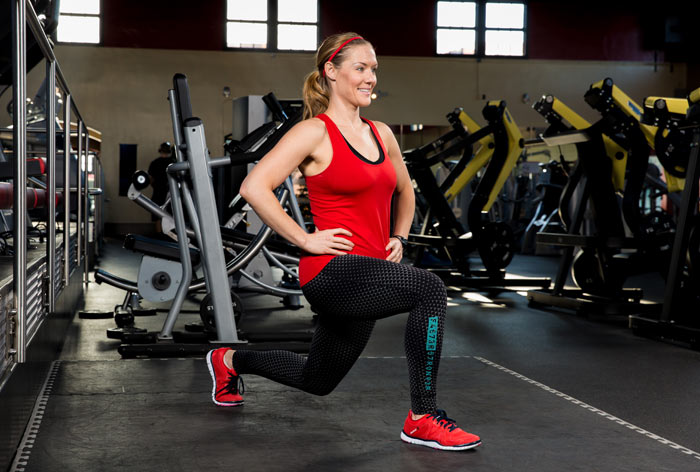
Static-stance Lunge
static stance lunge

Stand with your feet together, shoulders pulled down and away from the ears, and your core engaged. Step forward with one foot and find your balance. Your feet should be far enough apart so that when you go down into the lunge position, your knee is facing directly forward and not going over your toe. If you don’t have enough balance for this exercise, stand by a wall or hold on to a stable chair. Keep your torso erect by continuing to engage your core (don’t lean forward). Drive your hips toward the floor, controlling the movement until your thighs become parallel with the floor. Push with the front leg to come back to the top of the lunge and repeat.
Advanced: Perform an alternating plyometric lunge. After doing one lunge, add a hop before moving into the next one, switching the lead leg each time.

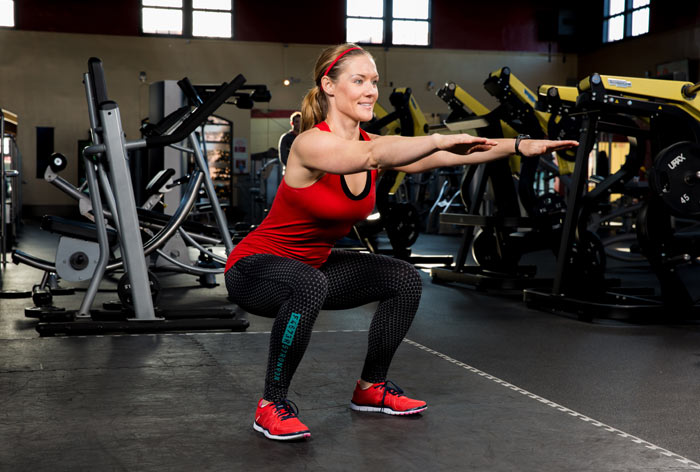
Squat
squat

Stand with your feet a little wider than hip-distance apart and toes pointed slightly outward. Engage the core and lift the chest. Look straight ahead and keep your hands by your sides. Shift your weight back into your heels and push your hips behind you until your thighs become parallel with the floor. Your knees should be moving in the direction of your toes. Do not let your torso become rounded or let your heels come off of the floor during the movement. Lift your hips, torso and chest simultaneously as you return to the starting position.
Advanced: Perform a squat; extend first the right and then the left leg out to the side at the base of the squat. Bring the foot back toward the center and stand back up to the starting position.

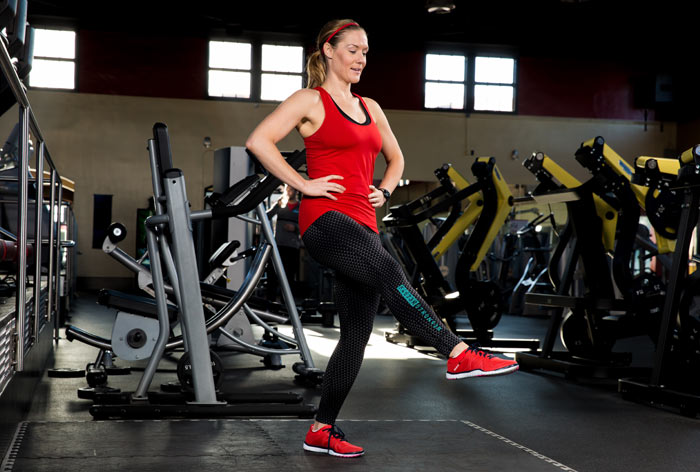
Balance
Balance

Stand on one leg; use a chair or stand by a wall for support, if needed. Lift one leg off the ground and write the alphabet in the air with your toe; repeat with the opposite leg. This can be a great exercise to do while standing in the kitchen cooking or while folding laundry.
Advanced: Stand on one leg and extend your arms straight out from your body. Rotate your arms so that your right arm is pointing toward your toes and your left arm is extended to the ceiling. Next, switch so that the left arm is pointed toward the ground and the right arm is extended toward the ceiling.

Lateral Lunge
Lateral lunge

Stand with your feet parallel, hip-width apart. Look straight ahead and keep your hands in a comfortable position to help you maintain your balance during the exercise.
Inhale and slowly step to the right while keeping your weight in your left heel; keep both feet facing forward. Once your right foot is firmly placed on the floor, begin to shift your weight toward the right foot, bending the right knee and pushing the hips back. Continue to lunge until your shinbone is vertical to the floor and your right knee is aligned with the second toe of your right foot. Your left leg should be as straight as possible and your body weight should be distributed into the right hip. Keep the heels of both feet flat on the floor.
Advanced: Perform a lateral lunge as described above, but after the lunge, bring the knee up and place a small ball or med ball underneath the leg and then return to the lateral lunge.

Source

Sunday, 23 November 2014

Preparing for Your First Bikini Competition

Soy will have to wait.

My bestie and I were catching up over peppermint tea and dark chocolate (we were chatting on facebook, but a girl can dream) when she mentioned that she wanted to compete in her first bikini competition and asked me to help her out, I gladly agreed. So, I put my metaphorical internet surfing goggles on, cracked my knuckles, and started typing.
As I started collecting information to give to my friend, my good decisions birdie popped up in my head and suggested I make a blog post about preparing for competition. That way, I get to help not just a friend out, but hopefully other people too!
So, without further ado, here it is! The Bikini Competition Guide – A Compilation of Other Peoples Information
Are You Ready for the Prep?
First things first, before you decide to begin your journey to the stage, you need to consider all of the things that go into competing: cost, time, energy, sacrifice, and much more.
Things you’ll need to buy:
  • Bikini
  • Hair and makeup on competition day
  • Spray tan
  • Nails
  • Shoes
  • Registration and competition fees
  • Travel/lodging fees
Another thing to consider are the sacrifices that must be made for success. You’ll have to miss important events, sometimes even holiday celebrations. You will need to push yourself when all you want to do is give up – no one can make this happen for you. You will have to pass up on social events when you think that you might be tempted to go off your diet – and learning to be honest with yourself in this way is one of the most important parts of your training.
I’m not trying to scare you out of competing, I am trying to get you to be realistic. And you don’t need to have it all together at the start. Competition prep is a learning process, and those qualities that will help you succeed are developed just like your muscles are. So, let’s get started then!
The Basics
Here are a list of the basic tips that will make your prep and time on stage go more smoothly. Dualfit.com strongly urged paying the extra money to get a coach. They have experience, will help to keep you accountable, and will help you if the road gets bumpy.
Candice Perfect, with a very appropriate last name, was featured on Fitbodyhype, and her suggestions for new competitors were to practice posing and walking in your heels, pay the extra money to have a professional apply your spray tan, and get a custom bikini that fits your body.
Natalia Muntean has a great competition prep guide on her website that is definitely worth checking out. In this guide, she said this, regarding the look that bikini competitors need to aim for: “Nice and round shoulders, toned arms, flat stomach with 4-pack showing, no hard abs muscles, very firm glutes and sculpted legs. That being said, you still need to maintain a very feminine figure. Therefore – no dry veiny skin, no dehydrated look and no exhaustion on your face.
So, in summary:
  • Pay the extra price for a coach.
  • Practice your posing and walking – be confident on stage.
  • Get a custom bikini and professional spray tan.
  • Aim for a muscular, feminine look that is not dehydrated or tired.
The Timeline
Stephanie, from Beautiful to the Core posted a great bikini competition prep guide, which was very informative. If you have the time, you should check out her blog and see all of her great advice!
Stephanie’s prep timeline looks like this:
  • 12 weeks out (W/O): No more cheat meals, intense training begins, drink 2 gallons of water per day.
  • 8 W/O: Begin to practice posing and start tanning 2x per week.
  • 4 W/O: Cut diet down, reduce carbs and consume lots of greens and fish, schedule hair and makeup, and a photo shoot if you want to document your sick bod.
  • 2 W/O: whiten teeth, cut diet if needed
  • 6 days out: Get your nails done, increase sodium for days 6/5/4, decrease carbs, and have your last leg workout.
  • 3 days out: Cut to 1.5 gallons water, go back to a normal sodium intake, exfoliate, get a bikini wax, and nair your entire body (arms too!).
  • 2 days out: Cut to 1 gallon water, lower sodium, and REST!
  • The day before: Cut to 1/2 gallon water, cut all sodium, carb load, deep condition hair, exfoliate, shave before your spray tan, DON’T use deodorant, and get first round of spray tan.
  • Competition day: No deodorant, touch up spray tan, glue suit after meeting, pump up 15 minutes before stage, only take sips of water as needed, have a few sips of wine before heading on stage.
Stephanie also posted a great competition day packing list, it has a lot of things that you would not even think about but would really miss should you not have them with you!
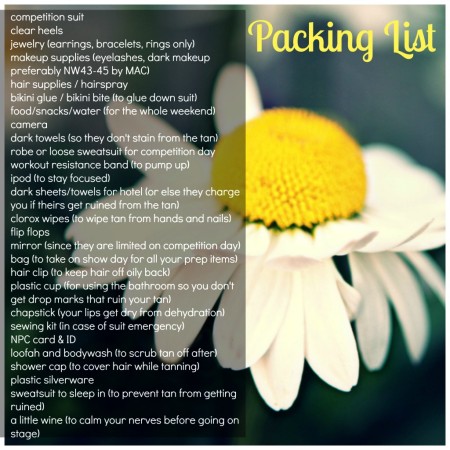
packing-list-1024x1024
The Training
Training comes second in competition prep only to diet. I am sure I do not have to lecture you on the importance of your workouts, so I will skip that and get right to the good stuff.
Bikini competitors need to be muscular while keeping their femininity. But, when you begin to cut your calories and diet down as competition day draws near, you need to make sure you have enough muscle on you so that you can afford to lose some to diet and cardio.
The Weights:
If you are starting at 12 weeks out and are already in relatively good shape, build muscle with 8 to 10 reps. Drop sets are great for developing muscle and definition, along with supersets and triple sets. If you are starting well before 12 weeks out, at 20-24 weeks for example, you can afford to drop the reps down a bit more to build more muscle mass. Try 5-8 reps for your big muscle movements, squat, deadlift, bench press, and overhead press, and 8-10 reps for your accessory exercises.
As you start to get closer to competition day, increase to 12-15 reps, and 15-20 reps. You want to focus on building lean and long muscles once you have a good base from your lower rep workouts. Keep up with your supersets, drop-sets, tri-sets. To really burn fat, you can incorporate active rest into your workouts. For example, instead of resting the traditional way between sets, do 30 seconds of jumping jacks, mountain climbers, or rope skipping between each set instead. This will keep your heart rate up and increase your calorie burn.
The Cardio:
Cardio is a crucial tool in your fat loss tool box. Before you reach 12 weeks out, do 20-30 minutes of steady state cardio 2-3 times per week. Experiment with HIIT (high intensity interval training) so that when the time comes, you will be able to do it multiple days per week without trouble. For your HIIT, start with a 1/2 work/rest ratio, like this: 30 seconds sprinting, 1 minute rest. Repeat for 20 minutes. When this gets easy, lower your work/rest ratio as you like, and increase the duration of the workout.
At 12 weeks out, you want to start doing cardio at least 4 days per week. Keep doing your HIIT workouts and steady state workouts, and increase the duration to at least 30 minutes per session. When you start to cut (4-6 weeks out), increase your cardio to 50-75 minutes per day. You can do a combination of HIIT and steady state cardio to keep it less boring. Try doing AM/PM workouts as well if you don’t want to spend a lot of time at the gym. Incline walking, sprints on the bike or treadmill, and plyometrics workouts, are all great forms of cardio for fat loss.
So, in summary:
  • Before 12 weeks out: 5-8 reps for large muscle group exercises (deadlift, squat, bench press, overhead press), 8-10 reps for accessory exercises. Cardio 2-3 days per week, begin to do HIIT for 20 minutes a few days per week to get used to it.
  • 12 weeks out: 8-10 reps and 10-12 reps for large muscle group exercises and accessory exercises, respectively. Experiment with drop-sets, supersets, and tri-sets. Increase cardio to 30 minutes, 3-5 times per week. Increase intensity and frequency of HIIT.
  • 6 weeks out: 12-15 reps and 15-20 reps for large muscle group exercises and accessory exercises, respectively. Focus on building lean and long muscles, and stay flexible. Increase cardio to 50-60 minutes per day. Increase frequency of HIIT and decrease frequency of steady state cardio.
  • 4 weeks out: 15-20 reps. Increase cardio to 60-75 minutes per day, half HIIT and half steady state cardio like incline treadmill walking.
  • 6 days out: light upper body work, last leg workout before show.
  • The day of: use light dumbbells 5-10 lbs to pump muscles 15-20 minutes before you step on stage.
The Diet
Diet is the most important determinant in your success on stage in terms of your body. Good training is nothing without good diet. Before you start to cut, the diet is simple: clean. Make sure you are getting adequate fat (0.5xbodyweight in pounds), protein (1-1.5xbodyweight in pounds), and carbs (1-1.2xbodyweight in pounds).
Before 12 weeks out, if you are bulking to build muscle, you need to eat more calories than you need to maintain your weight. Check out an awesome formula for calculating your daily needs here. Once you’ve calculated your daily needs, add 500 calories to that. That is how many calories you will be eating while bulking.
At 12 weeks out, you want to start to diet down. Decrease your calories by 100 or so every couple of days until you eventually get to a level that is 500 calories less than your calculated daily needs. At 4 weeks out, you are going to really start to diet down. I would suggest carb cycling during this time for best results: 1 day high carb, 3 days low carb, repeat. As mentioned earlier by Stephanie from Beautiful to the Core, during 4 weeks, fish and veggies are going to be a staple in your diet, along with egg whites, whey protein, and peanut butter.
Check out this website for some great bikini competition diet tips.
And that’s all she wrote, folks! Seriously, its 12:30 AM, I need to go to bed. Competing for the first time can be scary, but it is well worth it. Stick to your guns, stay motivated any what that you can, and don’t be afraid to lean on others when you are struggling. And most importantly, don’t forget to enjoy yourself and be proud of all that you have accomplished. Good luck!

Source