Showing posts with label abs. Show all posts

Saturday, 10 October 2015

30 Minute Intermediate Full Body Workout

Ladies, what do you think about this 30 mins full body workout? Honestly I feel so much better after this workout.

30 Minute Full Body Workout with Rebecca Louise in full HD # 2 (no music
version). Shape up your abs, legs, butt, and strengthen your core with
this great routine. This workout burns 221 - 303 calories.

Thursday, 10 September 2015

Rope Climbs: Benefits, Technique, and Performance

Rope climbing has been an immense physical strength test for decades. To this day it has been used as a strength test in the military as well as in gymnastics to build strength. This week in gymnastics class we will be focusing on rope climbs.  Rope climbs are a total body workout. It is an effective exercise for the arms, upper back, core, grip strength, and legs. Beyond muscular strength, rope climbing increases the cardiovascular system and builds muscular endurance. The rope may be intimidating to you, but all it takes is a little self-confidence. There are two types of ways to climb the rope that we will learn.  One, which is called the S wrap or Spanish wrap (safer lock method). The other is the Russian Wrap (faster method, widely used in competition.  Keep in mind that when we think about climbing the rope, as Carl Paoli says; think about doing knees to elbows and then standing up.  Now, once we are able to perform a climb, great, but let’s talk about how we can make these better.


To improve your rope climb, think about 3 things: 

1.  Shoulder strength- This is super vital for that body weight climb. Performing lifts such as overhead press, snatch, clean and jerk, and strict pull ups will help build the strength to climb the rope at speed. 

2.  Fingertip pushups: This movement requires the hands, back, chest, and forearms to work together improving grip strength. 

3.  Time yourself climbing the rope: This will help increase power and dynamic strength for longer and more climbs. 
If you have never tried to climb the rope, now is the time to learn! Let’s increase that pulling strength and get you up there! 

Source http://pbcrossfit.com/article/lindsay-renteria

Monday, 10 August 2015

How and why you should train with TRX

TRX - WHAT IS IT?
Well, it is amazing! There’s not one thing I don’t love about TRX for myself and for my clients. Maybe you have seen that “ropey, strappy thingy” at the gym or maybe you just want to know more, or perhaps you’re hearing about TRX for the first time. No matter what, I want to cover the basics for you in hopes that you try it out and learn what all the hype is really about.
Being a TRX Certified Instructor, I use TRX in my own training routine as well as with my clients. I use TRX Training at my gym and also have one in my home for an anytime workout. I love how you can pack it up and take it to the park, do a workout in your own home, or bring it along with you when traveling. No excuses, right? No matter your fitness level, the TRX is perfect and versatile for everyone; athletes, rehab, stay at home moms, body builders, young and old. TRX offers a cardio workout, a resistance workout, muscle flexibility workout, as well as balance. No matter what your goals are, you can benefit from the TRX. Before we discuss everything there is to know about the TRX, it’s important to first understand exactly how the body works.

HOW THE BODY WORKS: 
I am a trainer who incorporates many types of functional and corrective training in my clients’ routines. You’ll see why in just a moment. It is so important to understand the fundamentals and foundation of your body. Everything you do in life starts with one part of your body. Any guesses? IT’S YOUR CORE. Your core is not just about those six pack abs you see - it is so much more than that. Your core is made up of your pelvis, back, chest muscles, and also the abdominals. It is your core that is responsible for your body stability, flexibility and balance. Makes sense, right? Also, do we always move in the same direction every day like robots? No, we surely do not! We move with twisting, bending movements and we’re going left, right, down, up, side-to-side, as well as forwards and backwards. This is called “multi-plane” movements. Once you think of your body moving “all around” these different ways, wouldn’t you agree it would be very important to train your body the same way?
Whether you’re picking up after the kids or dog, playing sports, cleaning your house or car, and of course then working out, you are using your CORE whether you know it or not. For the most part, you are moving multi-plane. This is very important for us to understand because the stronger your core is and the more familiar your body is with moving multi-plane, the less injuries you will have, not only in your lower back but in your entire body.

WHAT IS TRX EXACTLY?
TRX stands for Total Body Resistance Exercise. It’s a type of training that uses your own body weight and gravity to build strength, balance, coordination, flexibility, core and joint stability, all while preventing injuries. Not to sound intimating, the TRX was originally designed by a Navy Seal who needed to stay in shape within limited space using something he could easily take on his travels. (This is why you can pack it up and take it with you nearly anywhere you can place the anchor point.) Consequently, he created TRX and boy, did the rest of the world catch on. 

THE MANY ADVANTAGES OF USING THE TRX SYSTEM:


  For starters, you can minimize your training time by working your whole entire body switching from one exercise to the next in just seconds. The best part to me? As I mentioned, in every exercise you engage your core. So, this is great news if you’ve been focusing on your core. Now watch how much harder things become when you REALLY engage your core. Are you up for the challenge? Just think of how developing good core strength and stability will only enhance your performance and way of life. Your whole body will work and feel better.
Another advantage in using your own body weight and gravity is you are able to adjust your own personal fitness level. I love that you have control of the intensity just by walking yourself closer or further away from the anchoring point. That means instead of having to grab a different set of dumbbells or add more weight to machines, you just simply adjust your foot placement. Easy enough, right? This is also why you can keep your heart rate up and keep moving. No wasted time (important in my workouts!) which keeps you constantly challenging your body through every exercise.
WHAT ARE SOME EXERCISES I CAN ADD TO MY ROUTINE TO HELP MY PERFORMANCE?
With any new workout routine (yoga, weights, spin class,) it’s important to start off with the basics. Make sure you have mastered the proper form and technique before you move on to advanced movements. The basic movements (yet still challenging) include: Chest Press, Row, Lunge, Squat, Plank, Tucks, Pike, Side Lunge, Oblique Twist and Back Extension. Say hello to CORE work! Some of my favorite moves that are more advanced are: atomic push-ups and single-leg squats. What I also LOVE doing with TRX is stretching. You can get fantastic full body stretches for your entire body in ways like no other. 
TRX has been a huge part of the fitness industry and is only growing larger, from professional athletes who need peak performance to everyday people who just want to feel and look their best. Personally, I love that TRX is exactly what I preach all the time--there is no tension on the joints if alignment and form are on point. That is how all workouts should be. It is uncomplicated to learn and a truly great way to incorporate new resistance training to any workout routine. You can find videos online to understand more and when you purchase one, it comes with a fantastic workout DVD. 
My hope when you see TRX for the first time is to feel more encouraged and give it a try!

 Posted by Monica Nelson of Monica Nelson Fitness

Saturday, 9 May 2015

The Different Benefits that Core Workouts for Women Can Give

Ladies these days are looking for the best core workouts for women because experts says that it can give anyone a truly strong toned midsection.

 A lot of ladies are now searching for the best core workouts for women because it has been proven that it can give anyone a truly strong toned midsection. However, not all of the available workouts that are designed especially for women can guarantee the same results. Therefore, if you desire to have a healthy sexy body out of performing the several available exercises for ladies, it is important for you to choose those core workouts for women that target a strong, tight core. 


Before deciding which workout program to include in your daily routine, you must be aware of the fact that the core actually includes four different parts which are, serratus (between last and front abs), intercostals (side of rib cage), oblique (side of waist) and rectus abdominus (from pelvis to sternum). These muscle groups form the woman’s abdominals, and are actually made of twitch muscle fibers that are denser than the other remaining types of muscles. That is why it is essential for someonewho is searching for the right core workouts for women to look for a program that could help her grow the twitch fibers fast to be able to easily stimulate the abs. And for a woman to achieve the best growth, the core training that she should perform must belong to a moderate range of exercises because only these kinds of workouts can offer this kind of a result. 

The benefit of targeting this specific muscle groups will not only give a woman the best outcome that she desires, but also it can help her improve her sports performance.If you are a type of woman who is athletic and loves to try different kinds of sports, these specific proper workouts will help you improve your strength as a strong core also provides a firm platform for any sports. 

Being a great runner with strong feet is good, but it is also very important to have a strong lower back and hip muscles for an athlete to be physically fit and healthy. And doing some core workouts for women can enhance these body parts to give the right support for peak performance. Furthermore, it is very important for a woman, especially those who are into sports, to know that without having a strong core her shoulders, hips and knees are prone to different injuries. 
 
 There are many ways for a woman to strengthen her core, and all of these things relate to different exercises that she must perform on daily basis for her to be able to get the best possible outcomes. A fitness ball is nice exercise equipment that can provide a good alternative to help a woman strengthen her core. By following the different core workouts for women with the help of such equipmentHealth Fitness Articles, a woman will notice that her body gets stronger every day.

Friday, 8 May 2015

Functional Fitness Training

WHAT IS FUNCTIONAL FITNESS TRAINING?

Functional fitness training can be described as any program that includes exercises designed to mimic and/or help you to perform daily tasks or activities safely and efficiently. Examples of these types of tasks or activities include loading and unloading furniture from a truck, or picking your kid up and carrying them up the stairs.

Functional exercises are generally multi-joint movements that involve using both upper and lower body muscle groups simultaneously while engaging the core.

 For example, while an exercise like a dumbbell curl ONLY works the bicep and is performed in most cases for aesthetic purposes, an exercise like a dumbbell farmer's walk trains the body to lift heavy objects properly off the ground, engaging the core, driving through the heels, then moving those heavy objects from point A to point B. Muscles worked: glutes, quads, hamstrings, upper traps, forearms, and core. In addition, it's not a bad high intensity cardio workout either. In a real world scenario, an exercise such as this is much more likely to transfer over to a common task such as carrying two heavy grocery bags from the store to your car.

SHOULD YOU BE INCORPORATING FUNCTIONAL MOVEMENTS IN YOUR EXERCISE PROGRAM? 

Everyone can benefit from performing functional movements. Don't wait until you slip a disc in your back trying to pick up that 50 pound bag of dog food before you decide it's time to learn how to deadlift properly. Lower back injuries are the most common, nagging, reoccurring injuries in our society today. In fact, 31 million Americans experience low-back pain at any given time.Experts estimate that as many as 80% of the American population will experience a back injury at some point in their lives. Knowing the reasons why people experience these injuries and training your body in ways that will help you to avoid them is something everyone can and should do.

If you're a bodybuilder, does it make sense to perform only functional movements in your routine? No. You'll most likely be going with a split routine of some sort. However, for most everyone else, whether you're a stay at home Mom with two kids, or the owner of a refurbished vintage furniture store (had to throw some of my real life client examples in here), you need to know how to properly squat down and pick up your kids or your furniture, then properly lift them up and carry or load them off somewhere.
The answer for 99% of us is yes, at the very least, the two foundational functional movements, the squat and the deadlift, should be incorporated in your program somewhere.

WHAT ARE THE BENEFITS OF FUNCTIONAL FITNESS TRAINING?
  • Reduced risk of injury.
  • Improved ease of daily tasks.
  • Safe, efficient and effective performance of common activities.
  • Improved balance, agility, and strength.
  • Improved quality of life.
EXAMPLES OF FUNCTIONAL EXERCISES
  • Squat, deadlift, lunge (all variations)
  • Push-up, pull-up, dip
  • Kettlebell swing
  • Dumbbell carry
  • Medicine ball slam
  • Box jumps
  • Sled push
  • Battle rope
  • Core rotation exercises
  • Cable machine
  • Medicine ball
  • Resistance bands
  • Body weight
  • TRX Rip Trainer

Source : Coach Brian Donovan

Sunday, 26 April 2015

The Difference in Female Bodybuilding, Figure Competitions, Bikini Contests, and Women's Physique

If you are new to the sport of figure competitions and women's physique contests you may have seen those glamorous figure models on the cover of magazines and on websites.
If you ever had the desire or goal to look like one of these figure models and sport the look of fabulous and sexy muscle, then here are a few quick and easy tips and guidelines to help you decide on your new fitness journey.

Female Bodybuilding - The whole women's fitness movement began with female bodybuilding contests, the first legit one starting in 1978. From then on the women became more and more competitive, working harder to gain more muscle and decrease body fat. Female bodybuilders had perfected the sport by the late 1990's and competition was so great that only the best of the best could survive on stage with a chance of going pro.
 

 Figure Competitions - The popular figure competition is a spawn off of female bodybuilding. It was introduced in 2001 to allow women to compete who didn't want to obtain a great amount of muscle. Figure competitions opened the door so that almost any woman can compete with a chance at placing. However, as the years passed, the figure competitors, too, became more competitive, getting more and more muscular and defined. This division also became somewhat secluded where only the best of the best could place well and become pro.

Bikini Contests - As the figure competitions grew in popularity, so did the competitors muscle, which opened a door to another new division to allows more women to compete on stage without having to build muscle. This new category is the bikini contest. The bikini competitors don't need to display any muscle or definition. They simply have to look good in a bikini and pose according to the guidelines.
 

 Women's Physique Contest - The women's physique contest was introduced in 2010, another new division for women. Basically, the women's physique contest is a lighter version of female bodybuilding. While the women are allowed to have muscle, NPC guidelines state that they can't have striated in muscle detail. Also, there is no lat spread, front and back biceps poses are executed with open hands, and feet must be placed to the side on the front and back poses rather than flat-footed. Also, the side chest pose is executed with arms extended.

To decide with fitness category you would like to compete in it is a good idea to read more on each and attend a competition so you can see the classes and how the women look on stage.


Source Karen Sessions Ezine

Wednesday, 26 November 2014

Balance Training for the Glutes and Abs

Targeting the gluteals and abdominals in a training session is a popular goal for many fitness seekers, but what about training for balance? Do you regularly seek out strategies for improving balance in your exercise routines? Considering that balance training has been shown to reduce the risk of falls (especially in older adults) and improve dynamic balance in both athletes and non-athletes, incorporating this type of training could be a wise choice. In addition, many of the exercises used to train balance call upon the muscles of the hips and trunk to provide stability. This means you get the added benefit of strengthening the glutes and abs while you’re working to become more balance savvy. Plus, the various single-leg exercises that target the glutes in balance-training programs are beneficial for knee health because they promote proper alignment between the hip, knee and ankle.
To experience these benefits, add one set of the following exercises at the beginning of your workouts, twice a week for at least six weeks (in other words, perform these balance exercises 12 times over the course of six weeks). To check your progress, take the single-leg balance test* (for both legs) during the first week. Retake the test again after the sixth  week of training to see if there is a difference in your score.
*Single-leg Balance Test:
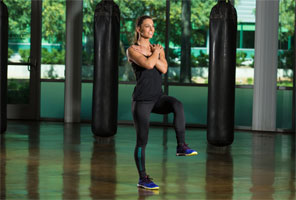
single leg balance
Grab a stopwatch and stand with your feet directly underneath the hips.
Cross your arms over the chest.
Lift one leg off the floor, making sure your legs do not touch each other.
Start the timer the instant your foot leaves the floor. Stop the timer when your foot touches back down, or if your body starts flailing to regain balance. The test should be performed with minimal bodily movement.
Record your score for each leg. The longer the time spent standing on one leg, the better your balance.
There are no norms for comparison, only your own score. The goal is to increase the time you are able to stand on one leg from pretest to post-test.
Note: It is up to you whether or not you wear shoes during this test. It makes sense that if you train in shoes, you should also test your balance wearing shoes. Clearly, this is not a scientific assessment, but making the pre- and post-tests factors the same, and the training variables the same as during testing (e.g., wearing shoes versus going barefoot), will give you a more realistic result.
1. Split Lunge
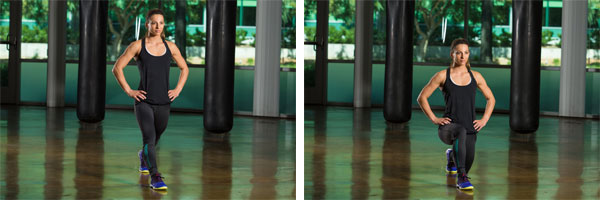
split lunge
Adopt a split-stance position with one leg in front of the other and your feet hip-width apart (i.e., your feet should not be directly in line with each other). Your front foot should be far enough forward so that the front shin remains vertical upon descent. Keep your front foot flat on the floor, while balancing on the ball of the back foot. Lower and raise your body by bending both knees and keeping your back heel off the floor. Go as low as you comfortably can without compromising balance. Perform 10 repetitions on each side.
For more challenge, try adding a small jump on the way up. Be very careful that the front knee stays in line with the toes and does not cave inward.
For less challenge, try holding the position (without raising or lowering) for 30 seconds on each side.
2. Side Shift Into Single-leg Balance
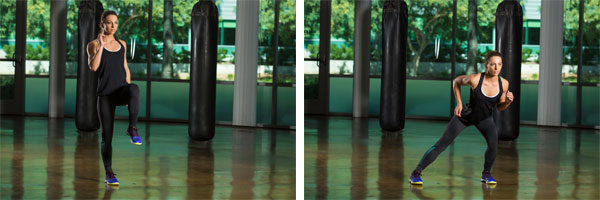
single leg lunge
To start, stand with your feet together. Take a long step out to the side, as if you are performing a side lunge. Quickly push off the floor and return the leg, but instead of placing the foot beside the other one, raise your knee up toward the chest and hold for a count of 2. Essentially, you’re performing a quick side lunge directly into a single-leg balance without letting the foot touch the floor upon the return. Perform 10 repetitions on each side.
For more challenge, hold a dumbbell in the same-side hand as the lunge leg.
For less challenge, return the lunge foot to the starting position beside the other foot, instead of lifting the knee.
3. Standing Cross-body Rotation
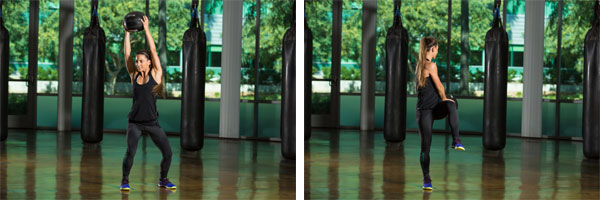
standing cross body rotation
To start, stand in a wide squat. Pull one knee up toward the opposite shoulder, while driving the opposite elbow to the outside of the knee, essentially creating an across-the-body rotation with opposing limbs in a single-leg stance. Keep your torso as vertical as possible as you rotate through the trunk. Perform 10 repetitions on each side.
For more challenge, hold a dumbbell or small medicine ball with both hands. Lift the weight up on a diagonal and then drive the weight to the outside of the knee that is lifted.
For less challenge, bring the foot in to tap the floor beside the other foot, instead of lifting the knee.
4. Elbow Plank Leg Raise
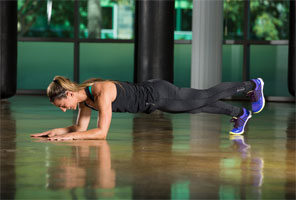
plank leg raise
Adopt a plank position on your elbows and toes. Be sure to engage the abdominals to prevent the hips from rocking side to side. Squeeze the same-side glutes to lift up one leg at a time. As you lift the leg, the movement should be controlled by the glutes. Keeping the knee very straight while you lift will help prevent the hamstrings from contributing more than they should. Perform 20 repetitions (10 on each side).
For more challenge, place your elbows on a BOSU trainer or other unstable surface.
For less challenge, tap one knee to the floor at a time, instead of lifting the leg.
Putting It All Together
As noted earlier, perform your balance work early in your exercise session. This will help you avoid the risk of neuromuscular fatigue, which could occur if you wait until the end of your workout. Interestingly, available research shows that a multicomponent exercise program that consists of strength, endurance and balance training appears to be the best strategy for improving balance (Cadore et al., 2013; Zech et al., 2010). Hence, for the most benefit, balance exercises should be included as part of a comprehensive training program.
Source

Sunday, 16 November 2014

IFBB Bikini Pro Anna Virmajoki Talks

Quick stats:

Age: 27
Weight: 135lbs.
Height: 5’8”
Anna Virmajoki

How did you get started?

I discovered the world of fitness when I was in high school. At first I did aerobics classes, and little by little after I gained more confidence I moved to the weight room. I remember flipping through a fitness magazine and thinking that “One day I want to look like these girls!” At that time my English wasn’t that good so I needed to use a dictionary to translate all the workouts. It took some time but it was well worth it! I started competing back in 2008 when I lived in Canada. I did smaller local shows, and did well as I won 2 competitions. After living in Canada for 4 years I moved back to Helsinki Finland and started competing with the IFBB in bikini (when it arrived to Finland) in 2011.
I found the perfect team that helped me to achieve my best physique ever “Team Bombshell” and the rest is history!
Anna Virmajoki

Where does your motivation come from?

I like setting goals. Having a goal motivates me to work out harder and I always follow my workout and nutrition plans 100%. I also like the challenge that reaching a goal brings. I am one of those people who love to exceed and accomplish new things. I am a very visual person as I draw inspiration from motivational photos that I find on the internet and fitness websites.
When it comes to discipline, I’m hardcore. I’ve found my sport and to do even better in the future I want to put all my heart in to it and give it all I have got.
Anna Virmajoki

What workout routine has worked best for you?

Monday: Legs

  • 5 X 15 Leg Extensions
  • 5 X 20 Shoulder Width Leg Press
  • 5 X 15 Switch (Jump) Lunges
  • 4 X 15 Narrow Stance Squats
  • 4 X 10 Walking Lunges

Tuesday: Shoulders/Triceps

  • 4 X 10 Shoulder Press
  • 4 X 10 Barbell Press
  • 4 X 10 Rear Lateral Raises
  • 3 X 8 Arnold Press
  • 3 X 8 Lateral Raises
  • 3 X 15 Rope Pushdowns
  • 3 X 10 DB Skull Crushers
  • 3 X 15 DB Kick Backs

Wednesday: Back/Biceps

  • 6 X 8 Pull Downs
  • 6 X 8 Seated Cable Rows
  • 4 X 12 Barbell Rows
  • 4 X 12 One Arm Pull Downs
  • 5 X 15 Hyperextensions
  • 5 X 15 Supermans
  • 4 X 8 Preacher Curls
  • 4 X 12 Seated DB Curls
  • 4 X 15 Incline DB Curls

Thursday: Legs

  • 5 X 15 Leg Curls
  • 5 X 12 Squats
  • 5 X 12 Weighted Step Ups On Bench
  • 5 X 12 Seated Leg Curls
  • 5 X 12 Stiff Legged Deadlifts

Friday: Chest/Shoulders/Legs

  • 5 X 12 Pullovers
  • 5 X 12 Incline Chest Press
  • 8 X 8 Side Lateral Raises
  • 5 X 15 Leg Press
  • 5 X 12 Walking Pump Lunges
  • 5 X 15 Cable Squats
  • 4 X 20 Hyperextensions

Saturday: Off

  • Rest day

Sunday: Off

  • Rest day
Anna Virmajoki

Top 3 favorite exercises and why?

  1. Squats: They’ve given me nice and round glutes and very strong and fit legs. I absolutely love squats to death.
  2. Box Plyometric Jumps: This a great way to challenge yourself. It works my legs and glutes and gets my heart beat up. So it´s a quick cardio and weight movement in one.
  3. Military Shoulder Press: Nice round shoulders give width to my physique and creates the “X” shape which is what I am aiming for. Wide shoulders, tiny waist and muscular round legs.
Anna Virmajoki

Favorite form of cardio?

I’m a big fan of High Intensity Interval Training. I like pushing myself to my limits with every cardio session. While I do cardio you would find me with my headphones on sweating and huffing and puffing like a crazy person. I also find this a great way to vent. I add HIIT training to my cardio routine about 3 times per week.
Anna Virmajoki

What is your diet like?

I never starve myself! Advice for the ladies – to get a nice muscular and toned looking body you need to eat quality food and get enough calories from your daily diet. I normally get 40% of protein, 30% of carbs and 30% of fat. My calories vary from 1400-2200 calories per day.
Full Diet:
  • Meal 1: 4 Egg Whites, 1 cup of Spinach Leaves, 1/2 cup of Oatmeal
  • Meal 2: 3 oz. Tilapia, 2 oz. Cottage Cheese & 1 Rice Cake
  • Meal 3: Whey Protein, 2 cups of Spinach Leaves with 1 tsp. of Olive Oil & Balsamic Vinegar & 1/4 cup of chopped Broccoli
  • Meal 4: 3 oz. Chicken Breast, 1 slice Ezekiel Bread
  • 1/3 slice Cucumber & 2 thin slices of Tomato soaked in Balsamic Vinegar
  • Meal 5: 3 oz. Chicken & ¼ Grapefruit, 1/3 cup of Peas, 3 oz. Sweet Potato
  • Meal 6: 3 oz. Turkey Breast, 1/4 cup of Green Beans & 3 oz. Squash
Anna Virmajoki

What supplements do you use?

I’m a Mass Nutrition sponsored athlete so I’ve used their products for the past year. I use the following products throughout the year:
  • Glutamine
  • Whey Protein
  • BCAA
  • Multivitamins
  • Omega 3
  • Probiotics
  • MSM Powder for my joints
  • CLA and Fat Burners
Anna Virmajoki

What is it like competing? How does it feel to win?

I love being on the stage! That is my moment to shine! Before I hit the stage I give myself a little pep talk, bring a huge smile to my face, take a deep breath and prepare myself to dazzle the judges. The feeling that I have before I hit the stage is almost euphoric.
I’ve won two huge international shows, 2012 European Championships and the 2012 World Championships. The moment they announce the second place and you know that you have won, it feels amazing. I never know whether I should cry or laugh from all the excitement. The best feeling must be when they play your national anthem!
It takes some time to really understand what you have accomplished. The whole experience is truly something special and something that I will never forget.
Anna Virmajoki

Favorite Quote

“I bust mine so I can kick yours”
 Source