Showing posts with label trx suspension trainer. Show all posts

Monday, 10 August 2015

How and why you should train with TRX

TRX - WHAT IS IT?
Well, it is amazing! There’s not one thing I don’t love about TRX for myself and for my clients. Maybe you have seen that “ropey, strappy thingy” at the gym or maybe you just want to know more, or perhaps you’re hearing about TRX for the first time. No matter what, I want to cover the basics for you in hopes that you try it out and learn what all the hype is really about.
Being a TRX Certified Instructor, I use TRX in my own training routine as well as with my clients. I use TRX Training at my gym and also have one in my home for an anytime workout. I love how you can pack it up and take it to the park, do a workout in your own home, or bring it along with you when traveling. No excuses, right? No matter your fitness level, the TRX is perfect and versatile for everyone; athletes, rehab, stay at home moms, body builders, young and old. TRX offers a cardio workout, a resistance workout, muscle flexibility workout, as well as balance. No matter what your goals are, you can benefit from the TRX. Before we discuss everything there is to know about the TRX, it’s important to first understand exactly how the body works.

HOW THE BODY WORKS: 
I am a trainer who incorporates many types of functional and corrective training in my clients’ routines. You’ll see why in just a moment. It is so important to understand the fundamentals and foundation of your body. Everything you do in life starts with one part of your body. Any guesses? IT’S YOUR CORE. Your core is not just about those six pack abs you see - it is so much more than that. Your core is made up of your pelvis, back, chest muscles, and also the abdominals. It is your core that is responsible for your body stability, flexibility and balance. Makes sense, right? Also, do we always move in the same direction every day like robots? No, we surely do not! We move with twisting, bending movements and we’re going left, right, down, up, side-to-side, as well as forwards and backwards. This is called “multi-plane” movements. Once you think of your body moving “all around” these different ways, wouldn’t you agree it would be very important to train your body the same way?
Whether you’re picking up after the kids or dog, playing sports, cleaning your house or car, and of course then working out, you are using your CORE whether you know it or not. For the most part, you are moving multi-plane. This is very important for us to understand because the stronger your core is and the more familiar your body is with moving multi-plane, the less injuries you will have, not only in your lower back but in your entire body.

WHAT IS TRX EXACTLY?
TRX stands for Total Body Resistance Exercise. It’s a type of training that uses your own body weight and gravity to build strength, balance, coordination, flexibility, core and joint stability, all while preventing injuries. Not to sound intimating, the TRX was originally designed by a Navy Seal who needed to stay in shape within limited space using something he could easily take on his travels. (This is why you can pack it up and take it with you nearly anywhere you can place the anchor point.) Consequently, he created TRX and boy, did the rest of the world catch on. 

THE MANY ADVANTAGES OF USING THE TRX SYSTEM:


  For starters, you can minimize your training time by working your whole entire body switching from one exercise to the next in just seconds. The best part to me? As I mentioned, in every exercise you engage your core. So, this is great news if you’ve been focusing on your core. Now watch how much harder things become when you REALLY engage your core. Are you up for the challenge? Just think of how developing good core strength and stability will only enhance your performance and way of life. Your whole body will work and feel better.
Another advantage in using your own body weight and gravity is you are able to adjust your own personal fitness level. I love that you have control of the intensity just by walking yourself closer or further away from the anchoring point. That means instead of having to grab a different set of dumbbells or add more weight to machines, you just simply adjust your foot placement. Easy enough, right? This is also why you can keep your heart rate up and keep moving. No wasted time (important in my workouts!) which keeps you constantly challenging your body through every exercise.
WHAT ARE SOME EXERCISES I CAN ADD TO MY ROUTINE TO HELP MY PERFORMANCE?
With any new workout routine (yoga, weights, spin class,) it’s important to start off with the basics. Make sure you have mastered the proper form and technique before you move on to advanced movements. The basic movements (yet still challenging) include: Chest Press, Row, Lunge, Squat, Plank, Tucks, Pike, Side Lunge, Oblique Twist and Back Extension. Say hello to CORE work! Some of my favorite moves that are more advanced are: atomic push-ups and single-leg squats. What I also LOVE doing with TRX is stretching. You can get fantastic full body stretches for your entire body in ways like no other. 
TRX has been a huge part of the fitness industry and is only growing larger, from professional athletes who need peak performance to everyday people who just want to feel and look their best. Personally, I love that TRX is exactly what I preach all the time--there is no tension on the joints if alignment and form are on point. That is how all workouts should be. It is uncomplicated to learn and a truly great way to incorporate new resistance training to any workout routine. You can find videos online to understand more and when you purchase one, it comes with a fantastic workout DVD. 
My hope when you see TRX for the first time is to feel more encouraged and give it a try!

 Posted by Monica Nelson of Monica Nelson Fitness

Tuesday, 28 July 2015

Monday, 27 July 2015

The Benefits of TRX Suspension Training

To the untrained eye TRX suspension straps may look like a limited form of training. However, in the right hands (or ankles, arms......) they become an all over body workout! The TRX works via gravity assisted moves and gravity resistive moves - with the only weights involved be that of your body. There are hundreds of different exercises which can be performed using the straps, ranging from those suitable for beginners through to the most elite of athlete.

Below are just a few of the many benefits TRX suspension training can offer:
a) TRX suspension training can take place virtually anywhere, is extremely portable and requires only limited space.
You don't need a fancy gym or fitness centre to train with TRX. All that is required is a beam or other suitable prop for attaching the suspension traps to. That makes TRX ideal for outdoor training, and given it's lightweight and size it is an easy piece of equipment to take on your travels - giving you no excuse for your training to suffer! It is also very fast to set-up in any location.
b) TRX suspension training is an effective total body workout.
There are numerous suspension exercises and workouts which target all the body parts to varying degrees of intensity. Many of the exercises stimulate multi-muscle groups at different levels, making quick but effective workouts possible.
c) TRX is suitable for people of all age, sex or fitness level.
TRX suspension training is for everyone and anyone. From people in their 80's to teens, the difficulty, intensity and weight exerted can be tailored around the user via the thousands of exercises.
d) The equipment is relatively inexpensive.
To recreate the range of movements and muscles worked using traditional gym equipment would be very costly. The suspension straps can be used to work every muscle group meaning they are an all -in- one fitness solution. Each TRX comes with a DVD demonstrating some of the very best exercises, along with numerous extras.
e) Combine cardio and strength training into one workout / exercise.
Given the nature of TRX suspension training it can be utilized to combine strength training and cardio in the same exercise. This has benefits in regards to time saving, and means that even a short workout can have a bigger impact.
f) Increase Sports Performance.

TRX can be used to generate and build superb muscular balance, mobility, joint stability, and core strength - which will most certainly help you perform better in all sports and physical activities.
If you haven't tried TRX suspension training yet, maybe it's time you do!

Tuesday, 10 March 2015

5 Alternative Exercises to the Side Plank

The side plank is a staple in many people’s workouts because it is so effective at challenging the full body in the frontal plane, targeting the hips, quadratus lumborum (QL) and obliques, and improving shoulder stabilization.
While the side plank is great, it’s always a good idea to add variety to your workouts and challenge your body in new ways. Here are five exercises that are great alternatives to the side plank.

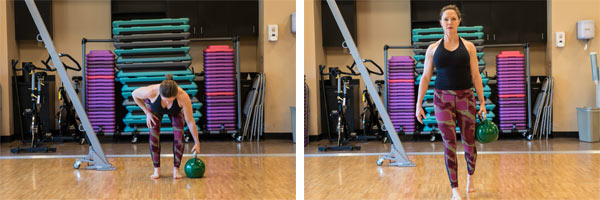
1. Asymmetrical Carry
asymmetrical carry
This exercise is a full-body challenge that requires you to stabilize the unloaded side.
Grab one heavy kettlebell. Keep shoulders parallel to floor and hips and walk as far as you can (aim for 100 yards), while maintaining good posture.

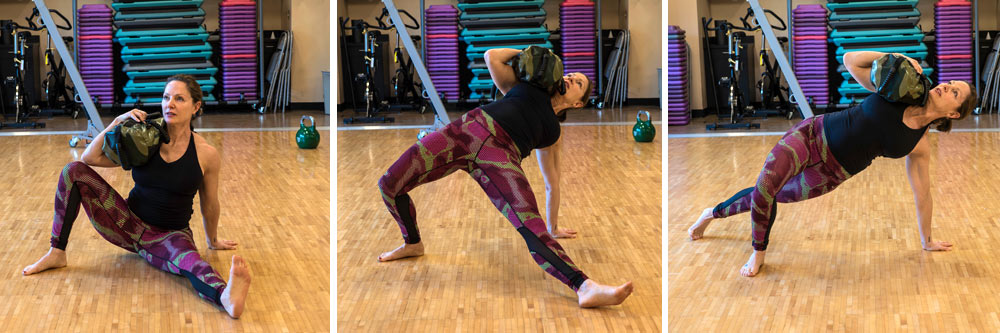
2. DVRT Leg Threading
DVRT Leg Threading
This variation of the side plank challenges the core and increases hip mobility and shoulder stability.
Sit on the floor with the right knee bent, right heel on the floor, and the left leg extended at about a 45 degree angle with the foot flexed and the left heel on the floor. Hold a Power Ultimate Sandbag (USB) and place it on the right shoulder. Keep the torso upright and tall. Extend the left arm and contract the latissimus dorsi. Press the heels into the ground and lift the hips up to bridge position. Lift the left leg and slide back into a plank position. Slide the leg back underneath to return to the starting position. Use control throughout the whole movement, making sure to maintain packed shoulders. Repeat on the other side. Try to observe if you have significant asymmetries on each side.

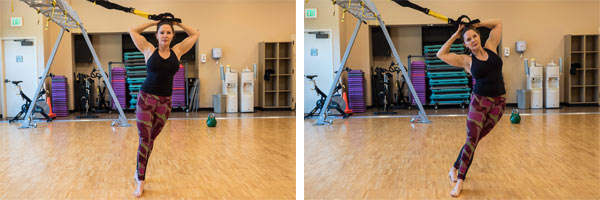
3. TRX Hip Drop
TRX Hip Drop
This side plank variation targets the whole side body, eccentrically loading the core from standing, while also challenging lateral mobility.
Adjust the TRX Suspension Trainer to mid-length and put the handles in single-handle mode. Stand with your right side to the anchor. Position the right leg forward in an offset stance, making sure that your hip is in line with the anchor. Grab the handles, maintain tension in the straps and place on top of the head (as if you are holding onto a hat). Keep the elbows open, beside your ears, and the shoulders down. Slowly lower the left hip toward the floor to the edge of your lateral flexion. Raise back to the starting position. If this resistance is too light, step in closer toward the anchor. Repeat on both sides. 

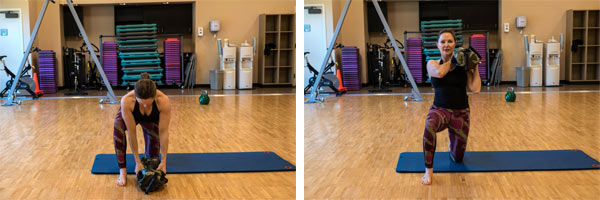
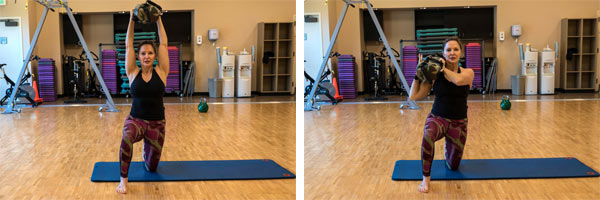
4. DVRT Half-kneeling Arc Press
DVRT Half-kneeling Arc Press
DVRT half-kneeling arc press
This variation of side plank is quite challenging because both the load and the body position are unstable. It also targets shoulder/scapulae control, mobility, and core and hip stability.
Assume a half-kneeling position. With the right knee forward, bring the Power or Core USB (smaller is preferred; grab the middle of the bag) to the left shoulder. Slowly lift the USB, forming an arc over the crest of the head to the right shoulder; return to center. The key here is to create a complete arc, extending the arms at the center, directly above the head. Move very slowly through the movement, counting to five or six for each repetition. 

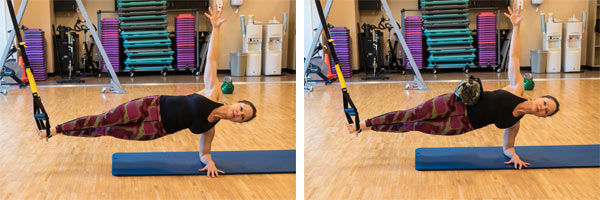
5. TRX Side Plank
TRX Side Plank
Being suspended requires greater shoulder stabilization, strength and control in loading eccentrically while resisting lateral flexion.
Adjust the TRX Suspension Trainer to mid-calf. Lie on your side with the left hip in line with the anchor. Position the elbow under the shoulder; keep the shoulder packed. With the toes in the straps, press the feet down into the straps until the body is lifted parallel to the floor. Hold as long as you can while maintaining stable shoulders and proper alignment. As you strengthen in the position, you can also add load at hips. Perform on both sides.

Source