Showing posts with label burning calories. Show all posts

Monday, 5 October 2015

10 Steps on Improving Your Metabolism

Get 10 tips on how you can increase your metabolism, naturally. You'll be surprised at how little things can affect your metabolism in a big way.

Are you sluggish and low on energy?

Do you feel like you work and work toward your weight loss goal and never seem to make any dramatic improvement?

You could be suffering from a slow metabolism. Even though you may have a slow metabolism, it does not have to destroy your weight loss efforts. You can dramatically improve your metabolism, and boost your energy levels without taking supplements.

Your metabolism simply refers to the conversion of food to usable energy by the body. It is the biological process, by which energy is extracted from food, and the net result is how fast or slowly the body burns those calories.

A few steps you can take to improve your metabolism naturally are:

Drink Water – Water is great to drink and you should be drinking a minimum of 8 to 10, glasses daily, of course, more is better. It will help increase your metabolism and flush out sodium, toxins, and fat. Drinking water before meals will fill your stomach so you feel full and prevent overeating. Avoid excess colas, coffee, teas, and sugary juices. Caffeine will dehydrate you, and the sugar will do more damage than good in the long-run.
  
 Eat Every Three Hours – Eat a small balanced meal every three hours, including snacks. Meals and snacks should be balanced, meaning they should contain a complete protein, carbohydrates, as well as natural fat. Failure to eat consistently can lead to a slower metabolism and fat storage. Also, skipping meals slows down your metabolism. To ignite fat loss you need to be consuming the right foods in a balanced manner throughout the day.

Don't Skip Breakfast – Breakfast is the most important meal of the day because it gets your metabolism running in high gear. You wouldn't drive your car to work on an empty tank, and you shouldn't start your day without adequate nourishment. Your first meal sets your metabolism for the day and keeps it going, as long as you eat every three hours. If you get up early and eat a late breakfast, you miss out on several hours of burning calories.

Don't Fear Fat – Fat has developed a bad reputation. Many people think fat makes you fat. This is false. The type of fat and how much fat you eat impacts your body fat composition. Fat is needed by the body. Those who follow a very low-fat diet have a harder time ridding their body of fat. Choose natural healthy fats such as olive oil, avocados, various nuts, flax, and natural peanut butter to receive your necessary fats.

Omit Trans Fat – Trans fat is the bad fat, the cause of weight gain, low energy, depression, cancer, and heart disease. You will never get the body you desire by eating "healthy" fast food, frozen dinners, and other processed choices. If it's man-made, it's not the best choice, and will halt fat loss endeavors. Eat the foods Mother Nature has provided to meet your fat loss goals.

Be Active Daily – Stay active at least six days a week. Take the stairs when possible or park further out to get that little bit of extra movement to keep the heart and lungs working optimally. The more movement you get daily, the better you will feel overall.

Do Cardiovascular Exercise – Cardio exercise is necessary for heart and lung health. It also burns calories. Doing cardio first thing in the morning on an empty stomach can tap into fat stores, and keep your body burning calories at a high rate for about an hour after cardio is finished. If you fail to eat adequately daily, first morning cardio on an empty stomach can work against you. Doing morning cardio on very low calorie diet can burn muscle. Another good time to incorporate cardio is in the evening after your last meal. This allows you to burn calories so you are not sleeping on them. You do not have to implement a morning and evening session, choose one or the other or cycle between the two to prevent staleness and boredom.

HIIT It – Blend some High Intensity Interval Training (HIIT) into your cardiovascular program from time to time to give your body and metabolism a good shock. The body is programmed for adaptation. Therefore, doing the same cardio format day in and day out can become stale really fast. Take one or two days a week and implement some HIIT to give the body an added shock.
HIIT is basically alternating low intensity and moderate to high intensity cardio training.  For example, a 20 minute HIIT session would look similar to this:

Minute 1 and 2 – Low Intensity (Walking) Minute 3 and 4 – High Intensity (Light jogging or running) Minute 5 and 6 – Low Intensity Minute 7 and 8 – High Intensity and so on…
Weight Train – Resistance training builds muscle, which is metabolically active tissue. The more muscle you acquire, the faster your metabolism will be.  Adding more lean muscle tissue to your body will put curves in the right places and allow you to eat more calories a day.

Listen to Your Body – Killing yourself with workouts is just as dangerous as not working out at all. Listen to your body and get proper rest. Don't train if you are ill, still sore from the previous workout, or just simply too tired. Training in such a state can cause more problems than it solves.

If any of the above fails to prove results in 4 to 6 weeks, there could be an underlying problem, such as a food allergy, sluggish thyroid, hormonal imbalance, toxins, parasites, etc. If so, I recommend searching for a natural healer in your area to determine the cause. and work from there. For the most part, proper diet, detoxifying, and herbs can correct any ailments.

Damian@FitnHealthy

Saturday, 8 August 2015

Cardio Kickboxing Workout to Burn Fat at Home - 25 Minute Kickboxing Cardio Interval Workout

Workout Details

Blow off stress while burning off calories with this cardio kickboxing workout. Take out any frustration you might have on this kickboxing routine, and you'll feel relieved and accomplished by the time you're done.
I'm relatively new to kickboxing, and trying to learn my basics; keeping my hands up in a defensive position (even though I don't have an opponent), keeping a slight bend in my knees, and not holding my breath. I also tend to flex my wrists when I throw a punch, which would probably break my wrist in the unlikely event that I actually had to connect with something solid. To be clear, and before anyone considers ripping apart techniques pertaining to actual fighting, this is obviously not actual defense training, but instead purely for a little cardio, calorie burn, and fun.


Cardio Kickboxing Workout structure
Quick Cardio Warm Up
50 Seconds of a kickboxing interval
10 Seconds active rest
Groups of 2-3
Quick Cool Down & Stretch

Kickboxing Exercises
Jab + Cross + Kick
Repeat on opposite side
Upper Cut (R), Upper Cut (R), Hook (F), Hook (R), Knee (R)
Repeat on opposite side
Knee (r) + Knee (r) + 3 Uppercuts
Repeat on opposite side
Jab + Jab + Elbow + Elbow
Repeat on opposite side
2 Hooks + 2 Uppercuts + Stance Switch
Repeat  for second interval
Quick Burnout Cardio Round:
- High Knee Holds
- Lateral Lunge Pops
- 2 Jumping Jacks + 3 Uppercuts

This is the perfect routine to squeeze into a busy schedule. In a very short amount of time, you get in a cardio warm up, an incredibly effective bout of bodyweight cardio, and a cool down and stretch. Quick, no equipment, doesn't require a lot of space...it's the kind of workout that leaves you with absolutely no excuses not to try it.
If you're having trouble finding the motivation to workout, try to think ahead to how much better you're going to feel once your workout is over. If you're struggling with motivation, you're spending the energy worrying about it anyways - why not just stop worrying and get it over with? You'll not only feel less stressed, you're also going to give yourself a sense of accomplishment. As an added bonus, you will have burnt off a good number of calories, as well.
Another bonus is that because this is a workout that's easy to do at home in your own living room, you don't even have to get dressed to go to the gym. Workout in your pajamas, your favorite ratty old sweats, or your underwear. No one is going to see you, so who cares? That workout time is yours and yours alone, especially when you're working out in your own house! Realize that this is your "you time", and enjoy it.


Sunday, 26 July 2015

No More Winter Excuses: Cardio Exercises For Inside Your House

19indoor.jpgThe treacherous inconvenience of grisly winter weather might lead you to cozy up with a thick blanket next to the fireplace, but snowstorms and icy rain showers are not legitimate reasons to neglect working out. Even if you're legitimately unable to escape your home due to horrid outdoor conditions this winter, you have the power to exercise within the gentle confines of your own home, and you don't need fancy workout equipment in order to do so.

Circuit training

Circuit training is the most effective method of burning calories and maintaining a sleek physique without the aid of a complete fitness facility. A 30-minute at-home workout utilizing proper circuit training technique can result in lasting post-workout calorie burn, which can increase your metabolism and enable you to fend off unsightly body fat. According to the American Council on Exercise, a cardio-based circuit includes eight to 10 exercises that are completed in succession with 30 seconds of rest time in between sets. At home, do jumping jacks, pushups, planks, lunges, high-knee rises, abdominal crunches and jogging in place. Each of these exercises can be performed without the aid of extra equipment.

Advanced exercises

Circuit training should serve as the foundation of your at-home cardio-based workout. Over time, your body will naturally acclimate to the intensity levels of high-endurance exercise, like circuit training. This will enable you to add new variations of more advanced exercises into your workout, such as the rocket jump. A rocket jump is performed by standing in the starting position with your feet hip-width apart, and your legs slightly bent at the knees. Jump up and throw your hands directly into the air while extending your entire body. Land softly on your feet and repeat 10 to 15 times. This plyometric exercise will work the muscles in your legs and core.

Utilizing equipment

Although it's totally possible to complete a rigorous workout merely with your own body weight, it's most advantageous to have access to a few helpful exercise devices, such as a jump rope, dumbbells, and an elevated bench. Jumping rope is an extremely effective method of burning calories. To increase the intensity level of your circuit training regimen, jump rope for 60 seconds and perform 10 to 15 rocket jumps. Then, complete 10 to 12 repetitions of dumbbell curl-to-shoulder shrugs and finish with a 60-second plank. This variation can be completed in a super-set, and repeated four times as part of a complete workout.

Advantages of at-home exercise

The advantages of at-home exercise are not simply limited to the freedom of working out in your own living room. For those who sometimes feel self-conscious at the gym, it's an opportunity to exercise without the strain of feeling overwhelmed. At-home cardio exercise also enables you to exercise without needing an onslaught of gym equipment. Most of all, you can burn nearly 300 calories in just 30 minutes of an at-home circuit training session, according to the American Council on Exercise.

Source 

Saturday, 7 March 2015

Jump Rope for the Ultimate Cardio Workout

Our favorite form of cardio at the Exercise Equipment Fanatic is jumping rope. Jumping rope burns more calories per minute than just about any other form of cardio exercise. If you've never tried it before you are really missing out. It does, however, take some time to get your rhythm down as well as to build up enough stamina to be able to do it for more than a few minutes at a time. But they are definitely are a great way to get in a fun, challenging, and intense workout.

By the way, if you don't already own one you can pick one up online for less than 8 bucks!

To get started, you'll want to make sure you are using the proper jump rope length, otherwise if the rope is too long or too short, you'll constantly be tripping yourself up and get frustrated quickly. It's easy to determine the proper rope length. Simply step into the middle of the rope with either foot and pull the handles up towards your armpits. You want the rope ends to stop right at your armpits, if they do not reach your armpits the rope is too short, likewise if they extend past your armpits the rope is too long.

There are also a number of different kinds of ropes as well, speed ropes, beaded ropes, leather ropes and ropes with weighted handles. We recommend you just start with a basic cloth or leather rope and then move on to a speed rope or weighted rope. Beaded ropes are good if you plan on jumping outside, since they take longer to wear out. Weighted handle ropes typically have a pound or so each in the handles. While this doesn't sound like much, those little weights give your shoulders a great workout, and until you are used to them you'll probably have to take them out after just a couple minutes. Speed ropes are made of a thin vinyl cord and are really the best kind to get for cardio fitness. This is the same kind that boxers typically use.

Once you choose your rope you'll want to start performing some jump rope workouts. We recommend starting slow and overtime building up your endurance and skill so that you can really get in the zone. Before we get started with the jump rope moves you should learn first, we want to briefly remind you of the benefits you get from jumping rope.

As mentioned before, you can burn a LOT of calories jumping rope. Of course, you will have to master the movement first, but once you get it down, you can burn up to 1,000 calories per hour! You don't need a ton of space either, just make sure to have the proper overhead clearance. Jump ropes are also very inexpensive and portable, so you can easily pack them in your suitcase on a business trip or take them to your local park and get a nice workout in.

Basic Jump Rope Moves
Once you get good at it, jump rope workouts become really fun. And that, to us, is the biggest benefit of all because the more fun an exercise is, the more you'll want to do it! So let's go over some of the more basic jump rope moves to start off with:
Basic Hop - This is the old fashioned one hop where you just use both feet at the same time to jump over the rope
Alternating Jumps - This is where you hope back and forth from one foot to another
Single Foot Jump- Just as the name implies, jumping over the rope while standing on just one foot.
Front and Side Straddles - You perform this jump by splitting your feet in the air and landing on them either wide apart or with one foot in front of the other
Running In Place - This jump can be a little tricky. You have to spin the rope a little faster until you are essentially running in place while the jump rope passes underneath you
Remember, it's a good idea to mix in all the different jumps mentioned above and will probably take some practice for you to be able to do so. Once you can perform the above jumps with ease you can move onto some of the more advanced moves such as double and even triple unders, criss-crosses, heel jumps, backwards and a bunch of others. The point here is that there is always more you can learn.

Some final tips to remember when you are doing your jump rope workouts and learning the different jump rope moves:
Jump on the balls of your feet
Stay relaxed
Try to use only your wrists when swinging the rope
Find your rhythm
and practice, practice, practice!

 Source

Friday, 27 February 2015

Metabolic Training: The Workout

Metabolic training is about getting the “biggest bang for your buck,” but is often misinterpreted as “work out until you puke.” The true definition of metabolic training is doing exercises that are geared toward improving the capacity of certain energy systems—in other words, almost anything! But metabolic training, in the traditional sense, is likened to interval training—bouts of harder work followed by important rest intervals. Metabolic training not only has the benefit of being fun and taking less time out of your day, but this type of training also increases one’s capacity for high-intensity exercise, offers a longer “after burn” (burn more calories AFTER your workout is finished), increases production of testosterone or growth hormone (helps maintain muscle mass while still burning calories), and enhances the ability to move more functionally.
So what should be one’s overall goal with metabolic training? Safely completing a large amount of work in a short amount of time.

The Workout
The exercises below use many muscle groups and can be very high intensity. To ensure safety, regressions are listed for each exercise. Be sure to respect the rest intervals so that the anaerobic energy systems are always challenged!
Warm-up: 30 seconds of each at an easy-to-moderate intensity:
-Body-weight Squats: Warm-up those hips by challenging your range of motion while squatting.
-Alternate Leg Runners Stretch With Opening: Open up your hip flexors and rotational muscles by placing both hands on the inside of your front leg in a deep lunge. Reach the outside hand toward the sky, trying to create as much distance from one hand to another, while continuing to hold the runner’s stretch.
-Arm Swings (Forward and Backward): Loosen up your shoulders for the pressing and pulling movements to come.
-Lateral Lunges: Begin in a wide stance with toes pointed forward. Place one hand directly on top of the other in front of your body to brace your core, and sink your hips side to side.
Workout: Perform each exercise for 30 seconds at the highest intensity you can safely maintain. Follow the exercise with a 30-second rest and then move onto the next movement. After your warm-up, the metabolic training workout will take 10 minutes. For more advanced levels this workout can be repeated twice after a five-minute rest break.
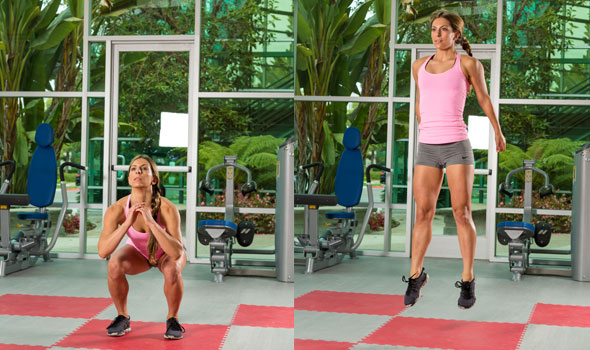
Squat Jump
Squat Jump
While maintaining perfect squat posture, explode off of the ground with both feet, making sure your knees are bent upon landing. (Regression: speed squats with no jump)
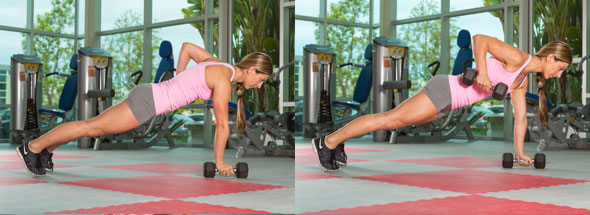
Kettlebell or Dumbbell Renegade Row
Kettlebell Renegade Row
Maintain a solid plank position (no saggy hips!) and create a wide base of support with your feet. Alternate rows from one side to another with minimal rotation. (Regression: perform a hand plank with arm and leg raises)
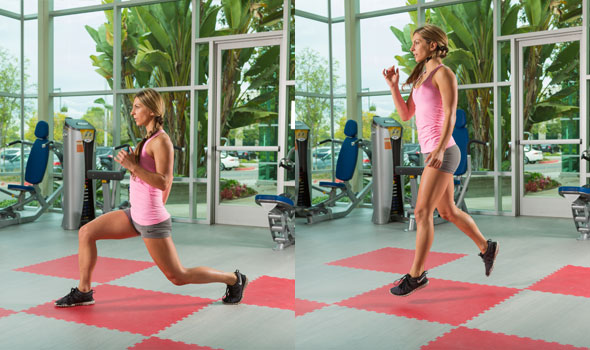
Lunge Switch Jumps
Lunge Switch Jumps
Lower down into a stable lunge with both knees bent to 90 degrees. Squeeze your glutes and explode off of the ground, landing in the opposite lunge position. Use your arms for added height and intensity. (Regression: alternating leg step-back lunges)
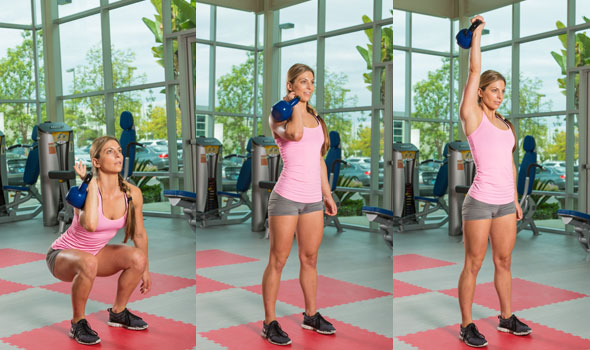
Kettlebell Single-arm Squat Push Press
Begin with kettlebell in racked position. Sink your hips down and back and then stand with intensity while thrusting the kettlebell straight up to the ceiling. Repeat on the other side after 30 seconds of work and 30 seconds of rest. (Regression: single-arm kettlebell or dumbbell press)
Kettlebell Hard Swings
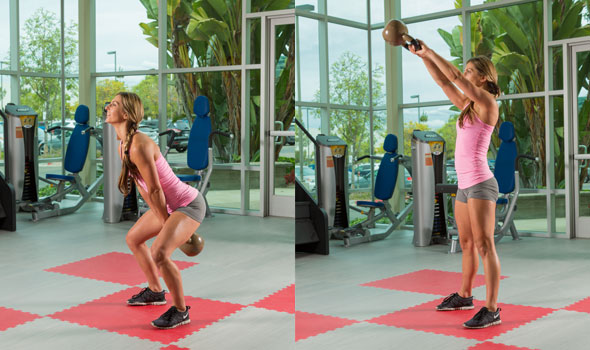
Select a challenging yet safe weight and initiate your swing with the hips. Brace the core and squeeze the glutes on the top of the swing and maintain a good hip hinge on the bottom. (Regression: dumbbell straight-leg deadlift)
Medicine Ball Wood Chops
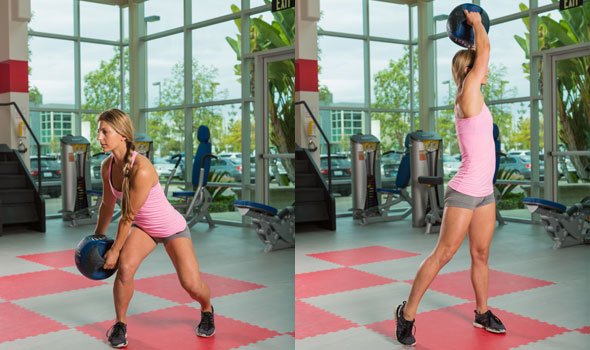
While lowering down to your squat, lower the medicine ball to the outside on your left knee. As you extend at the knees and hips, drive the medicine ball up to the right, bracing the core and squeezing the glutes on top to avoid an arched back. After 30 seconds on this side, rest for 30 and repeat on the other side. (Regression: seated medicine ball twists)
Skater Leaps
Skater Leaps
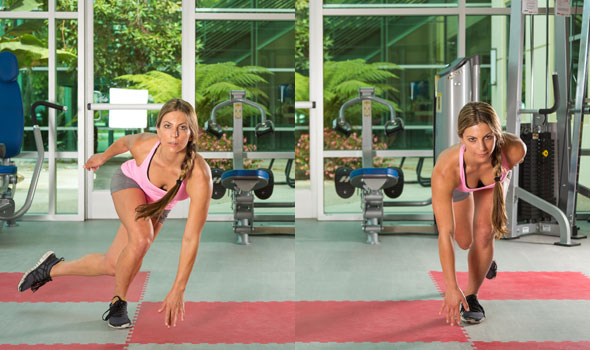
Push laterally off of the left foot and land on the right with a soft knee bend. If possible touch the floor with your left hand. Instantly explode off of the right foot onto the left with an immediate knee bend, touching the floor with the right hand. (Regression: side-step touches)
Battling Ropes Side Slams
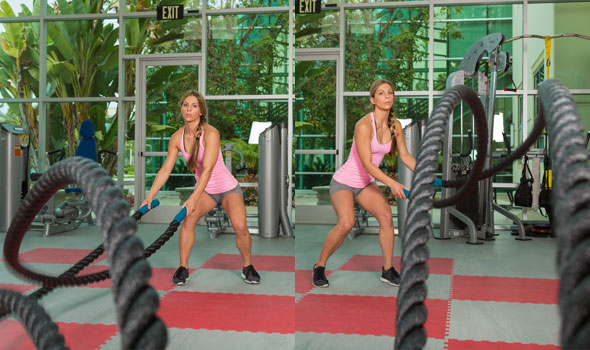
Hold the battling ropes in an overhand grip, beginning on the left side of the body. Lift the ropes up and over an imaginary fence in front of you and slam them down on the right side of your body. Repeat in the other direction while maintaining a solid hip hinge.

Source