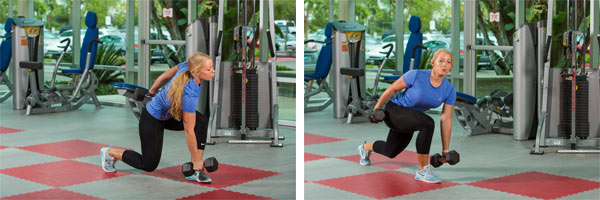
We know that using free weights and machines is the fastest and most efficient way there is to improve your metabolism and strength, but for many reasons these may not be convenient or readily accessible to you.
 You may also have no access to a commercial gym, home gym or are on business trip, but there can be a solution, a strength-training workout without the need of expensive machines.
As with any exercise, whether you are using your own body weight, machines or free weights, if the resistance doesn't increase, your muscles won't be worked to their maximum capacity and the stimulus these fibres need to grow will be missing.
Exercises done correctly will build the lean muscle and increase your metabolism in the same way as performing exercises at a gymnasium, but without the time constraints and associated costs.
These exercises can be easily done in a bedroom, hotel room, a park, school yard, ceiling rafters in a garage or in a doorway and all you have to do is use your imagination. There will always be a way to add more resistance to your workouts.
Please remember: It doesn't matter where you are working out — at home, a hotel, or a park — always warm up properly before beginning your session, and cool down and stretch when you are finished.
Leg Exercises
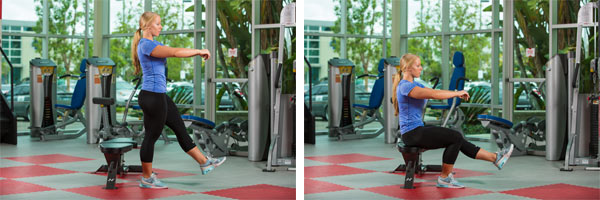
Squats
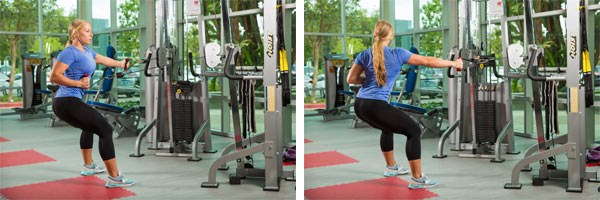
They build muscle in the thighs, shape the buttocks and improve endurance. Position your feet about 13 to 17 inches apart or at shoulder width, keeping the back straight and your head up. If you want you can use something that will give you some support, i.e. a desk, bookcase, sink etc.
Now squat down to where the tops of the thighs are parallel to the floor, hold for a second and then stand up, but don’t bounce at the bottom of the movement, use a nice fluid motion. Always exhale your breath as you stand up.
Lunges
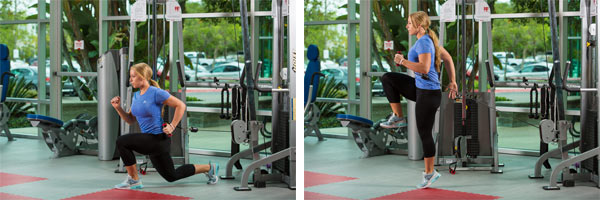
Stand straight in correct posture; now stand with one leg forward and one leg back. Keeping your abdominal muscles tight and chest up, lower your upper body down, bending your leg (don't step out too far).
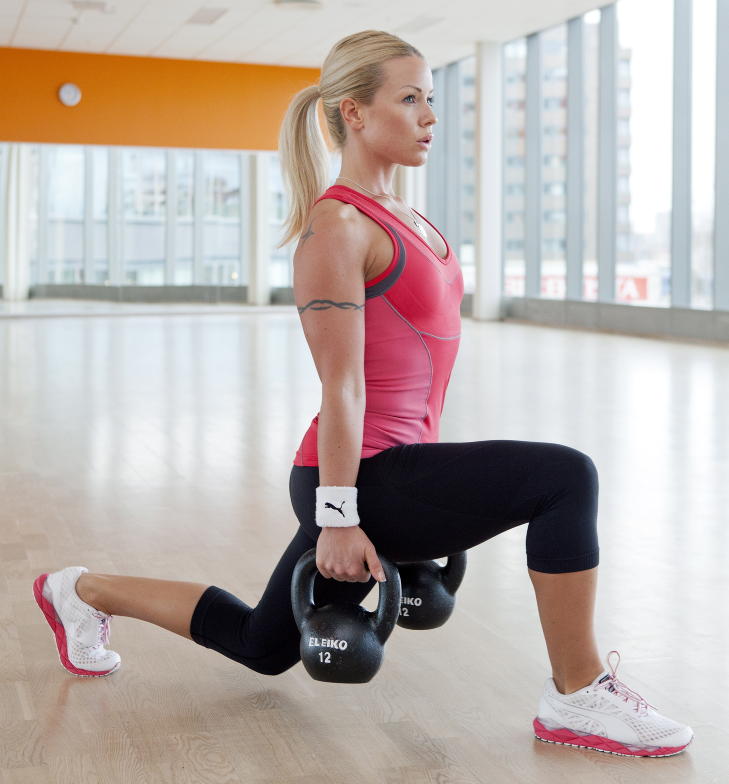
You should have about one to two feet between your feet at this stage, the further forward you step, and the more your glutes and hamstring muscles will have to work.
Do not allow your knee to go forward beyond your toes as you come down and stop where your feel comfortable (try not to let your back come forward) then push directly back up. Do all your reps on one leg then switch legs and do all your reps on the other leg.
Back Exercises
Chin-ups
Chin-ups are a great upper body workout, particularly targeting your biceps, deltoid and lat muscles. Use a doorway chin-up bar, ceiling rafters in a garage or grab the moulding of your door frame, position your hands with an under hand grip and hang down stretching the lats, slowly raise your body until your chin reaches the bar level.
Pause a moment before slowly lowering yourself back to the starting position. Don’t swing or use momentum to get your body to the top, just use the target muscles. Doorway chinning bars remove from the doorway when you are not using them and can be put up and taken down in seconds.
Bent Over Row
Take up a position with your right hand and right knee braced on a sturdy bed or some other flat surface that will provide a good support. Now pick up a dumbbell or something heavy that you can hold onto with your left hand.

Visualize your arms as hooks and slowly bring the dumbbell or object up to the side of your chest, keeping your back straight, then lower the weight back down to arms length, no lower, on extremes, safe form only please. Concentrate on your back muscles. Reverse the whole procedure and do the exercise now with your right arm.
Chest Exercises
Push-Up
The push up is used for building chest, shoulders and arms. Lie face down on the floor with your hands about shoulder width apart and keeping your palms turned slightly inward. Now push-up until your arms are straight, lower and repeat for repetitions.
To make it more difficult elevate your feet. Try placing the toes of your feet on a stable, elevated surface such as a bench, chair or a stair. Straightening your body, position your hands on the floor at shoulder width, lower your body until your chest touches the floor at the bottom, and then return to the starting position in a nice fluid motion.
Dips
This exercise can be done between two sturdy chairs or other surfaces that provide stability. The dip is another great upper body exercise. It’s a compound movement as well and involves working all the muscles that the push up works.

Keep your head up and body as vertical as possible. For the beginning of the movement, start at the top (arms fully extended) and lower yourself until your upper arms are parallel to the seat of the chairs, hold and then push up to the top of the movement until your arms are fully extended again. Keep looking straight ahead and don’t bounce at the bottom of the movement.
Adding Weight
Although the simple weight of your own body is enough resistance to provide an effective workout we need progressive overload (added resistance) to become stronger.
So all we need to do is add some weight wherever we can find some. Because there are no metal plates and fancy machines to use it doesn’t matter because the body doesn’t care where it is as long as it's receiving resistance of some kind.
You can use heavy books clasped in your hands. You can buy some cheap weighted dumbbells or ankle weights. A weighted vest will also allow you to add resistance for both chin-ups and push-ups. Try to buy one that will let you remove and add weight as you see fit. Also a backpack filled with books can be perfect for most of the exercises and is a cheap alternative.
How about a couple of buckets and fill them with a certain level of water? As you get stronger fill them with more water. This is perfect because depending on the exercise, all you need to do is to increase or decrease the amount of water in the buckets for the required amount of resistance.
To wrap things up…
We know that using free weights and machines are the fastest and most efficient way there is to gain lean muscle and strength, but by performing the exercises in this article you’ll find that they will provide you with the same benefits as going to a gymnasium but without the ongoing costs and time constraints.
Brigi G by Fit 4 Health