Showing posts with label stability-ball exercise. Show all posts

Sunday, 12 April 2015

Seven Great At Home Exercises For Women

Don't have time to go to the gym? The busy lives of women just became easier with these 7 best at home exercises for women. Who says you need all the fancy equipment in the gym?


What you do need is the foundation behind weight loss and muscle building so you will begin to see inches falling off in record speeds. There is a right and wrong way to exercise. You can spend hours doing the wrong form of exercise and never see a difference in your body.

Cardio Vs. Cardio
Ever see a heavyset marathon runner? Here's why. Our body is a master at adapting. Our body will regulate to almost any condition we throw ourselves into. If we do steady state cardio, such as the treadmill at the same speed, elliptical at the same level, walking, or even jogging, without changing any factor; our body will adapt and our heart rate will regulate. Start sprinting or running up stairs and BAMM! Bye bye adaptation and fat. When we change the state our body is experiencing, our body will not be able to adapt to the constant change.

Aerobic Vs. Anaerobic
Aerobic exercise is what most people refer to as ‘cardio'. This type of exercise is done at a low to moderate pace where your heart rate is approximately 50-70 percent of your maximum heart rate. At this pace, and with reasonable conditioning, you should be able to supply the muscles with sufficient oxygen to keep them contracting and performing for some time. Aerobic means with oxygen.
Anaerobic exercise, in contrast, is done at an intensity in which your muscle requirements for oxygen succeed the amount you can supply. Anaerobic meaning without oxygen. You will be forced to stop this type of exercise sooner because your muscles will cease to function. At this intensity, your heart rate will be at 90-100 percent of your maximal heart rate.
Here is why anaerobic exercise is much better for weight loss: When we are using the aerobic system, the body will regulate itself, creating enough energy to carry out the exercise. With anaerobic exercise, you will create a huge deficit of oxygen that will stimulate the body to continue to use energy to replace this deficit for hours after your workout. Our body uses macronutrients for energy and if we are eating just enough to cover the amount of energy needed to supply the body in normal conditions, anything above this will cause our body to look for energy elsewhere; fat tissue.

Foundation of Weight Loss
The key to weight loss is calories out > calories in. This does not mean you need to go on a low calorie diet. Our body needs nutrients in forms of protein, fats and if we are exercising, carbohydrates. Our body uses carbohydrates for energy. There isn't a place to store excess carbohydrates in the body. All extra carbs that are not used for energy will be stored in fat cells. Too bad our body wouldn't just get rid of them instead.
If you are very active, you need carbohydrates for energy and recovery.
The key is using carbohydrates for those two purposes and those two alone; exercise and recovery. Now that you know the basics of exercise and nutrition, let's look at how using the right exercises will help to create the body of your dreams, give you energy long into your later years of life, and will create a positive self image.

Foundation of Muscle Building
Muscle can do one of two things:
1. Grow larger and/or stronger
2. Shrink and/or get weaker
The only way to create muscle tissue is by breaking down the muscle tissue and rebuilding stronger and bigger cells. The most effective way of doing this is through resistance training.
With proper training your muscles grow stronger and larger. Benefits of muscle include:
  • performing daily activities more easily,
  • burning more calories daily,
  • building stronger bones, preventing osteoporosis,
  • improves your flexibility, stability and balance,
  • improves strength and posture
  • improves body composition
  • reduces loss of muscle mass due to inactivity.
Muscle Balance
Earlier I stated that there is a right and wrong way to exercise. One key aspect of a workout program is the focus of creating balance throughout every muscle. Each muscle has an opposing muscle, the antagonist. Let's use squats and lunges as examples. Here, the quadriceps is the agonist (dominant muscle being used), while the hip flexors are the antagonist (opposing muscle) and hamstrings become the synergist (stabilizer or helper) muscles. When you are performing more quadriceps dominant exercises as opposed to hamstrings or hip dominant exercises, your pelvis will tilt, causing pain in the lower back, and knees that are prone to injuries.
We can fix this by adding hip and hamstring dominant exercises to balance out all muscle groups. As a rule, you should never do more quadricep dominant exercises than hip movements. Always keep the volume balance between each muscle.

Large Muscle Groups
Any exercise plan needs to involve large muscle groups, focusing on working the antagonist in the same amount as stated earlier. Knowing the proper exercises can ensure you will also target the smaller muscle groups, creating harmony throughout the entire body by incorporating stability muscles as well. And in doing so, you will also cut the amount of time needed in the gym by leaving out certain body parts that were already targeted in other exercises.
You also need to be aware of the muscles being worked with each exercise to ensure you keep balance throughout all muscles. A simple chest press targets your pectoalis major, but also uses pec minor, deltoids, trapezius muscles, and your rotator cuff for example.

Importance of the Core
The core encompasses more than two dozen abdominal muscles, lower back muscles, and hip muscles that stabilize your spine to keep your torso upright. Your core allows you to bend forward, back, side to side, and rotate. Your core plays a major role in movement. Working your core (stability muscle) is crucial to optimal performance.

7 Best At Home Exercises For Women
By now you understand the importance of exercise. You don't need fancy equipment for you to benefit from exercise. Here are just 7 at home exercises, especially for women, that will not only better your appearance, they will better your health.

Chin-up/Pull-up-These exercises target your lats but also hit your tere major (stabilizer muscle) and biceps (more so with chin-ups). Your core and middle back are also involved in assisting in the movement or acting as stabilizers.

Pushup-This exercise targets your pectoralis major but also involves your front deltoids and triceps. As for stability muscles, your rotator, traps, serratus anterior, and abdominals all assist with this movement.

Inverted Shoulder Press-The shoulder press targets your front deltoids, middle deltoids, and the triceps. They also activate your upper traps, rotator cuff, and serratus anterior which act as stabilizer muscles.

Squat-These exercises target your quadriceps, but also activate your core, and every muscle in your legs including your glutes, hamstrings, and calves. This exercise burns a ton of calories and is a must-have home exercise for women.

Stability Ball or Towel Leg Curl-This exercise is great for targeting your hamstrings and glutes, and also activates your lower back muscles and core. Because the glutes are the largest muscle in the body, any exercise involving your glutes will burn a lot of calories.

Single-Leg Toe Hops off Bench or Chair-This exercise targets your calves, but also incorporates your quads, hamstrings, glutes and gets your heart rate up to the fat-burning zone.

Side-plank-This exercise improves the strength in your back and will help with performance. Planks target the entire core, making this exercise a must-do for health and appearance sake.

Your At Home Workout
The workouts are split into different combos with 3-4 exercises in each combo. Each exercise is preformed 3 times before moving onto the next combo. Do the different exercises back to back, then repeat for a total of three sets. You must always warm up for 10 minutes and cool down for 10 minutes.
After you are able to do these workouts in 45 minutes or less, add 20-30 minutes of cardio following your workout on three of the five days. Two days of cardio should be HIIT and the other day should be steady cardio for endurance training. Stretching is also vital following the workouts.
Use these 7 at home exercises for women for 6-8 weeks to improve strength, build muscle and burn fat.

Source
 

Sunday, 1 March 2015

Five Creative Ways to Use a Stability Ball

The stability ball is a great tool for strengthening the core, but there are so many other exercises you can do with it. Here are five fun exercises that you can use to work the entire body using this incredibly versatile piece of equipment.
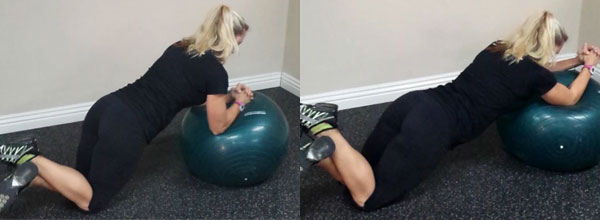
The Exercise: Rollouts
Rollouts
Targeted Muscles: Abs, back, chest and ats
The Movement: Bend your elbows at 90 degrees and place them on the top of a stability ball. Place your knees on the floor so that your knees, hips and shoulders are in a straight line. Engage your abs and open your shoulders, pushing the ball forward away from your body. Roll the ball out as far as you can without breaking the straight line between your knees and shoulders. Engage your abs and upper body, and then roll the ball back toward your body.
Challenge: For an added challenge, place your feet on the floor instead of your knees.
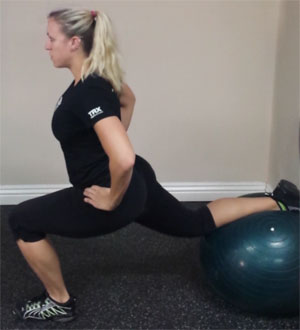
The Exercise: Bulgarian Split Squat
Bulgarian Split Squat
Targeted Muscles: Glutes and hamstrings
The Movement: Place the ball against a wall. Stand facing away, about 2 to 3 feet from the ball. Place the top of your left foot on the ball, so that you feel a slight stretch in your left hip flexor. Keep your shoulders square and chest up, and engage your core. Once balance is established, bend your right knee, keeping your right knee directly over your foot so that your shin remains vertical. Go as low as you can. Push through your right heel and stand back up. Repeat 10 to 15 times, and then switch legs.
Modification: To modify the exercise, start with a half squat, just to establish balance. You can also place the ball in a corner to prevent lateral shifting of the ball.
Challenge: If you have great balance and want an extra challenge, try this exercise without a wall behind the ball. As you lower, push the ball back with your foot, and then as you stand back up, pull it back in to starting position. You can also try holding on to dumbbells for more glute/hamstring activation.
The Exercise: Plank Variations
Targeted Muscles: All muscles depending on variation, but especially the abs, glutes, lower back and hips
The Movement: Set up is similar to the rollouts. Place your elbows on the ball and your feet behind you on the floor; maintain a straight line from ankles to hips to shoulders. Do not allow your upper body to collapse onto your elbows; rather, keep an open angle between your arms and torso, and keep your visual focus on your hands. Start by holding a plank. Once you can hold a plank for 30 seconds without breaking form, progress to plank variations.
The Variations: Lift alternating legs while maintaining a tight plank. Try lifting one leg up and then out to the side 1 to 2 feet while holding the plank. Try lifting one arm out to the front, and then out to the side. Alternately bring one knee in to touch the ball just below your chest. Alternately bring one knee out to the side and then forward to touch the ball on the outside of your elbow. Try a side plank by propping yourself on your right elbow, with your left hand on your hip, and then switch sides.
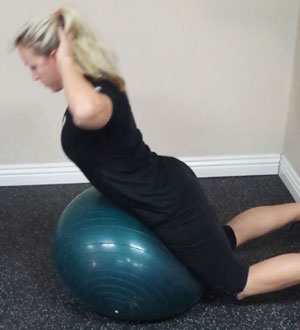
The Exercise: Glute/Ham/Low Back Extensions
Stability Ball Exercise
Targeted Muscles: Upper and lower back, glutes and hamstrings
The Movement: Lie prone (facedown) with the stability ball positioned under your hips and your feet pressed flat against a wall. Bend your knees so you “hug” the ball between your torso and knees. Place your hands behind your head and lift your torso, hinging at the hips, by pressing your feet against the wall. Keep your back straight throughout the exercise. Finish with your knees, hips and shoulders in a straight line at about a 45-degree angle from the wall. Be careful not to overarch your back. Bend at the hips and lower back down until your stomach contacts the ball again.
Challenge:  Hold a 5-pound medicine ball at your chest while completing the movement. Alternatively, hold 5-pound dumbbells in each hand and perform a reverse fly as you lift.
The Exercise: Push-ups
Targeted Muscles: Chest, triceps, abs, core, glutes and back
The Movement: Place your shins on the stability ball and your hands on the floor so you are in push-up position. Bend your elbows and lower yourself to the ground. Finish with your chest between your hands, keeping a tight, straight back during the whole movement. Squeeze your abs to keep the ball from rolling laterally.
Modification: To make this exercise a little easier, start with the ball closer to your torso, on your thighs or knees. As you get stronger, try to roll the ball back a little more each time, until you can eventually do push-ups with your feet on the ball.
Challenge: To make ball push-ups harder, engage your abs by adding a knee tuck after each rep—bend your knees and roll the ball to your chest. Straighten your legs back out and repeat the next push-up. You can also lift one leg about 6 inches above the ball while performing the push-up. To activate more upper-body stabilizer muscles, place your feet on the floor and put your hands on the ball to do your push-ups.

Source 

Wednesday, 17 December 2014

8 Exercises Every Woman Should Be Doing

Strength training is an important part of improving your overall fitness, and for women, it can mean much more. In addition to numerous health benefits, adding weights to your routine can become a form of personal development that builds strength in all areas of life. The purpose of this campaign is to celebrate strength training and the strength of all women, no matter their size or life circumstance.

There are many reasons why women should regularly hit the weights, and the following exercises capitalize on those benefits. So get the girls together and try these female-friendly moves the next time you head to the gym.
LATERAL LUNGES
Why? Because women have wider hips than men, most of us have a wider “Q-Angle,” which puts us at increased risk for ACL injuries. Lateral lunges and other lateral movements help strengthen and stabilize the hips, thus decreasing the risk of injury to the knees.
How: Begin with feet in a narrow stance and then step to the right side, keeping the right foot pointing forward and the knee in alignment over the foot. Sink the right hip down and back while keeping the left leg straight. Squeeze through the hips for stability and bring the left leg in and step together.
Options: This move can be done traveling (i.e., moving across the room) or stationary (i.e., staying in the same spot while alternating sides). It can also be loaded with a medicine ball or unloaded with a TRX Suspension Trainer.
KETTLEBELL SINGLE-ARM SQUAT PUSH-PRESS
Why? Having strong shoulders and the strength and power to put a heavy object overhead is no longer just a man’s job. This functional move helps you gain upper-body strength and power so that you don’t have to ask for help.
How: Begin by holding a medium-weight kettlebell in your right hand next to your chest with the palm facing inward. Drop your hips down and back, then drive through your glutes and return to standing while thrusting the kettlebell into the air. Slowly return the kettlebell to your chest and repeat.

Options: This move can also be done with a dumbbell (with a modified starting position). Also, ensure you have proper squat form before adding a load and speed to it.
TRX LOW ROW

Why: Strengthening the muscles of the upper back helps improve posture, which leads to decreased risk of injury, better power transfer, and taller and more confident aesthetics.

How: Fully shorten your TRX Suspension Trainer and stand facing the anchor point. Keeping the body perfectly planked, walk under to an angle that is safe, yet challenging. Begin the row by retracting and depressing your shoulder blades and then follow through by pulling your body to your wrists, with wrists facing inward; don’t lose your plank.
Options: Can also be done under a Smith machine bar at varied heights.
PULL-UPS

Why: With higher levels of estrogen, women have the benefit of building shape through strength training without the extra bulk. Pull-ups strengthen and tone the back, which leads to a smaller-looking waist.
How: Begin your pull-ups in an assisted pull-up machine. Using an overhand and shoulder-width grip, contract your outer back muscles and lift your chin to your hands. Keep the body straight and tight as you lower down to the starting position with control.

Options: When enough strength has been established, try this movement on a pull-up bar with no assistance, but be careful not to swing or arch.
WALKING LUNGES


Why? Women make fantastic athletes and this functional exercise that targets the hip and knee extensors should be included in every athlete’s repertoire.
How: Step forward into your lunge stance, ensuring the front knee tracks just over the middle toes and both knees bend to 90 degrees. Keep the hips tight and shoulders down and back as you step together with the other leg.
Options: Perform standing body-weight lunges or unloaded lunges with a TRX Suspension Trainer.
BALL ROLLOUT

Why? This version of a plank helps realign and strengthen the spine, especially after giving birth. The instability of the ball leads to a full-body strengthening and stabilization from the shoulders all the way to the ankles.
How: Begin with your forearms on top of a Swiss Ball and knees on the ground. Keep the shoulders, hips and knees in a perfectly straight line and roll the elbows forward on the ball a few inches and return. As you progress, this movement can be done with your knees off of the ground, with your shoulders, hips and heels in alignment.
Option: If your hips are sagging during this movement, move your plank to the ground until you have gained enough strength to advance to an unstable environment.
RIP PUNCH

Why? Punching feels GREAT! And adding resistance helps improve posture, supports the back and helps us rotate safely for sport and life.
How? Hold the TRX Rip Trainer with both hands palm down in zones 1 (the end of the bar) and 4 (three-quarters of the way down the bar). Begin in the end range of motion with the punching arm fully extended and back leg pivoted. Slowly release the punching arm and then simultaneously pivot the back foot and push and pull with the upper body to punch with power!
Options: Before beginning this exercise, master proper punch mechanics off of the Rip Trainer. The grip on the bar can be varied to increase or decrease difficulty.
SQUATS

Why? Let’s face it. You want a better butt. The answer? Squats. And for those of you are quite satisfied with your hind quarters, squats, like lateral lunges, build strength to protect your knees and help you become the best athlete you can be!

How: With your feet slightly wider than hip-width apart, lower your hips down and back, keeping the back angle and shin angle parallel. Choose a depth that is safe for your knees and hips, yet still challenging (this will vary from person to person). Engage your glutes and drive up from the floor.
Options: Squats do not need to be loaded immediately. Begin mastering your squat form with just your body weight or even unloading your weight using a TRX Suspension Trainer.
Of course, all movement is important for women and exercises should be regressed or progressed as appropriate for the person. By adding any resistance training to our workout regimen, we will have stronger bones, feel better and move better for longer—leading to a much more fulfilling life. Now go add some estrogen to that weight room! 

Tuesday, 9 December 2014

Core-strengthening Stability Ball Workout

The stability ball was originally used as a physical therapy aid for postural re-education and orthopedic rehabilitation. Today, you can find these large, air-filled balls in a variety of sizes in just about any fitness setting. They are used by exercise professionals in personal training and group fitness as a way to add interest and fun to core and stability-based workouts. Although stability-ball exercises appear to activate about as much deep abdominal muscle as similar movements on the floor without a ball (Martuscello et al., 2013), they can add value to a training session when you’re looking for variety and whole-body integration while working the core.


The following workout circuit on a stability ball adds a new twist to your ab routine. Perform 10 to 15 repetitions of each exercise, and do the circuit more than once if you want more challenge. Choose a ball size that allows you to sit comfortably on top with your feet flat on the floor, thighs parallel to the floor, and both hips and knees bent at 90 degrees. Keep in mind that to work the entire mid-section, it’s important to challenge the torso from various directions. That is, there is more to a balanced core program than just performing crunches or sit-ups. The following routine features movements that address the entire functionality of the trunk muscles—flexion, extension, side bending and rotation.
Note: Only attempt this workout if you have had previous experience using a stability ball and feel confident moving on the ball in all of the positions shown.
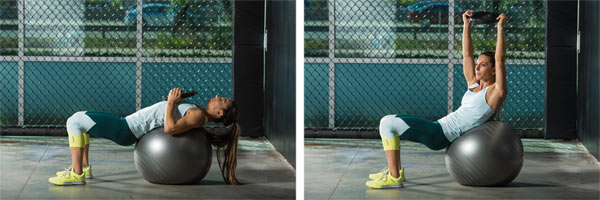
1. Ab Crunch With Diagonal Press
ab crunch with diagonal press
Grasp one, small weight (e.g., a 5-, 8- or 10-pound dumbbell, plate weight or medicine ball) with both hands. Sit on top of the ball and walk the feet forward until your back is supported by the ball. Start with the weight on the chest. As you come up into an ab crunch, straighten the elbows and push the weight at a diagonal away from you toward the ceiling. As you return to the start position, bend the elbows and bring the weight back down to the chest.
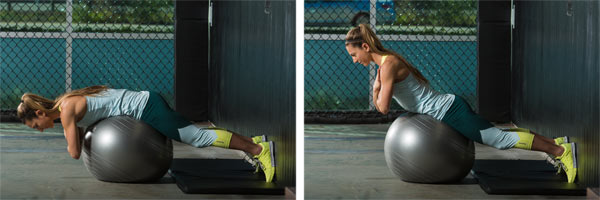
2. Back Extension Over Ball
back extension over ball


On an exercise mat, kneel with your back to a wall and position your feet against the wall. Lean over the ball and position it underneath your abdomen. Slowly straighten your knees as you lean over the ball, which will effectively put the ball under your hips. You should be leaning over the ball with the upper half of your body unsupported, while your hips and thighs are supported by the ball and your feet are support by the wall. Keep your abdominals contracted and your glutes tight and cross your arms over your chest. Slowly lower and lift your torso to work the trunk extensor muscles.
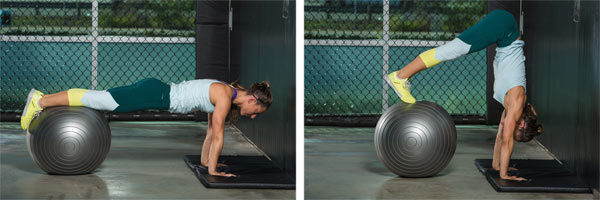
3. Pike on Ball
pike on ball

Adopt a plank position with your hands on the floor aligned underneath the shoulders and your thighs on top of the ball. Position yourself with your head toward a wall that is strong enough to hold your weight in case you lose your balance and need back support from the wall (this will prevent you from rolling forward into a summersault). Slowly roll the ball toward your body as you lift the hips upward into a pike position. If you feel comfortable in a handstand, align the hips above the head in the end position so that you are essentially upside down. However, if you are unsure of your ability, only bring the hips upward as high as you feel confident and stable. Slowly roll the ball back out to the start position.
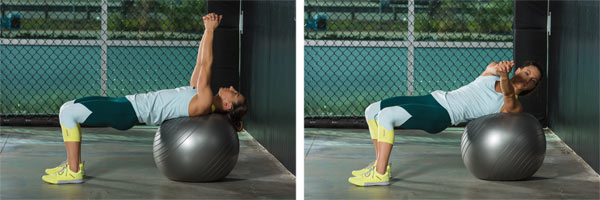
4. Supine Twist on Ball
supine twist on ball

Sit on top of the ball and walk the feet forward until your back and head are supported by the ball. Clasp your hands together and straighten your arms up toward the ceiling. Keep the feet hip-width apart and the head, neck and hips in a straight line from your head to your knees. Slowly rotate your upper trunk to one side and then the other while keeping the pelvis in place.
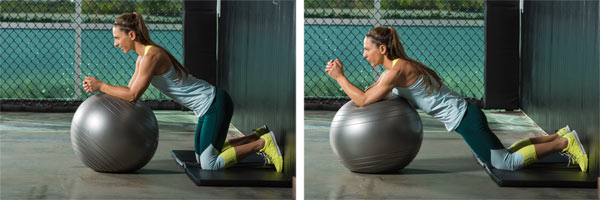
5. Kneeling Plank Roll-out
kneeling plank roll out

On an exercise mat, kneel in front of the ball with your knees about 12 inches from the ball and lean on your forearms so that your shoulders are directly above your elbows. Gently contract the abdominals and slowly straighten your arms as you push down into the ball to move it forward. Roll out the ball as far forward as you can, but stop if your hips start to sag. Return to the starting position, keeping the abdominals engaged throughout the exercise.
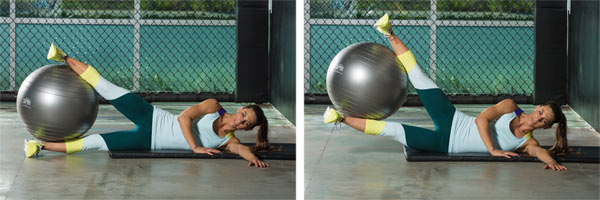
6. Side-lying Leg Lift
side-lying leg lift

On an exercise mat, lie on one side with your bottom arm outstretched in front of your chest and your palm facing the floor for support. Trap the ball between your feet and shins. Slowly lift the bottom leg off of the floor while keeping your torso stable and on the floor. Return to the start position with the leg on the floor. Complete all of the repetitions on one side before moving on to the next.

Source