Showing posts with label plank. Show all posts

Wednesday, 15 July 2015

6 Exercises for a Stronger Core

Your core consists of the muscles that stabilize the spine and hips, and includes all the muscles of the abdomen, back, glutes and upper legs. A strong core helps protect the entire midsection, and enhances both mobility and stability, which, in turn, improves movement efficiency and keeps the muscles functioning in coordination with one another. This, of course, helps improve balance, posture and strength.
A common misconception is that doing exercises while lying supine automatically increases core strength. While these exercises can help improve abdominal strength, the entire core must be challenged to help improve total-body function. A better approach is to use a variety of stances, such as single-leg, supine and prone, to incorporate a wide range of movements. Here are a few of the best exercises to challenge the entire core.

Glute Bridges

While many consider the abdominal muscles to be the most important for increasing stabilization, strong glutes are essential as well. Many injuries and faulty movement patterns are a result of underactive glutes and overactive quads and hip flexors. To combat this, activate and fire those glutes before workouts to make sure they are turned on and ready to work.
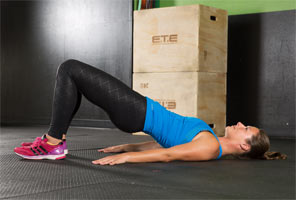
Lie supine on the floor with knees bent and both feet flat on the floor. Keep the head relaxed and slowly push through the heels to raise the hips as high as possible. The knees, hips and shoulders should be in one straight line. This exercise activates the glutes and hamstrings, and stretches the hip flexors, which are often overactive and tight. Hold the top position for three seconds and slowly lower. Do eight to 10 reps per side. To progress this exercise, try one leg at a time or place the feet on the round side of a BOSU.

Medicine Ball Single-leg Reach
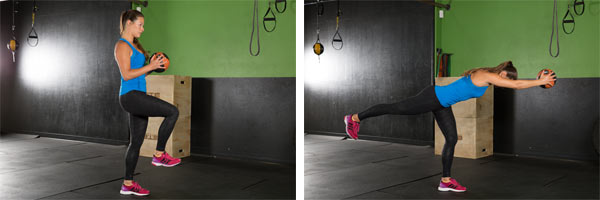

Disguised as a leg workout, this move is great for the glutes, hips, back and abs. Grab a 5- to 10-pound medicine ball and stand on the right leg. Slowly reach forward while hinging at the hips (not the back). Simultaneously lever the back leg out behind the body. Reach as far as possible—work toward bringing the arms, torso, and left leg horizontal to the floor. As the core gets stronger, increase the weight of the medicine ball. Perform two to three sets of eight to 10 repetitions per leg.

BOSU Plank Variations
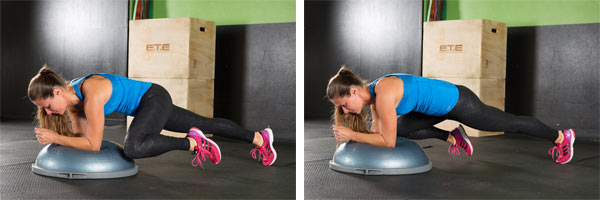

Before attempting planks on the BOSU, make sure your client has impeccable plank form and can hold it for at least 30 seconds on the floor before attempting advanced variations. Planks are meant to strengthen the core, so if your client’s form wavers too much (back sinks, arches or bends), have him or her practice a little longer before advancing.
Start with the elbows on the round top of the BOSU. This creates an element of instability that must be controlled throughout the exercise. Perform a plank for 30 seconds. Begin adding small, alternating single-leg lifts, focusing on lifting the leg with the glutes and not shifting the hips at all. Next, try bringing one leg out about 45 degrees to the side, tapping the toe to the ground and returning to plank position. Perform five repetitions on each leg. Finally, try bringing the left knee out to the side, and tapping it to the BOSU just outside the left elbow. Repeat five times per leg. To regress these variations, perform them on the floor or on a flat bench before moving to the BOSU

Medicine Ball Single-leg Woodchop
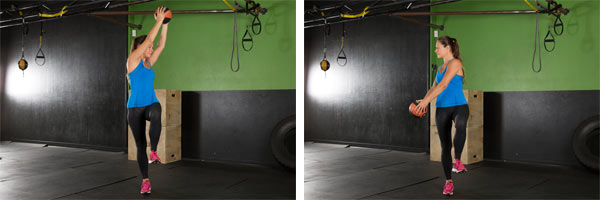

Grab a 5- to 10-pound medicine ball and stand on the right leg. Raise the medicine ball overhead, slightly over the left shoulder. Swing it down quickly, but with control, to the outside of the right leg. Try to keep the torso upright, with a constant slight bend in the right leg. Slowly bring it back up to starting position and repeat eight to 10 times. To regress this exercise, start on two legs and gradually progress to standing on one leg.

TRX Pike


Place the toes in the foot cradles and lie prone on the floor, ready to plank. Push up into a high plank on the hands, establishing perfect form. Keeping the legs straight, push the hips straight up into the air while simultaneously pulling the TRX toward the hands. Slowly lower back down to finish in plank position. Complete eight reps to start, gradually increasing to 15 reps as core strength improves. To regress this exercise, bend the knees to pull the TRX toward the hands.

Hanging Leg Lowers
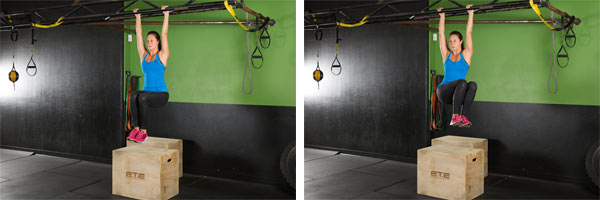


Exercises in which the legs are unsupported are a great way to work the deep abdominal muscles and the hip stabilizers. However, these exercises are not recommended for individuals with diagnosed lower-back pain.

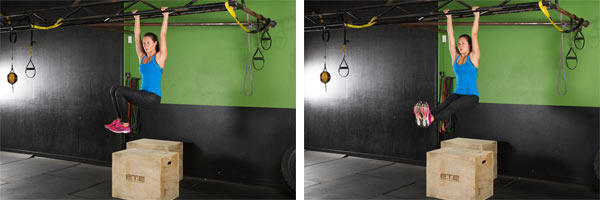
If your client is a beginner, start this exercise using a Captain’s Chair. Once the client has developed a good strength base, progress to ab straps or hanging from the hands. Start with the knees bent, and lift them slowly as high possible, pulling the knees to the chest. Instead of focusing exclusively on the upward movement, think about the slow downward movement. Take about five seconds to slowly lower the legs back down to the starting position. This eccentrically works the deep abdominals, providing control and stabilization, while also preventing swinging. Repeat eight to 10 times. To progress this exercise, slightly twist the knees to the left and right to challenge the obliques. Additionally, try keeping the legs straight but only raise them as high as possible while maintaining straight knees. Again, focus on the slow lowering motion.

Source

Tuesday, 14 July 2015

Plank Exercise Variations

There is definitely no reason at all not to spice up a standard weight training workout with a few planking postures. Plank training benefits are extensive. When utilizing any planking posture, you'll be strengthening core muscles, that are essential stabilizers for your entire body. You'll very quickly see lumbar issues getting better, coupled with increased abdominal definition. Undoubtedly, the easiest way to increase muscular strength while reducing back conditions and enhancing alignment is plank training. While conventional stomach workouts, like sit-ups and crunches, put stress on the spinal column, plank exercises maintain a straight pose, enhancing posture.
Everybody is able to really benefit from plank routines. Athletes of most sports use planks to develop mid-section strength and durability, probably the most crucial element of pretty much every sport. The military services also supports core muscle training due to their rapid, stomach strength and durability development.
Let's see why you should add planking to your workout routine!

One of the better parts of planking postures is the numerous that may be made from each and every one. As an example, to improve the ab training routine while using the standard plank position, steadily lift up 1 foot off the yoga mat and maintain the posture. The very same approach may be used in types of planking. For additional intense plank exercise routines, consider making use of a chair. Creativity is important because they could be utilized in a plethora of possibilities. Among the more conventional methods of adding a weight bench would be to assume the regular planking pose, and positioning your feet on top of the bench. Yet another popular posture turns around this, and it has the arms on top of a bench.
Lateral planking, as the name indicates, are like standard planking but carried out laterally. Using the lateral plank, the sole parts of the body in contact with the floor include the arm on the side closest the surface, in addition to the feet. This amazing planking activity focuses on the ab muscles along the side of the mid-section, referred to as the oblique muscles. Lateral planking poses are much harder versus classic front side planking position, and definitely will call for a substantial amount of abdominal area power.
The posture of inverted planking is quite simply a standard plank flipped. You should have your backside oriented with the floor together with both arms in contact with the surface. You will need to bear in mind for all planking postures, the sole body parts that are in contact with the surface include the arms, feet and hands. The inverted plank focuses on basically the identical muscle groups as the front side plank exercise.
The question for you is how one can transition this information of a planking workout routine to a health club. Adding planking along with other training is extremely advocated. Despite the fact they may be absolutely advantageous by themselves, planking training is in most cases built into a complete exercise routine. As with every workout routine, the positive outcome of the execution is dependent mainly on the level of fitness of one's participate. With respect to standard and inverted planking, beginning with only thirty second reps is perfectly fine. The wonderful thing about planking is inside of a month or so you will realize quick positive changes on the time period you will be able to maintain for each and every planking posture. For veteran "plankers", a normal front side planking posture is comprised of 2 to 3 minute reps, together with about 5-10 sets or higher. A standard lateral planking posture is made up of 1 or 2 minute reps. This is obviously just a approximate guideline as every person adapts planking postures to fulfill their own particular requirements.
The biggest benefit of a planking workout is the fact that it's free! Zero health and fitness center memberships or complicated equipment are necessary for these activities. The only mandatory tools are spirit, iron will and dedication. Since plank activities don't require related equipment, you can utilize them anywhere. Take a couple of minutes at lunchtime or maybe when you feel exhausted at the job, move down to the ground, perform a couple of plank exercises, and acquire the amazing returns. You will quickly feel recharged and much less worn out than your coworkers who stuffed themselves at break. The number one overwhelming positive regarding plank workouts is how the negative aspects are practically non-existent. A result of the large number of adaptations, virtually all fitness levels can take advantage of plank exercises. They are one of the best calisthenic exercises that is 100% free, uncomplicated and hassle-free.

Source 

Monday, 13 April 2015

5 Best Abdominal Exercises To Carve a Flat Abs Within Just 3 Weeks

Does there exist best abdominal exercises that can make your abs flat in just a short period of 3 weeks? It sounds too good to be true. But it is true that with the regular workout of these best abdominal exercises you are more likely to see your abs being flat in just 3 weeks from now. Read more to learn about these best abdominal exercises.


These exercises are best to develop a flat abs in a short time. They do not require any special equipment and can be done even at home. However if you are an obese, you need to reduce your body fat through diet and then consult your physician before venturing into any abs workout. Nevertheless, whatever your current weight is, you will see substantial result in less than 3 weeks following these best abdominal exercises.
Note: Do the following exercises a minimum of 5-6 days a week to a see a desired result in less than 21 days. With consistency and determination you will it's amazing effect in just 2 weeks time.

1. Side Plank
Method:
  • Lie down on your side with your right elbow supporting your body above the ground.
  • Now lift your body sideways. Make sure your body is in one line without any bends and arches.
  • Your left hand should be either straight in line with your body or facing the sky. Make sure your left hand should not be on your waist.
  • Hold this position for 30-60 seconds and repeat 3-4 times with both right & left elbow.
2. The Bicycle exercise
Method:
  • Lie down on the floor facing upside and place your hand behind your head.
  • Lift your shoulder blades without pulling your neck.
  • Bring your left knee above and try touching your chest.
  • Straighten your left leg at an angle of 45° and try to touch your left knee with your right elbow and vice versa.
  • Keep repeating the process for about 12-16 times.
3. Naukasana Yoga
Method:
  • Lie flat on the ground, with your back on the floor.
  • Raise your upper body and legs simultaneously to an angle of 30 degrees to form a V-shape. Hold the posture for 30-40 seconds and contract your upper and lower abs.
  • Repeat this exercise for 5-6 times initially and increase to 10 times or more.
4. Lying Trunk Twist
Method:
  • Lie flat on your back with both hands extended out to the sides and your palm facing the sky.
  • Your knees should be pulled over your chest. Place a ball between your knees (optional).
  • Contract your abs and twist your hips to the right, getting your right knee towards the ground but not touching it.
  • Hold this position for a few seconds making sure your shoulders, hands and abdominal region remain stable.
  • Now slowly use your back to get your knees back to the starting position.
  • Repeat the same process on your left side.
  • Do this 4-5 times on either side.
5. Hanging Knee Raise
Method:
  • Begin hanging from the bar with your arms straight.
  • Bring knees up with hip flexed at approximately 90 degree.
  • Slowly lower legs, ensuring rest of the upper body remains stable.
  • Repeat the exercise for 5-6 times.
These are an excellent exercises to really strengthen your core and achieve flat abs quickly. Once you have mastered it, do the same exercises with light dumbbells in each hand.
For the beginners these exercises will be a little daunting but you need to keep going to see the results. Every week you need to challenge oneself to increase the number of reps you perform at least twice as compared to the previous week until you can comfortably perform 20 reps. And with practice you will be performing these exercising in about 15-20 minutes.
The most effective formula for well-toned abdominal muscles is Abs exercises + Right diet. So if you mix these best abdominal exercises with the proper low-calorie diet, you will start seeing the effects in as many as seven days.

Source
 

Sunday, 12 April 2015

Seven Great At Home Exercises For Women

Don't have time to go to the gym? The busy lives of women just became easier with these 7 best at home exercises for women. Who says you need all the fancy equipment in the gym?


What you do need is the foundation behind weight loss and muscle building so you will begin to see inches falling off in record speeds. There is a right and wrong way to exercise. You can spend hours doing the wrong form of exercise and never see a difference in your body.

Cardio Vs. Cardio
Ever see a heavyset marathon runner? Here's why. Our body is a master at adapting. Our body will regulate to almost any condition we throw ourselves into. If we do steady state cardio, such as the treadmill at the same speed, elliptical at the same level, walking, or even jogging, without changing any factor; our body will adapt and our heart rate will regulate. Start sprinting or running up stairs and BAMM! Bye bye adaptation and fat. When we change the state our body is experiencing, our body will not be able to adapt to the constant change.

Aerobic Vs. Anaerobic
Aerobic exercise is what most people refer to as ‘cardio'. This type of exercise is done at a low to moderate pace where your heart rate is approximately 50-70 percent of your maximum heart rate. At this pace, and with reasonable conditioning, you should be able to supply the muscles with sufficient oxygen to keep them contracting and performing for some time. Aerobic means with oxygen.
Anaerobic exercise, in contrast, is done at an intensity in which your muscle requirements for oxygen succeed the amount you can supply. Anaerobic meaning without oxygen. You will be forced to stop this type of exercise sooner because your muscles will cease to function. At this intensity, your heart rate will be at 90-100 percent of your maximal heart rate.
Here is why anaerobic exercise is much better for weight loss: When we are using the aerobic system, the body will regulate itself, creating enough energy to carry out the exercise. With anaerobic exercise, you will create a huge deficit of oxygen that will stimulate the body to continue to use energy to replace this deficit for hours after your workout. Our body uses macronutrients for energy and if we are eating just enough to cover the amount of energy needed to supply the body in normal conditions, anything above this will cause our body to look for energy elsewhere; fat tissue.

Foundation of Weight Loss
The key to weight loss is calories out > calories in. This does not mean you need to go on a low calorie diet. Our body needs nutrients in forms of protein, fats and if we are exercising, carbohydrates. Our body uses carbohydrates for energy. There isn't a place to store excess carbohydrates in the body. All extra carbs that are not used for energy will be stored in fat cells. Too bad our body wouldn't just get rid of them instead.
If you are very active, you need carbohydrates for energy and recovery.
The key is using carbohydrates for those two purposes and those two alone; exercise and recovery. Now that you know the basics of exercise and nutrition, let's look at how using the right exercises will help to create the body of your dreams, give you energy long into your later years of life, and will create a positive self image.

Foundation of Muscle Building
Muscle can do one of two things:
1. Grow larger and/or stronger
2. Shrink and/or get weaker
The only way to create muscle tissue is by breaking down the muscle tissue and rebuilding stronger and bigger cells. The most effective way of doing this is through resistance training.
With proper training your muscles grow stronger and larger. Benefits of muscle include:
  • performing daily activities more easily,
  • burning more calories daily,
  • building stronger bones, preventing osteoporosis,
  • improves your flexibility, stability and balance,
  • improves strength and posture
  • improves body composition
  • reduces loss of muscle mass due to inactivity.
Muscle Balance
Earlier I stated that there is a right and wrong way to exercise. One key aspect of a workout program is the focus of creating balance throughout every muscle. Each muscle has an opposing muscle, the antagonist. Let's use squats and lunges as examples. Here, the quadriceps is the agonist (dominant muscle being used), while the hip flexors are the antagonist (opposing muscle) and hamstrings become the synergist (stabilizer or helper) muscles. When you are performing more quadriceps dominant exercises as opposed to hamstrings or hip dominant exercises, your pelvis will tilt, causing pain in the lower back, and knees that are prone to injuries.
We can fix this by adding hip and hamstring dominant exercises to balance out all muscle groups. As a rule, you should never do more quadricep dominant exercises than hip movements. Always keep the volume balance between each muscle.

Large Muscle Groups
Any exercise plan needs to involve large muscle groups, focusing on working the antagonist in the same amount as stated earlier. Knowing the proper exercises can ensure you will also target the smaller muscle groups, creating harmony throughout the entire body by incorporating stability muscles as well. And in doing so, you will also cut the amount of time needed in the gym by leaving out certain body parts that were already targeted in other exercises.
You also need to be aware of the muscles being worked with each exercise to ensure you keep balance throughout all muscles. A simple chest press targets your pectoalis major, but also uses pec minor, deltoids, trapezius muscles, and your rotator cuff for example.

Importance of the Core
The core encompasses more than two dozen abdominal muscles, lower back muscles, and hip muscles that stabilize your spine to keep your torso upright. Your core allows you to bend forward, back, side to side, and rotate. Your core plays a major role in movement. Working your core (stability muscle) is crucial to optimal performance.

7 Best At Home Exercises For Women
By now you understand the importance of exercise. You don't need fancy equipment for you to benefit from exercise. Here are just 7 at home exercises, especially for women, that will not only better your appearance, they will better your health.

Chin-up/Pull-up-These exercises target your lats but also hit your tere major (stabilizer muscle) and biceps (more so with chin-ups). Your core and middle back are also involved in assisting in the movement or acting as stabilizers.

Pushup-This exercise targets your pectoralis major but also involves your front deltoids and triceps. As for stability muscles, your rotator, traps, serratus anterior, and abdominals all assist with this movement.

Inverted Shoulder Press-The shoulder press targets your front deltoids, middle deltoids, and the triceps. They also activate your upper traps, rotator cuff, and serratus anterior which act as stabilizer muscles.

Squat-These exercises target your quadriceps, but also activate your core, and every muscle in your legs including your glutes, hamstrings, and calves. This exercise burns a ton of calories and is a must-have home exercise for women.

Stability Ball or Towel Leg Curl-This exercise is great for targeting your hamstrings and glutes, and also activates your lower back muscles and core. Because the glutes are the largest muscle in the body, any exercise involving your glutes will burn a lot of calories.

Single-Leg Toe Hops off Bench or Chair-This exercise targets your calves, but also incorporates your quads, hamstrings, glutes and gets your heart rate up to the fat-burning zone.

Side-plank-This exercise improves the strength in your back and will help with performance. Planks target the entire core, making this exercise a must-do for health and appearance sake.

Your At Home Workout
The workouts are split into different combos with 3-4 exercises in each combo. Each exercise is preformed 3 times before moving onto the next combo. Do the different exercises back to back, then repeat for a total of three sets. You must always warm up for 10 minutes and cool down for 10 minutes.
After you are able to do these workouts in 45 minutes or less, add 20-30 minutes of cardio following your workout on three of the five days. Two days of cardio should be HIIT and the other day should be steady cardio for endurance training. Stretching is also vital following the workouts.
Use these 7 at home exercises for women for 6-8 weeks to improve strength, build muscle and burn fat.

Source
 

Tuesday, 24 February 2015

3 Effective Belly Exercises For Women

In this article I want to share 3 highly effective belly exercises for women. These exercises can help you to strengthen and tone your stomach. If done while pursuing a healthy and sensible diet, these exercises can help you to flatten your abs.

Here are the exercises:
Flutter kicks
  This is an awesome lower belly exercise that can be quite intensive. I love flutter kicks as you can feel the effort in your abs very quickly. To do this exercise you need to first lie down on the floor with your body stretched out and your hands at your side. Raise both legs about 5 inches off the ground with your feet pointing away. Start moving your feet up and down very quickly in small motions no more than 4-5 inches in length. All the while, keep your lower back and upper body firmly on the floor. It won't take long until you feel your abs "screaming" for mercy. Try it. It's an awesome exercise.


Reverse crunches
I love reverse crunches because it's a highly effecive stomach exercise for women (and men too) and is much easier on the lower back than many other exercises. To do reverse crunches you need to lie on the floor with both knees bent. Lift both feet a few inches off the floor. By crunching your abs, bring both knees in the direction of your chest. Make sure to really crunch your stomach muscles at the end of the movement. Lift your butt off the floor a bit during the motion to give you an addition range of motion. On the return movement, make sure to not let your feet touch the floor and to not let your lower back rise from the ground.

The Plank
The plank is an awesome static abdominal workout that really strains the muscles. To do the plank, you need to go into a position that looks like that of a push up with one small difference: you shouldn't rest on your palms but on your forearms. Make sure your back and neck and head are straight and form one line. Keep your eyes firmly on the floor and hold this position for as long as you can. Make sure to be stable and not allow yourself to sway. Hold your abs in tightly and breathe normally. You'll find that the plan is a truly challenging exercise that can help you flatten your abs.