Showing posts with label abs workout. Show all posts

Monday, 28 September 2015

Great Abs With Balance Ball!

Doing yoga on the ball can benefit anyone, including:

1. Yoga beginners. Moving into poses with the ball's support builds confidence and can help your muscles gradually stretch and strengthen as you improve your yoga routine.

2. People recovering from injuries. Some injuries create muscular weaknesses that make it difficult or painful to do yoga postures such as backbends or Warrior poses. A ball can ease you into a pose comfortably and with less risk for re-injury.

Work Those Abdomens!

Abdominal work is only part of the story. You may be surprised to learn that even more essential to your core stability than a set of six-pack abs are tiny muscles that run along the spine and support the body's joints. Normally we associate a strong body with the large muscle groups.

But, what really improves overall body fitness is the strength of these tiny muscles. They're the ones that keep you from falling, wrenching a disk in your back, or spraining your ankle when you slip on a patch of ice.

Elevated Pushups for Pecs, shoulders, triceps, and abs

How to do it: Place the front of your knees on the ball and your hands flat on the floor (your whole body should be parallel to the floor). Look down at the floor and lower your face to within a few inches of it, then push back up to the starting position.

To Inflate the Ball

1. Attach the yellow piece to the pump by screwing into place.

2. Before inflating, use a yard stick or tape measure to mark the size of your ball in centimeters (55, 65 or 75) on a wall or floor.

3. Inflate the ball as much as possible, without over inflating.

4. With use, the ball will stretch a bit and can be further inflated.

5. Add more air as necessary, never inflating the ball larger than the centimeters in diameter indicated on the box.

The balance ball rolls around easily, so core strength and balance are required to keep it still. The challenge of keeping the ball still makes the ball an excellent tool to teach stability and rehabilitation. The simplest movement can become a huge challenge when you do it on the ball. Using a ball can give your workout a little more variety and extra challenge. You can try these exercises after your Pilates mat work.


Brigi G | by Fit4Health

Sunday, 20 September 2015

30 Minute Intermediate Full Body Workout - Head to Toe Torcher

30 Minute Full Body Workout with Rebecca Louise. These body shaping moves will work your abs, core, legs, butt, arms, shoulders, and more! This workout burns 221 - 303 calories.

Saturday, 15 August 2015

40 Min Cardio HIIT Workout Butt, Thighs, Abs: Ultimate Workout for Bel...


Workout Details

I'm typing this write up pre-filming, but I already know this one is going to be brutal. The only thing that gets you through a tough workout like this one is reminding yourself of how effective it is if you just keep pushing. This HIIT workout is very effective at fat burning, but it's also fantastic for reshaping and firming the butt and thighs, and toning the abs. You wont get more than 2 active intervals in before you realize how much lower body work is in this routine - there's a hidden squat or lunge in almost all of these exercises and your butt and thigh muscles are going to be screaming by the time you're done with this!
It's impossible to spot reduce fat from anywhere on the body, but one of the best things to reduce overall body fat and stubborn belly fat is with cardio of varying intensities and time spans. You probably already knew that, but this is not your ordinary cardio workout. In fact, this bodyweight HIIT and cardio workout will put your typical treadmill, elliptical, or group fitness cardio to shame.
If you do it right (with proper form and at an intensity that challenges you personally) you're going to struggle your way through this workout video - and that's a good thing. Assuming that you are at least a moderately experienced exerciser who is capable of reading, and listening to your own body's messages, I don't want to you to work your way comfortably through this routine; I want you to push yourself - move as fast as you possibly can, concentrate on going for a full range of motion with each rep, and do your best to make it through each active interval with minimal extra rest. With that said, keep in mind that you should never push yourself to the point of losing your stomach during a workout. In contrast to what you see on television regarding exercise; the end goal during a good workout isn't to vomit. Stop before you reach that point - it usually only takes a very quick rest before you can catch your breath, regain your composure, and start again. As you get more and more fit, you will require shorter and fewer rests along the way.


Why this is a fat burning powerhouse: High intensity interval training (HIIT) is short, intense, unsustainable bursts of physical activity, paired with intervals of quick rests. We're using a traditional Tabata workout timing structure in this particular video; 20 seconds on, 10 off. In a nutshell, this training style causes a sort of metabolic disturbance, resulting in the body burning calories at a higher rate - up to 48-72 hours later, some research indicates. In addition to the research-backed, tried and tested fat burning HIIT in this video, we also have a burnout bodyweight cardio workout after the more intense part of the routine; this will not only drive up the total calories and fat burned for the workout, but also help increase your endurance and stamina. I've thrown in some intervals of core work that focus specifically on the abs, obliques, and lower back, just to wake up those muscles (once you're at a healthy bodyweight, those muscles may even start to make an appearance).

Friday, 14 August 2015

10 Ways to Get the Best Fitness Workout Routine

When it comes to a holistically hale and hearty life, fitness is definitely one of the watchwords! If you do not feel fit and healthy, you simply can't feel happy from within! I'm sure none would disagree. Each one of us must make sure that we take out some time from our hectic schedules to pursue a fitness workout routine. Let's take a look at some of the ways we could aim for a fitter self!

1. The best exercise for abs: side plank.
You should lie down on your left side with your elbow below your shoulder and your legs stacked. Then the right hand should be placed on your left shoulder or on your right hip. Once you have braced your abs and lifted your hips off the floor, hold on for as long as you can. Switch sides and repeat.


2. Standing dumbbell fly: For broader shoulders
A dumbbell should be held in each hand by your sides. Without shrugging, the upper body should be used to swing the weights up by a few inches. The arms and torso should form an upside down V shape. It will contribute hugely to your fitness healthy lifestyle!

3. Towel Cable Row: For great arms!
A towel is to be hooked to a cable pulley, following which you should stand in front of it, set up to do a row, while holding an end of the towel in each hand. Then the shoulder blades should be squeezed together and the towel rowed to your rib cage.

4. Pec Minor Dip: One of the best workout routines for chest
Once you've suspended your body over parallel bars, let your shoulder blades come together as you lower your body towards the floor. Make sure your elbows are locked while doing this. Thereafter, your shoulders should be spread and your body pushed upward again. There, can you feel your pecs working? Even with slight movement, it can do a lot to improve the overall size and shape of your chest.

5. Deadlifts for back muscles.
Begin with a low squat position and grab the bar with an overhand grip. Then your torso should be raised once you've sat back on your hips, pushed through your heels, and ascended upward. Throughout the motion, a tight core and straight back should be maintained.

6. The kettlebell complex: Most effective functional fitness workout
This will work wonders for you if you are short of time, or looking for a quick workout involving minimal stuff. All you need for this is a kettlebell and 20 minutes!

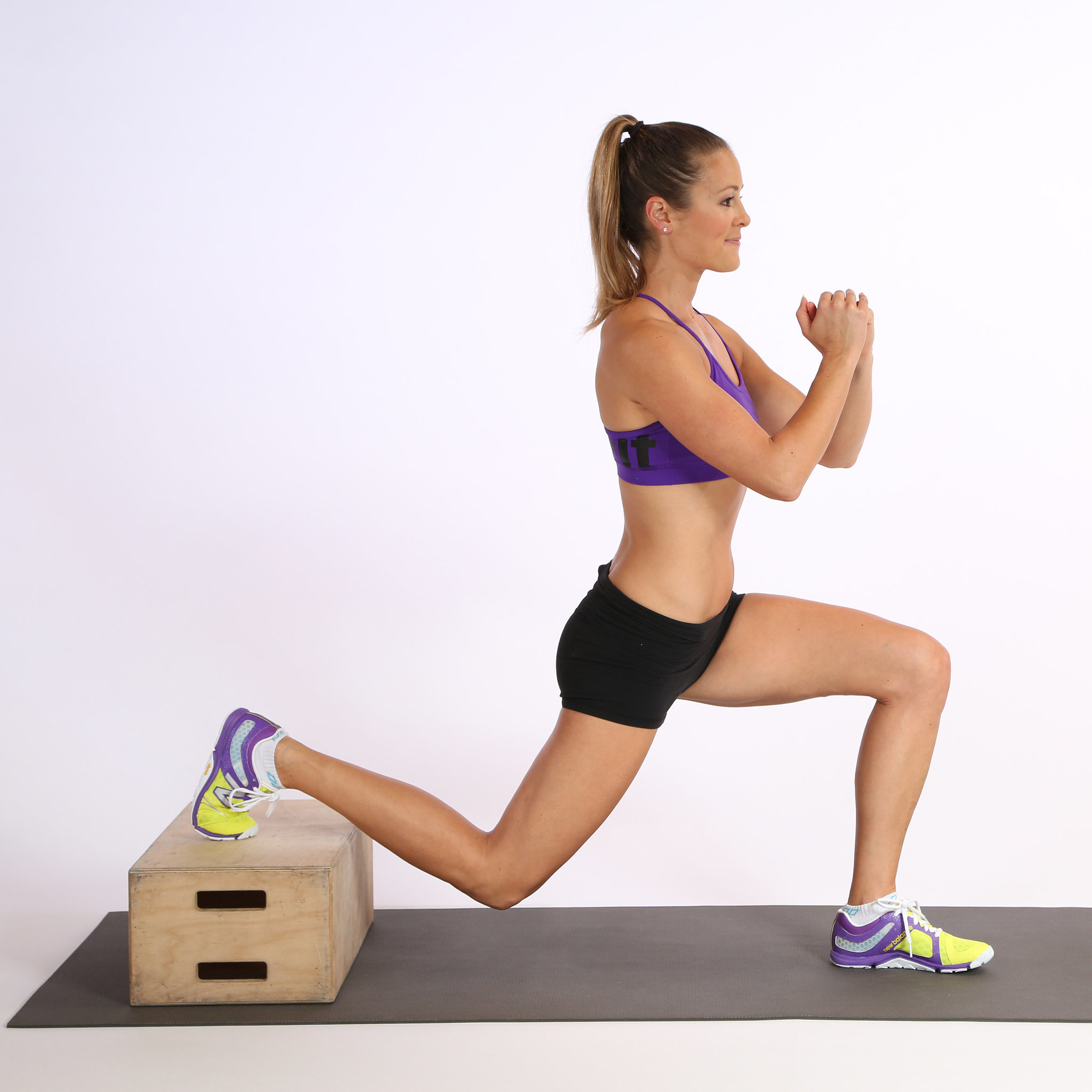
7. Bulgarian split squat: one of the best leg workouts
Hold a dumbbell in each hand once you stand lunge-length in front of a bench. Then the top of your left foot should be rested on the bench behind you. Your body should be lowered until your rear knee nearly touches the floor and your front thigh is parallel to the floor.

8. TRX Atomic Pushup: An excellent time-crunch move
Begin with your feet in a TRX suspension trainer or on a sliding surface. Follow this up with a pushup and then your knees should be pulled to your chest and then pushed back.

9. Squat with Ball: The best workout routine for toned thighs
Once you place an exercise ball between the wall and the curve of your lower back, stand with your feet apart by shoulder-width. Follow this up with bending your knees and lowering 5 to 10 inches. Make sure your shoulders are level and your hips square. This position should be retained for 3 seconds and then repeated.

10. K-Tread: Workout even while you're swimming, for a fitness healthy lifestyle!
In the deep end of the water, tread on it, making small circles with cupped hands and the right leg should be lifted straight in front of you, bringing it at hip level. Reach for the toes of left leg towards bottom of pool. Following this, the legs should be switched quickly, bringing right leg down as the left leg is raised, and hold on to this position for 5 seconds. This should be continued for 30 seconds, altering sides.

Happy workout, folks!

Tuesday, 16 June 2015

Women Fitness: How to Tighten That Tummy and Unveil Those Abs

Everybody is aware of the possible dangers that can be caused by unwanted fat deposits in the body. The beauty conscious women, young and the old have the dream of a tight tummy and solid abs as a part of women fitness. The way to achieve the dream is to reduce the fat deposit in the mid section. There are many useful tips to reduce the fat deposits.
The usual and effective way is to get committed to exercises that give more workouts to the mid section. The selection of different modes of exercise depends upon the age and health condition of the women. Crunches are the most preferred kind of exercise. Torso twists are also getting increasingly popular. Some women are receiving astonishing results through torso twists. Undergoing these popular types of self motivated exercise schedule under proper guidance can make your tummy tighter and will make your abs into the perfect shape. For women to get the extra fat removed from your waistline means to become attractive. No medicines or external factors other than exercise can bring about the desired results with long lasting effects.
Your diet is another aspect to be carefully looked into in order to avoid unwanted fat deposit around your waistline, which can lead to loosing your shape and beauty. Your diet holds the pivotal point. You should avoid extra fat contained food substances and in its place you can substitute fruits, green leafy vegetables and other low calorie foods. Food supplements can be relied on, in order to avoid malnutrition. If you are a woman who wants to flatten your tummy to unleash solid abs then you have to bring some changes to your daily schedule as well as your diet. Proper nutrition and regular exercise is the key to loosing the fat deposits around your tummy and to create sexy smart abs. In order to be lean and healthy at the same time, your body needs special and different nutrients. The only way to control your diet and to keep away from malnutrition is to adopt a diet plan that you will be able to follow continuously. Not just the selection of the diet plan won't help the course; you have to follow that strictly.
There are many tips for women to reduce you tummy and to bring attractive shape to your abs. The main one among them is to make aerobic exercises a part of daily routine. Daily exercise can increase the metabolism rate and there by the unwanted calories can be burnt off. Do the exercise for at least 30 minutes a day. Morning time will be preferable. An additional 30 minutes per day can help you lose the unwanted deposit of fat in your tummy faster and this will aid you closer to your dreams faster. Another most important point is that, you should not starve in the name of diet control. Building more muscles can increase the metabolism rate and thus a good way to burn extra calories. You have to drink lot of clean water and should reduce sugar intake.
These are some of the easier and sustainable ways for women to remain fit, tighten the tummy and to unveil those abs.

Source 

Sunday, 31 May 2015

A Fitness Routine for Six Pak Abs

by Brigi G | Fitness Inspired Formula

The goal of six pack abs mainly depends upon losing weight by completing exercises that focus on the muscles in the abdominal area. There are literally dozens of such exercises including many that are meant for other major muscle groups, but that can be modified to include a workout for your abdominal muscles. Here are just a few of the major abdominal emphasis exercises.

CRUNCHES

Crunches are done by lying on the floor either on a mat or not, with your arms crossed in front of your chest. Many people do crunches with the hands behind the head, but this can create lower back problems because of the pull on the head and neck. A slightly different position has the finger tips placed behind the ears, rather than crossed on the chest. It is important not to pull on the neck or on the ears for assistance in rising off the floor. Instead, suck the abdomen back toward the spine and inhale through the nose at the same time. Raise the shoulders toward the knees using only the muscles in the abdomen. The entire back should not be lifted from the floor, as this is likely to create back strain. No additional benefit to the abdomen is gained by raising the entire torso. The key part of the crunch is the initial flexing of the abdominal muscles as the shoulders are lifted off the floor. As the shoulders clear the floor, exhale through your mouth. Complete the exhalation with a gasp to expel the last of the air from the lungs as your shoulders stay clear of the floor. Lower the shoulders back to the point where the shoulder blade touches the ground while inhaling. It is important to maintain the proper breathing control and muscle flexing to get maximum benefit from crunches.

SIT UPS

Once again start in a position on the floor with your feet flat and your knees bent. The fingers should be placed behind the ears, or you can cross your arms on your chest. Slowly raise the entire back off the floor while inhaling deeply and exhale as you reverse the move. This exercise can be made more challenging in several ways. For instance, you can do sit ups from an incline with your head lower than your lower body. You can then add weights on the chest to lift while you are sitting up. Weights can become heavier on an incline bench. The next difficult step can be attained by holding the feet off the ground while doing sit ups or making a bicycle peddling motion while doing sit ups with your legs. These exercises may not be easy, but are very beneficial to the abdominal area.

LEG LIFTS

Leg lifts begin with the legs straight and the hands at your sides while lying on the floor. Lift both legs up at the same time without bending the knees until the legs are at a ninety degree angle or a close as possible. Not everyone is flexible enough to reach the ninety degree angle. Lower the legs as close as possible to the floor without actually touching and repeat several times. Increase the challenge of this exercise by adding weights to the legs while lifting them. Another challenging exercise for improving definition and musculature in the abdomen is to hang from a pull up bar while lifting both legs to a ninety-degree position. As with most other exercises, try to stay conscious of breathing while slowly doing the routines.

JACKKNIFE SIT UPS

This exercise begins by lying flat on the floor with the hands at your sides in order to provide better balance. At the same time you raise your knees, bring your torso up slowly till the face and knees meet. Return slowly to the original position while in full control of the movement. The jackknife name comes from the natural tendency of the legs to bend at the knee with the feet dropping to the hips presenting the shape of a jackknife. The difficulty level of this position can be increased by holding a weight between the feet while performing the sit ups.

V UPS

This exercise begins with you on your back on the floor with the arms extended over your head. Bring both legs and torso up at the same time without bending the knees or the arms. Keep the pace slow and steady and reach for your feet with your extended hands at the top of the arc. If possible, try to touch your feet, but this move can be tricky until your level of flexibility increases. As with other exercises, adding weight between the feet increases the difficulty level.


Saturday, 9 May 2015

The Different Benefits that Core Workouts for Women Can Give

Ladies these days are looking for the best core workouts for women because experts says that it can give anyone a truly strong toned midsection.

 A lot of ladies are now searching for the best core workouts for women because it has been proven that it can give anyone a truly strong toned midsection. However, not all of the available workouts that are designed especially for women can guarantee the same results. Therefore, if you desire to have a healthy sexy body out of performing the several available exercises for ladies, it is important for you to choose those core workouts for women that target a strong, tight core. 


Before deciding which workout program to include in your daily routine, you must be aware of the fact that the core actually includes four different parts which are, serratus (between last and front abs), intercostals (side of rib cage), oblique (side of waist) and rectus abdominus (from pelvis to sternum). These muscle groups form the woman’s abdominals, and are actually made of twitch muscle fibers that are denser than the other remaining types of muscles. That is why it is essential for someonewho is searching for the right core workouts for women to look for a program that could help her grow the twitch fibers fast to be able to easily stimulate the abs. And for a woman to achieve the best growth, the core training that she should perform must belong to a moderate range of exercises because only these kinds of workouts can offer this kind of a result. 

The benefit of targeting this specific muscle groups will not only give a woman the best outcome that she desires, but also it can help her improve her sports performance.If you are a type of woman who is athletic and loves to try different kinds of sports, these specific proper workouts will help you improve your strength as a strong core also provides a firm platform for any sports. 

Being a great runner with strong feet is good, but it is also very important to have a strong lower back and hip muscles for an athlete to be physically fit and healthy. And doing some core workouts for women can enhance these body parts to give the right support for peak performance. Furthermore, it is very important for a woman, especially those who are into sports, to know that without having a strong core her shoulders, hips and knees are prone to different injuries. 
 
 There are many ways for a woman to strengthen her core, and all of these things relate to different exercises that she must perform on daily basis for her to be able to get the best possible outcomes. A fitness ball is nice exercise equipment that can provide a good alternative to help a woman strengthen her core. By following the different core workouts for women with the help of such equipmentHealth Fitness Articles, a woman will notice that her body gets stronger every day.

Sunday, 1 March 2015

Five Creative Ways to Use a Stability Ball

The stability ball is a great tool for strengthening the core, but there are so many other exercises you can do with it. Here are five fun exercises that you can use to work the entire body using this incredibly versatile piece of equipment.
The Exercise: Rollouts
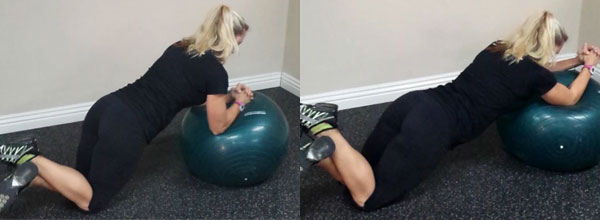
Rollouts
Targeted Muscles: Abs, back, chest and ats
The Movement: Bend your elbows at 90 degrees and place them on the top of a stability ball. Place your knees on the floor so that your knees, hips and shoulders are in a straight line. Engage your abs and open your shoulders, pushing the ball forward away from your body. Roll the ball out as far as you can without breaking the straight line between your knees and shoulders. Engage your abs and upper body, and then roll the ball back toward your body.
Challenge: For an added challenge, place your feet on the floor instead of your knees.
The Exercise: Bulgarian Split Squat
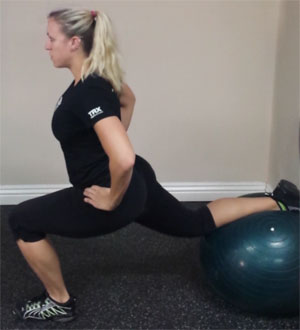
Bulgarian Split Squat
Targeted Muscles: Glutes and hamstrings
The Movement: Place the ball against a wall. Stand facing away, about 2 to 3 feet from the ball. Place the top of your left foot on the ball, so that you feel a slight stretch in your left hip flexor. Keep your shoulders square and chest up, and engage your core. Once balance is established, bend your right knee, keeping your right knee directly over your foot so that your shin remains vertical. Go as low as you can. Push through your right heel and stand back up. Repeat 10 to 15 times, and then switch legs.
Modification: To modify the exercise, start with a half squat, just to establish balance. You can also place the ball in a corner to prevent lateral shifting of the ball.
Challenge: If you have great balance and want an extra challenge, try this exercise without a wall behind the ball. As you lower, push the ball back with your foot, and then as you stand back up, pull it back in to starting position. You can also try holding on to dumbbells for more glute/hamstring activation.
The Exercise: Plank Variations
Targeted Muscles: All muscles depending on variation, but especially the abs, glutes, lower back and hips
The Movement: Set up is similar to the rollouts. Place your elbows on the ball and your feet behind you on the floor; maintain a straight line from ankles to hips to shoulders. Do not allow your upper body to collapse onto your elbows; rather, keep an open angle between your arms and torso, and keep your visual focus on your hands. Start by holding a plank. Once you can hold a plank for 30 seconds without breaking form, progress to plank variations.
The Variations: Lift alternating legs while maintaining a tight plank. Try lifting one leg up and then out to the side 1 to 2 feet while holding the plank. Try lifting one arm out to the front, and then out to the side. Alternately bring one knee in to touch the ball just below your chest. Alternately bring one knee out to the side and then forward to touch the ball on the outside of your elbow. Try a side plank by propping yourself on your right elbow, with your left hand on your hip, and then switch sides.
The Exercise: Glute/Ham/Low Back Extensions
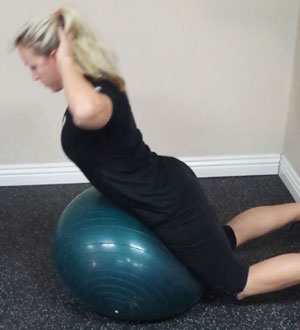
Stability Ball Exercise
Targeted Muscles: Upper and lower back, glutes and hamstrings
The Movement: Lie prone (facedown) with the stability ball positioned under your hips and your feet pressed flat against a wall. Bend your knees so you “hug” the ball between your torso and knees. Place your hands behind your head and lift your torso, hinging at the hips, by pressing your feet against the wall. Keep your back straight throughout the exercise. Finish with your knees, hips and shoulders in a straight line at about a 45-degree angle from the wall. Be careful not to overarch your back. Bend at the hips and lower back down until your stomach contacts the ball again.
Challenge:  Hold a 5-pound medicine ball at your chest while completing the movement. Alternatively, hold 5-pound dumbbells in each hand and perform a reverse fly as you lift.
The Exercise: Push-ups
Targeted Muscles: Chest, triceps, abs, core, glutes and back
The Movement: Place your shins on the stability ball and your hands on the floor so you are in push-up position. Bend your elbows and lower yourself to the ground. Finish with your chest between your hands, keeping a tight, straight back during the whole movement. Squeeze your abs to keep the ball from rolling laterally.
Modification: To make this exercise a little easier, start with the ball closer to your torso, on your thighs or knees. As you get stronger, try to roll the ball back a little more each time, until you can eventually do push-ups with your feet on the ball.
Challenge: To make ball push-ups harder, engage your abs by adding a knee tuck after each rep—bend your knees and roll the ball to your chest. Straighten your legs back out and repeat the next push-up. You can also lift one leg about 6 inches above the ball while performing the push-up. To activate more upper-body stabilizer muscles, place your feet on the floor and put your hands on the ball to do your push-ups.

Source 

Monday, 26 January 2015

6 Exercise Swaps for a More Effective Workout

One of the most common ways to learn how to exercise in a gym is by watching others go through their workouts. I’m sure most of us, at one time or another, have tried an exercise after watching someone else perform the movement. But just because someone with a buff body is doing an exercise does not mean that particular exercise is effective. In fact, there are many exercises that seem to be producing a desired outcome, yet aren’t really creating a beneficial physiological response. If you’re doing certain exercises because you saw other gym goers do them, you might want to consider trying these exercises instead: 

If you want to work your chest…
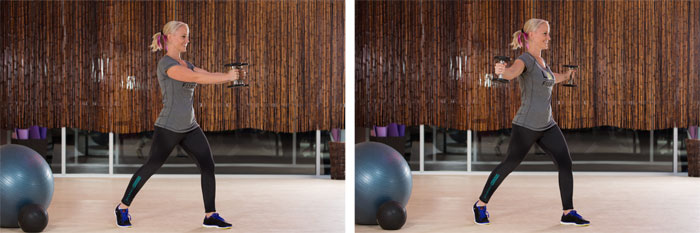
Instead of This: Standing Chest Flys With Dumbbells
standing chest flys
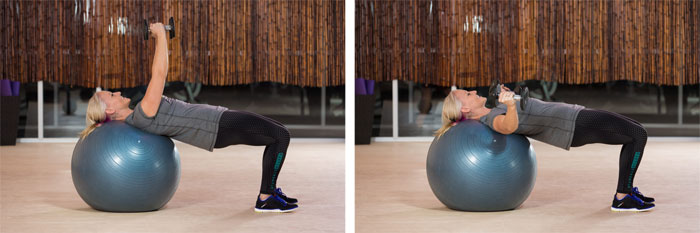
Do This: Lying Flys 
lying flys
When the goal is to strengthen the chest muscles, the load should be placed directly into the pectoralis major and minor, as is the case with push-ups, the bench press, pec-deck machine, or flys with dumbbells or cables. This is because the pull of resistance is lined up directly with the muscles, so when they shorten they are generating the greatest amount of force to move the shoulder joint. When doing chest flys while standing and holding dumbbells, the deltoid muscles of the shoulder are doing most of the work, while the pectoralis major or minor act as secondary muscles, which makes it more of a shoulder exercise than a chest exercise. If an instructor has you doing this exercise and says it’s for your shoulders, however, that’s fine.

If you want to work your glutes… 
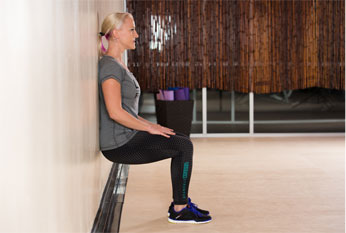
Instead of This: Wall Sit 
wall sit
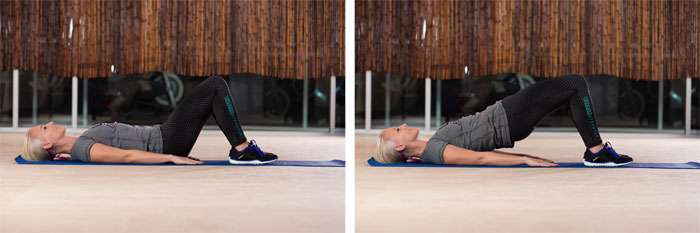
Do This: Glute Bridge
glute bridge
The purpose of squats is to strengthen and tone the muscles of the butt, thighs and hips. The most effective way to strengthen a muscle and develop definition is to take it through a full range of motion (ROM), which includes lengthening as well as shortening the involved muscle fibers. During a wall sit, an exercise featuring an isometric (non-moving) contraction, muscles are shortening, but they are not making the transition from lengthening to shortening because only a finite amount of muscle fibers are engaged. Compare that to an exercise like a regular squat where the muscles transition from lengthening to shortening through a complete ROM, which covers much more distance and allows more work to be completed. A wall sit makes you feel like your muscles are burning, but that is because they are holding static, non-moving contractions. The actual strength benefits, however, are minimal. The glute bridge is a better option because they take the hips through a full ROM. The benefit of lying on the ground is that it focuses the work on the hip extensor muscles of the glutes, hamstrings and adductors. 

If you want to work your inner thighs… 
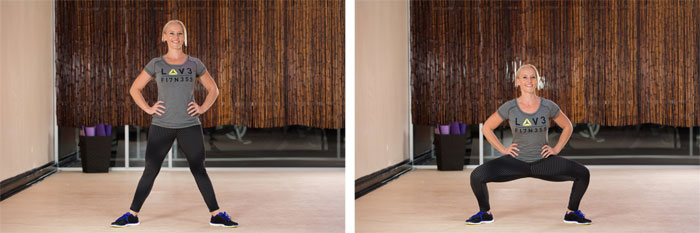
Instead of This: Plié Squats 
plie squats
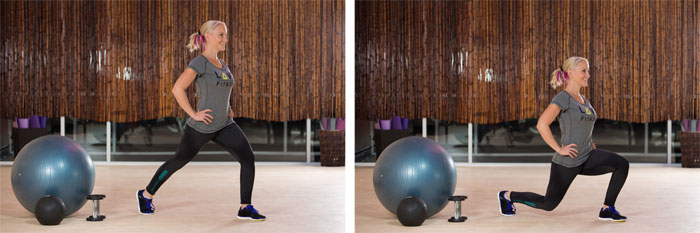
Do This: Lunges 
lunges
Plié squats are often done to create the perception of working the adductor muscles of the inner thigh. When the feet are in a plié position, the hips are in external rotation, which does lengthen the adductor muscles of the inner thigh. Holding this position tricks you into feeling your inner thigh because those muscles are being stretched during the motion. However, just because you feel a stretch doesn’t mean those muscles are doing more work. Understanding how a muscle works during gait can help us determine the best way to train that muscle with exercise. The adductor muscles of the inner thigh are responsible for creating hip flexion and extension during gait. They can bring the leg closer to the midline of the body (adduction), but should be trained with exercises that emphasize extension and flexion of the hip to help prepare the muscles for the forces they experience during normal movement patterns. Plié squats won’t necessarily increase your risk of injury, but they don’t provide the best option for training the adductor muscles. Don’t be fooled—if you really want to strengthen and tone your inner thigh muscles, do single leg step-ups, lunges or single-leg squats to engage all of the hip muscles.  

If you want to work your inner and outer thighs…
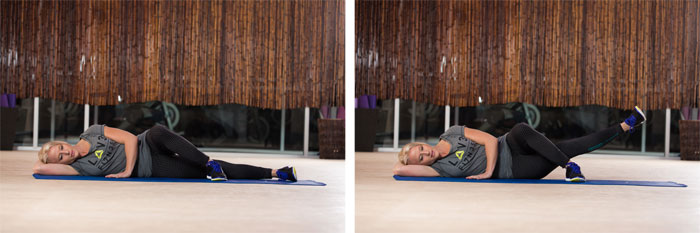
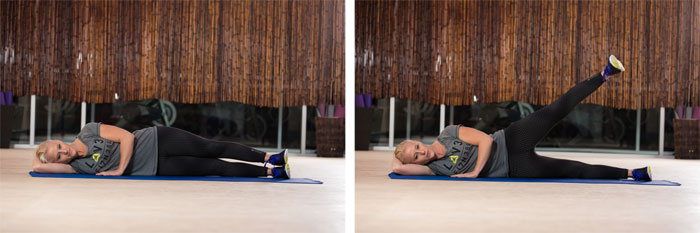
Instead of This: Lying Inner/Outer Thigh Leg Lifts 
inner thigh raises
outer thigh lifts
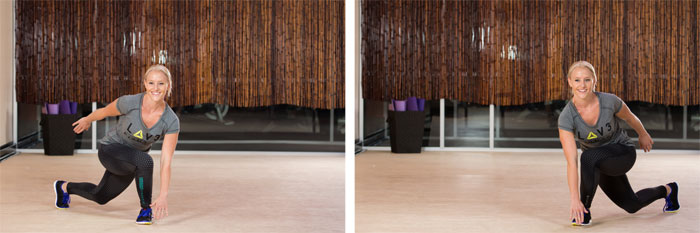
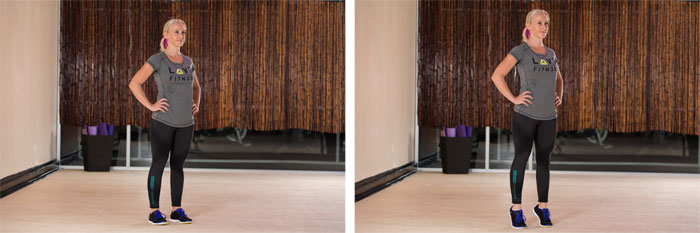
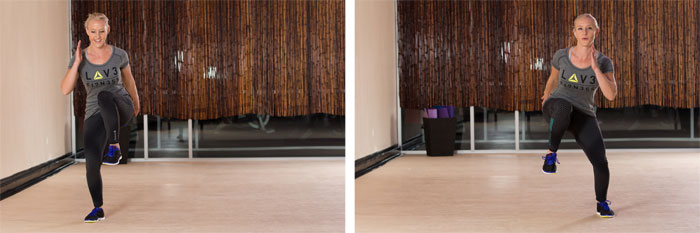
Do This: Ice Skaters 
ice skaters
Lying on your side and lifting your legs off of the ground can help you feel like you’re using the muscles of the inner and outer thigh, but this is not the case. Again, we need to understand how these muscles actually function during gait to determine the most effective way to use them during exercise. Traditional anatomy teaches that the muscles of the outer thigh work to move the leg away from the midline of the body. However, during the gait cycle the muscles that move the leg away from the body actually work to stabilize the body when you’re standing on one leg. For example, when you’re walking, your right outer-thigh muscles stabilize your body when you are balancing on your right leg and your left leg is swinging through the air. The most effective way to strengthen your outer-thigh muscles is to do single-leg exercises like step-ups, lunges or ice-skater (lateral) bounds. While leg lifts are unlikely to cause an injury, they are not the best use of your limited exercise time. 

If you want to work your abs… 
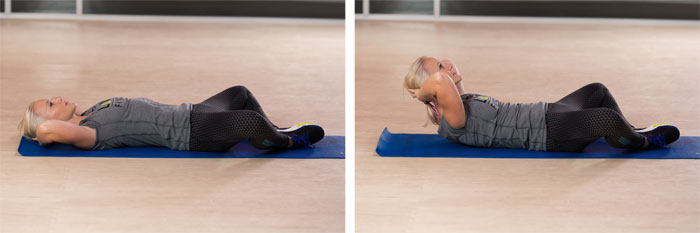
Instead of This: Frog Leg Crunch 
frog leg crunches
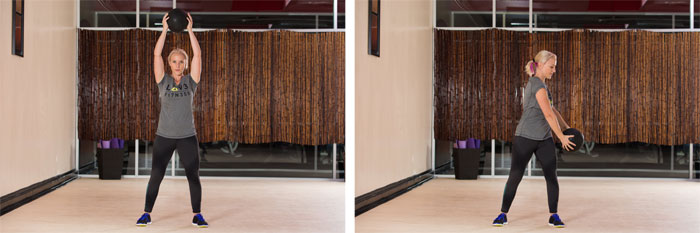
Do This: Medicine Ball Chops 
medicine ball chop
The idea behind frog-leg crunches is that placing the hips in an abducted position (with the upper thighs and knees touching the floor) will recruit the lower abs. The standard crunch involves using the abdominal muscles to roll the rib cage toward the pelvis, which can strengthen these muscles, but does not train them the way they are actually used during upright movement patterns. If your ab muscles were really responsible for flexing your spine, you would walk around bending forward every time your foot hit the ground. During gait, the six-pack muscle of the rectus abdominis is involved in decelerating the anterior (forward) rotation of the pelvis, while the external obliques are responsible for assisting with rotation of the trunk. While lying on the floor to train the abs can create the perception of muscle involvement and can be useful for individuals training for specific appearance-based goals, if you want to train your body the way it was actually designed to function, then consider training your core from a standing position. Medicine ball chops, for example, involve the muscles of the hips, thighs, back and shoulder, which can all be considered core muscles because of their attachments to the spine and pelvis. Start with the medicine ball near the right hip, sink into a quarter squat, and then use the hips and arms together to push the ball overhead before bringing it down to the left hip; alternate from side to side. 

If you want to work your calves… 
Instead of This: Toe Raises 
toe raises
Do This: The Heisman 
the heisman
Standard toe raises are great for strengthening and toning the calves because this exercise focuses on the concentric action of muscle shortening, which can increase size and definition. However, the function of the calf muscles during dynamic movements such as walking, running or jumping is to help decelerate the force of the body hitting the ground. As a result, the calves can experience extremely large lengthening forces. This means that exercises that focus on the shortening action of the muscles do not adequately prepare the muscles for the forces they frequently experience. Toe raises can make a calf stronger, but this exercise also increases muscle tightness, which can be a liability during explosive movements when the calves are required to rapidly lengthen as the foot hits the ground. In addition, people who wear shoes with an elevated heel keep their calves in a shortened position all day. Doing additional exercises to shorten the muscle could lead to a muscle imbalance along with potential knee or hip soreness. If you want to strengthen and tone your calves, adding sprints or agility drills to your workouts, such as the Heisman, are better options. 
If you only have a limited amount of time to exercise, it’s worth taking the time to take a close look at your exercise selection and focus on the ones that will provide the greatest benefits. If you have any questions about how to perform these exercises, consider investing in a few training sessions with an ACE Certified Personal Trainer who can provide the guidance you need to meet your fitness goals in the shortest amount of time possible.