Showing posts with label toning. Show all posts

Thursday, 30 July 2015

The Ultimate 30-Minute Cardio Pilates Workout!

When you combine Pilates, hand weights, and cardio, you get one wicked
workout. And by wicked, we mean really fun and really effective. Lisa
Corsello, the founder of Burn SF, leads you through 30 minutes of her
signature fitness routine, weaving Pilates core exercise with classic
lifting moves and cardio bursts. This workout is so varied that you will
never get bored.

Sunday, 19 July 2015

Victoria's Secret Model Workout: 20-Minute Body-Sculpting Moves

This 20-minute body-sculpting workout helps get Victoria's Secret model
Alessandra Ambrosio runway ready. Created by Allessandra's trainer
Heather Dorak, founder of Pilates Platinum, the workout is loaded with
moves to work multiple body parts are once. And that makes it efficient
for toning your body and great for torching calories. Press play and get
ready to work out like an Angel.

Friday, 10 July 2015

CrossFit Workout With Weights | Full-Body Exercise | Class FitSugar

Grab a set of dumbbells and get ready to get your CrossFit on with Reebok ambassador Yumi Lee. In this 10-minute workout, Yumi leads you through three rounds of full-body exercises. The moves are simple, but the pace makes it intense. It's an efficient workout that will work you from head to toe. Press "play," and get ready to sweat.

Thursday, 11 June 2015

10 Yoga Poses for Weight Loss: 5 Basic Poses and 5 Poses for Weight Loss


Yoga is an excellent technique to relax the body and raise flexibility. It’s also great for toning muscles, and increasing strength and balance. If you’re looking for some beginner information about yoga for weight loss, this blog will give you five basic positions and five positions for weight loss. Beginners of yoga should use a yoga mat or carpeted area for their poses. Also, remember to breathe.

Five Basic Positions

1. The Mountain Pose


Stand with feet slightly apart, shoulders relaxed and your arms at your side. Breathe in and lift your arms up and over your head. Your palms should be facing each other, and your arms should be straight. Reach up toward the sky with your fingertips. Exhale as you lower your arms to your sides once more. Your movements should be fluid and easy. Don’t overextend yourself, or you’ll hurt your muscles. This move is great as a warm-up to stretch your muscles.

2. The Child’s Pose

Sit back on your heels with your shins to the floor. Draw your chest forward and rest your forehead on the mat or carpet before you. Lower yourself as close to your knees as you can, and extend your arms out in front of you. Inhale and exhale as you hold this pose. Like the pose above, this is a great warm-up, or you can use it as a cool-down after your workout.

3. The Downward Dog Pose

You start in this position on all fours, hands directly beneath your shoulders and knees directly under your hips. Move your hands forward a few inches and spread your fingers apart. Press your palms into the mat or carpet, and bring your hips upward into an upside down V position. Your knees should be slightly bent to avoid locking them and cutting off circulation. Hold this position as you inhale and exhale three times.

4. The Cobra Pose


You will begin this pose by lying facedown on the ground with your thumbs beneath your shoulders and the tops of your feet against the floor. Pushing your hands into the floor, lift your chest off of the floor so your back is curved. Remember, don’t push yourself too hard. Return to the floor, and repeat the position.

5. The Warrior I Pose


warrior1pose
You will begin this pose by standing with your arms at your sides, like the mountain pose. Step forward with your left foot so your feet are about three to four feet apart. Turn your left foot inward slightly and your right foot ninety degrees. Bend your left knee ninety degrees, and straighten your right leg, and raise your arms up over your head. Hold this pose for one minute, or as long as you can manage, then switch sides and repeat.

Five Weight Loss Positions

1. The Warrior II Pose (Works the abs, hips, and thighs)


This move is similar to the Warrior I pose. Like the Warrior I pose, you will begin by standing with your arms at your sides. You will step forward with your left foot, again separating your feet by about three or four feet. You will turn your left foot slightly inward and your right foot ninety degrees. Bend your left knee ninety degrees, and straighten your right leg. This time, instead of raising your arms up over your head, you will spread your left arm parallel to your left leg, and your right arm will be parallel to the floor and above your right leg. Looking out over your left arm, you will hold this pose for one minute, switch sides, and repeat.

2. The Tree Pose (Works the sides of the abs)


treepose (1)
In this pose, you will begin by standing with your arms at your sides. Place the bottom of your left foot in the side of your right thigh with your knee bent to the side. Lift your arms and press your hands palms together in front of your chest. Inhale and exhale two times then lift your arms above your head as you inhale a third time, palms still facing inward and fingers stretched toward the ceiling. Exhale then inhale and bend your torso to the left. Inhale, and straighten your toros. Repeat this move three to five times then switch sides. Please note that this move requires some balance so please be careful as you do this move.

3. The Rocking Boat Pose (Works the abs and back)

rockingboatpose
Sit on the mat or carpet with your knees bent and your feet flat on the floor. Your hands should be on your thighs with your torso and head straight. Lean back 45 degrees, and lift your legs so your feet point up toward the ceiling about 45 degrees off the ground making a V shape with your body. Extend your arms so they’re parallel to the floor. Repeat three to five times.

4. The Bow Pose (Works the arms, legs, and abs)


bowpose
Lie on your stomach on the mat or carpet. Bend your knees and bring your feet toward your head. Reach around with your arms, and grasp your ankles. Lift your shoulders from the floor as you pull on your ankles. Hold as you breath in and out then release.

5. The Side-Stretch Pose (Works the abs, arms, and legs)


sidestretchpose
Stand and separate your feet a little wider than your hips. Turn your chest and your feet to the right, and bend forward. Keep your legs straight as you bend over your right leg until your chest is parallel to the ground. Reach toward the floor with your hands, bending down more each time you exhale. Repeat the move toward the left.

Things to Remember

Although yoga doesn’t seem as hard of a workout as walking or running, you still have to remember to stay hydrated and breathe. Also, if you’re more of a visual learner, you might want to consider taking a yoga class.

Sunday, 26 April 2015

The Difference in Female Bodybuilding, Figure Competitions, Bikini Contests, and Women's Physique

If you are new to the sport of figure competitions and women's physique contests you may have seen those glamorous figure models on the cover of magazines and on websites.
If you ever had the desire or goal to look like one of these figure models and sport the look of fabulous and sexy muscle, then here are a few quick and easy tips and guidelines to help you decide on your new fitness journey.

Female Bodybuilding - The whole women's fitness movement began with female bodybuilding contests, the first legit one starting in 1978. From then on the women became more and more competitive, working harder to gain more muscle and decrease body fat. Female bodybuilders had perfected the sport by the late 1990's and competition was so great that only the best of the best could survive on stage with a chance of going pro.
 

 Figure Competitions - The popular figure competition is a spawn off of female bodybuilding. It was introduced in 2001 to allow women to compete who didn't want to obtain a great amount of muscle. Figure competitions opened the door so that almost any woman can compete with a chance at placing. However, as the years passed, the figure competitors, too, became more competitive, getting more and more muscular and defined. This division also became somewhat secluded where only the best of the best could place well and become pro.

Bikini Contests - As the figure competitions grew in popularity, so did the competitors muscle, which opened a door to another new division to allows more women to compete on stage without having to build muscle. This new category is the bikini contest. The bikini competitors don't need to display any muscle or definition. They simply have to look good in a bikini and pose according to the guidelines.
 

 Women's Physique Contest - The women's physique contest was introduced in 2010, another new division for women. Basically, the women's physique contest is a lighter version of female bodybuilding. While the women are allowed to have muscle, NPC guidelines state that they can't have striated in muscle detail. Also, there is no lat spread, front and back biceps poses are executed with open hands, and feet must be placed to the side on the front and back poses rather than flat-footed. Also, the side chest pose is executed with arms extended.

To decide with fitness category you would like to compete in it is a good idea to read more on each and attend a competition so you can see the classes and how the women look on stage.


Source Karen Sessions Ezine

Saturday, 4 April 2015

Jillian Michaels: No More Trouble Zones Workout- Circuit 3

Jillian Michaels: No More Trouble Zones Workout- Circuit 3 is an intense
strength-building circuit that is designed to sculpt lean muscle, burn
fat, and tone stubborn problem areas using Jillian's surefire formula
that combines dynamic upper and lower body-toning exercises. Grab a
light set of hand weights and get ready to sweat as America's Toughest
Trainer, Jillian Michaels takes you through the third workout circuit of
her "No More Trouble Zones" Fitness DVD Series that will shape strong
arms, toned legs and buns, and chiseled shoulders. Blast away calories
and melt off the extra pounds as you tone your entire body with this
highly-effective strength training workout that will leave you looking
and feeling your best for summer.

Tuesday, 24 March 2015

10 Popular Fitness Terms Defined

Every subculture has its own terminology for describing its way of life. The health and fitness subculture is no different. A few years ago, complaining about the HIIT in your WOD at your local box would have only made sense to extreme fitness enthusiasts. Thanks to the explosive popularity of CrossFit and other high-intensity training programs, we now know that HIIT refers to high-intensity interval training and WOD is an acronym for the unique Workout of the Day offered at CrossFit training facilities (commonly called a ‘box’). 
Whether you’re new to the fitness scene or have been working out in health clubs for years, you’ve probably heard certain terms thrown around, maybe even used a few yourself without really knowing exactly what they mean. Here are 10 commonly used fitness terms along with a brief explanation of the science behind each one.
Burning 
When it comes to exercise, burning is often used to refer to the feeling of when muscles experience an accumulation of metabolic waste, which creates fatigue. Acidosis is a change in blood acidity—specifically, elevated levels of lactic acid and hydrogen ions—that is often the result of moderate- to high-intensity exercise. A burning sensation in a muscle is an indication of acidosis. It’s also a sign that it is time for a recovery period to allow the body to remove metabolic waste from the working muscles and replenish the nutrients required to continue performing muscle contractions. 
Cardio 
Cardio is short for cardiorespiratory or cardiovascular exercise and refers to exercise that elevates the heart rate to pump oxygen and nutrient-carrying blood to the working muscles. Most often used for exercise performed on equipment like treadmills, elliptical runners or stationary bikes, it is important to know that ANY exercise that elevates the heart rate can provide cardiorespiratory benefits. Circuit training with free-weights or performing an AMRAP (as many rounds of a particular circuit as possible in a given amount of time) can be considered cardiorespiratory exercise. 
Core Training  
This has become one of the most popular and overused fitness terms of the past several years. It seems as if almost any fitness class, workout program or equipment will provide “core training” benefits. The “core” most often refers to the muscles that make up the mid-section of the body, including the ever-elusive six-pack. However, it is much more effective to think of the body’s core as the center of gravity and not an actual group of muscles. When we look at how the body functions during upright movement patterns such as walking, lifting an object off of the ground or moving an object from one place to another, we have to consider the fact that any muscle that attaches to the spine, rib cage or pelvis influences movement around the body’s center of gravity. 
High-intensity Interval Training (HIIT)
We have written previous blogs about the benefits of HIIT here and here. This term makes the list because it is often used to refer to exercise performed at maximal intensity. However, it’s important to remember that intensity can be subjective—what may be low intensity for some may be high intensity for others.
For individuals with a history of being sedentary or who have been dealing with chronic medical conditions that limit their ability to exercise, simply walking continuously for a few minutes at a time could be considered “high intensity.” 
Metabolic Conditioning 
Similar to HIIT, metabolic conditioning is often used to refer to high-intensity exercise performed to the point of being out of breath or experiencing muscle soreness. Here is why this overused term ought to be retired from the lexicon: Metabolism is the chemical process by which a biological organism produces energy for muscular contraction. That means that any exercise requiring a muscle contraction (which in itself requires energy) is a form of metabolic conditioning. Standing from your chair after reading this post requires your metabolism to fuel your muscles. Therefore, it is more appropriate to describe the level of effort required to perform the planned activity, such as low-intensity, moderate-intensity, high-intensity or maximal intensity. 
Mind-body 
This term is commonly used to describe a general mode of exercise such as yoga or Pilates, because they are traditionally performed with bodyweight (with the exception of Pilates programs involving equipment such as a reformer or barrel) and require concentration to execute challenging movement sequences. However, any purposeful movement, whether it’s a biceps curl or downward facing dog, requires conscious effort. Therefore, almost any physical activity that involves learning and executing movement patterns, no matter how basic, requires cognitive focus and should technically be classified as mind-body.   
Muscle Confusion 
A popular consumer-oriented fitness program claims to be based on the science of “muscle confusion.” This is simply a marketing term created to describe the physiological effect of periodization, which is a method of organizing exercise programs based on alternating periods of intensity. The concept of periodization was developed by Soviet Union sport scientists who recognized that periods of high-intensity exercise (high stress) should be followed by a period of low-intensity exercise (low stress) to let the body to fully recover from the workouts and allow the time for the physiological adaptations to occur. 
Plyometrics 
Many programs or fitness classes refer to using plyos, which is short for plyometrics. Looking at the etiology of the word, ‘plyo’ (from pleio) is a pre-fix for “more” and metric refers to length; therefore, plyometric means “more length.” This describes the physiological affect of the involved muscles during jump training (the most common application for the lower body) or explosive movements such as medicine ball throws (often used for upper-body plyometric training).  
Plyometric training was developed by Soviet sport scientists who originally referred to it as “shock training” because of the high forces experienced by the involved tissue. That’s why it’s important to perform only a few repetitions at a time to achieve the highest level of force output possible. Any program requiring participants to perform more than five or six rapid movements (i.e., jumps or explosive lifts) in a row can significantly increase the risk of injury by placing too much force on the involved tissue. 
Tabata  
A number of exercise programs and classes are called Tabata, which is an actual person. Twenty years ago, Dr. Izumi Tabata, an exercise scientist from Japan, and his colleagues conducted research on ways to improve aerobic capacity using short intervals of extremely high-intensity exercise. They found that exercising at 170% of aerobic capacity on cycle ergometers for a work interval of 20 seconds followed by a brief recovery interval of only 10 seconds, repeated to exhaustion, was extremely effective at boosting aerobic capacity. Since publishing the study in 1997, Dr. Tabata’s name has been used to refer to a protocol of high-intensity interval training featuring 20-second work intervals followed by 10-second recovery intervals for eight cycles (a total of four minutes).  
Toning 
If you ask most people what their general fitness goals, the answer often is to “tone up and get in shape.” We have come to accept the term “tone” to mean muscular definition, or the appearance of a well-defined muscle. The term is actually short for tonus, which is the technical term used to describe a state of contraction in a normally functioning muscle. Using a muscle repeatedly during a strength training exercise will leave that muscle in a state of semi-contraction, creating the defined appearance we have come to expect as the result of exercise.

Saturday, 14 March 2015

Jillian Michaels: Yoga Meltdown Level 1

Yoga Meltdown Level 1 is designed to sculpt muscle, burn fat, and tone
your entire body fast! Begin with a gentle vinyasa, then kick up the
intensity with a series of yoga poses combined with Jillian's signature
exercises that focus on flow and form to build core strength and enhance
results.

Wednesday, 18 February 2015

Get Toned Thighs With These Inner Thigh Exercises

So You Want to Tone Your Inner Thighs
Which of the inner thigh exercises it the best? This a question I hear so frequently from my female clients and if there is one thing I have learned is that the waist, hips, and thigh region of women are the areas that want to improve the most. As this is the problem area for most women they all want to find the quick fast solution to solve the problem and want it yesterday. With these exercises and a few weeks you will have better looking thighs then you thought you could.

Seated Butterfly
The seated butterfly is a inner thigh exercise that requires you to start by sitting on an exercise mat with your back in an upright position. What you need to then do is bring the bottom of your feet together and make them come as close to your body as possible. Let both of your hands rest on your feet and apply a little pressure on your thighs. You will need to hold this position from 30-45 seconds and if you push on your knees gently using your hands the exercise will be the most effective.

Standing Leg Adduction With Fitness Bands
Start with a fitness band attached to a secure place like a door and attach the other end to your right ankle. With the support of a rail or chair and the weight on your other leg, move the right leg past the left leg until your feel a contraction in the leg and then slowly and carefully return the leg back to the starting position. Do 20 repetitions for your right leg then repeat the same for your left leg.
Side Lunges
Stand with your feet parallel and hip-width apart and make sure you place your hands behind your head. Tighten up your stomach muscles to brace yourself while keeping your head forward and weight on your heels. Lunge to the right while keeping the weight of your body over your heels and your left leg straight. Sit back on the heel of the lunging leg and hold the tension in the side leg, then while exhaling raise your body straight up and return to starting position.

Single Leg Circle
Begin by lying on your back on a mat with your arms on the mat by your sides with your palms down. Point your left foot up so that your legs and toes are reaching towards the ceiling and trace a circle on the ceiling with your leg. Make sure that you are moving your whole leg while your hips are still without coming off of the floor. Trace the circle 5 to 10 times in a clockwise direction then again in the counter clockwise direction.

Source

Tuesday, 17 February 2015

Dance Fitness Anytime Anywhere Workout Amazing Benefits

Dance and music are not only forms of art, but they are your way to good health and happiness.
There are various kinds of dance forms, but you need to find out what amuses you and which form of dance interests you the most, and you fill find developing a passion towards it.

You can dance at your convenience, while bathing, while changing your clothes or while just cleaning your room.


 Listed below are the primary benefits of dancing:
1. Dropping calories and toning down your body
As you dance with vigor, you are exercising the parts of your body, and this helps you to burn calories and drop a few pounds. Let's just say dance is the best workout.
It is imperative to hydrate yourself time and again, and keep drinking water as you perspire from the vigorous dancing.
Make it your passion, and dance regularly, and you will be surprised to see how many pounds you have actually dropped!
2. Movement Skills & Coordination
Dancing is nothing but grooving and moving in co-ordination with the music. Hence while dancing you begin to develop and nurture movement skills as well as good co-ordination. More often than not models, actors and people in the glamour industry incorporate dance forms in their workout routine because this helps them on screen as well as on the runway. Dancing makes you more agile, flexible and more graceful as well.
3. The perfect stress buster
Dancing is the perfect stress buster because when you are dancing, it is just your body and the music and you can shut the world out. You don't need to go out of the way, you can just put on some beats and dance while vacuum cleaning or in the shower after a long stressful day of work and you will feel fresh and vibrant after that.
4. Helps our Brain
Various dance forms require a lot of co-ordination and attentiveness which have various benefits for the brain. It does not only improve memory by attempting to memorize the steps, but also keeps the brain alert and attentive.
5. Toughens up & Tones our Body
The majority of muscles in our body are forced to work during dance. Consequently, they tighten up with continuous dancing and help in giving you a perfect toned body. However, keep in mind that muscles which aren't used waste away. Hence make sure to get the volume high and dance for minimum of half an hour before hitting the bed.
6. Confidence booster
People can be shy, have stage fright and may have persisting self-doubt and hence will never be able to perform in front of an audience. Dance and repeated dance practices will be a confidence booster because you will ace your dance moves. If you are scared or apprehensive, you can take private lessons and perform during small gatherings or family functions.
7. A great platform to connect with others
Dancing helps in connecting with new likeminded individuals who have equal passion for music, which helps in making new friends. Besides this, happiness toughens up the immune system for a better health.
8. A good Hobby
If you don't have a hobby and you are lethargic and bored, you tend to eat a lot of carbs and sugar, or even go into depression so in your free time, you can just dance at home as a hobby. You don't even need to be alone, you can find people with similar interests and call them over and dance together. You can even do this with your spouse and dance on slow music.
9. Keeps you healthy
Helps in Preventing Diseases & Medical Conditions
Dancing increases your heart rate and increases blood circulation which prevents diseases and medical conditions in your body.

Dance does not only increase heart rate but also helps eliminate toxins from your body and it de-stresses you. Hence, keeping you healthy- physically as well as emotionally!
Just make sure that you don't have any medical condition which will aggravate with dancing.

Source

Sunday, 8 February 2015

Pilates Ball Exercises: Strengthen and Tone with These Simple Steps

Exercise is great for your health, but not many people get excited about it until they find the one exercise that clicks with them. The Pilates exercise routine is one of the best loved exercise routines of all. The exercise program was pioneered by the man whose name it carries, Joseph Pilates, a German physical-culturist. Mr. Pilates wanted to design an exercise system that would strengthen the body as well as the mind. He designed this program using his knowledge of German practices of physical trainings that were believed to cure illnesses. Therefore, Pilates is very similar to therapeutic “corrective exercise” and “medical gymnastics”. For these reasons and more, you should try Pilates ball exercises. A great place to start is with this Udemy course, Pilates Fitness.Many Pilates’ enthusiasts claim that their flexibility, posture, motion, circulation, and abdominal strength have all improved significantly. Joseph Pilates claimed that he has been in perfect health since putting these exercises into practice and has not taken an aspirin nor has he sustained any injuries. Pilates exercise is recommended for stretching muscles and realigning problem areas that have become misaligned. This exercise is also great for strengthening muscle tone in all parts of the body because every muscle group is used and trained during the exercise.
Pilates is useful for relaxation and as a stress reliever. The entire body is involved in the workout program because it emphasizes inhaling and exhaling while holding the body in a particular position. Deep, even breathing is known to be a calming influence, and you must concentrate while performing the workout exercises. Your mind cannot be wandering all over the place, and this also helps you relax, thereby reducing stress. Focusing on the individual exercises improves your concentration levels and also transfers to other areas of life.

Types of Pilates Ball Workouts:

Chest Lift Workout
In this workout, you must sit on the exercise ball and keep your feet flat and legs parallel. Next, you move your feet out while you roll down until the ball is below your shoulders. Place your hands behind your head and keep the elbows and chest wide, and then, inhale. Wait a moment, and then, exhale. Tighten your abdominal muscles; move your head so that you are looking to the left, and then, turn your head to look to the right. Roll your upper body up to a sitting position. Sit still and inhale. Exhale and repeat.
Bridge Workout
This exercise begins with you lying flat on your back with your calves resting on the ball and your feet on top of it. Your feet and legs should be parallel throughout this exercise. Next, inhale and exhale. Lift your hips off the floor without moving the ball. Balance using your shoulders. Hold this position steady for two to four breaths, and then exhale while relaxing back to the mat.
Pike Workout
To perform the pike exercise, you must have practiced the plank pose successfully on the mat without the ball. For the pike exercise, you begin with the ball beneath your thighs.Your legs are extended straight out behind you, and your shoulders are rotated down and back in a plank pose. Using your hands to walk forward, shifting the ball’s position from beneath your thighs to beneath your knees or shins. The further forward that you go, the less stable you will be, so perform this exercise with caution.
Back Extension Workout
To do the back extension workout, your body must be draped over the ball, face down toward the floor. It is essential that your abdomen and hips are supported by the ball. For control, your feet must be put where the floor and wall meet. Bend the knees slightly, and exhale while curling the upper body over the ball. Your arms must point toward the floor, but they should not touch the floor. Inhale and lift your arms, use the abdominal muscles and spine to raise the body until it is at a diagonal to the floor. Exhale, roll back (your torso must be parallel to the floor) and curl again. Repeat this process.
Improve Your Posture
This is one of the most simple, yet effective exercises. Sit on the ball. The ball’s instability causes this ordinarily sedentary activity to become a workout. All muscles become involved as you try to stay seated. Your abdominal muscles are tightened and your back is straightened because it is impossible to slouch and remain seated on the ball. This improves your core muscle groups over a period of time.
Leg Squats
The ball must be propped against a wall for this exercise. With your back leaning against the ball, bend your knees into a 90 degree angle. Push yourself back to the starting position. Then, repeat fifteen times.
Catch
This exercise requires a friend. With accountability being an important aspect in any exercise routine, involving a friend will insure that you continue the exercise program. Use the exercise ball and play catch. Stand several feet apart from your friend, and with your feet shoulder width apart, toss the ball to one another. Play “catch” until your arm muscles are fatigued.
Birddogs With the Ball
Balance the ball beneath your abdomen while you are on your hands and knees. Lift and stretch your right arm and left leg off the floor, and then alternate with your left arm and right leg. Reach as far as you can and stretch those muscles while balancing and keeping your hips in a stable position.
Pushups
This exercise is used to strengthen the arms and abdominal muscles. Facing down and draped across the ball, place the exercise ball beneath your abdomen. With your hands on the floor, walk your hands forward into the plank position. The ball can rest in any position between your hips and ankles. Place your hands parallel and bend your elbows to lower your abdomen and chest to the floor. Extend your arms to push up. Repeat this several times.
What you get out of any exercise routine is dependent on how committed you are.. Pilates exercises are easy and cost-effective. Moreover, Pilates ball exercises are designed to improve the mind and body, and the routine is the perfect workout for you if you want to boost both your strength and energy levels.
Pilates can be done by individuals of any age and fitness level.

Source 

Thursday, 4 December 2014

Best toning exercises

All about the base? It's all about intensity with this serious fat-burning circuit

Want to shape up fast? You should try one of our favourite methods of training: Tabata. Think high-intensity intervals, incorporating hardcore 20-second bursts of exercise split up by 10 seconds of rest. Exercises include anything from squats to star jumps. Repeat these 30-second routines for eight bouts for an effective workout that will not only improve your endurance, but also help you perform better for longer at maximum effort, while boosting your metabolism - even after your workout has finished!
Warm up with two minutes of jogging on the spot, then leg swings, to help loosen your muscles and get your body revved up for the session. Next, do the first exercise at maximum intensity for 20 seconds, followed by 10 seconds of rest. Do all four exercises, then repeat so you’ve done a total of eight exercises and been working out for a total of four minutes. Rest for three minutes and repeat the four-minute sequence once more through. Don’t forget to cool down and stretch to stop your muscles seizing up. 

STAR JUMPS:
 
  • - Works: Gluteals, hamstrings, quads, calves, shoulders, core
  • - Time: 20 seconds
  • - Start with your legs together and arms by your sides. In one motion, jump and spread your legs out to the sides and arms out and up over your head.  Land in this position, then return to the starting position and repeat. 

SQUATS:
  • - Works: Gluteals, hamstrings, quads, core
  • - Time: 20 seconds
  • - Stand with your feet hip-width apart and arms down by your sides. Push your hips back and bend your knees to lower into a squat, bringing your hands up to your chest. Push yourself back to the start position.

PLANK UP AND DOWN:
  • - Works: Arms, shoulders, back and core
  • - Time: 20 seconds
  • - Start in a plank position on your forearms, with your palms facing in and belly button pulled into your spine. Walk your left hand in, placing it under your shoulder and pressing your body up, then walk your right hand in so that you end up in a full plank position with both arms straight. Quickly lower your left elbow to the floor, then your right, so you’re back in your elbow plank.

BICYCLE CRUNCH: 
  • - Works: Abs, obliques, hip flexors
  • - Time: 20 seconds 
  • - Lie flat on the floor with your hands behind your ears. Raise your legs a few inches off the floor and lift your shoulders up. Use your abs to drive your left elbow and right knee towards each other, twist back to the centre, then drive your right elbow and left knee towards each other. Continue alternating sides as fast as possible.  
 
 Source

Sunday, 23 November 2014

20-Minute At-home Bodyweight Circuit

For many trainers, the holidays can be a frustrating time. While there’s nothing better than going home for the holidays and spending time with loved ones, this time of year can put a wrench in your clients’ workout routines. Many of you have spent a significant amount of time helping your clients work toward their health and fitness goals, and when they travel for the holidays, it can be hard for them to maintain the same amount of dedication and self-control as they do the rest of the year. The solution? A circuit workout.
Share this workout with your clients before the holiday season to help them burn off those extra calories while getting a total-body challenge. All that is needed for this 20-minute at-home body-weight circuit is a little space in the family room, basement or hotel room.
How-to: Perform each of the following exercises for one minute, resting for 30 seconds in between each exercise. Once you complete each exercise once, take one minute to drink some water and catch your breath. Then go through the entire set once more for a total of 20 minutes.
Warm-up: Begin by jogging lightly for one minute.
1. Pass-through Lunge
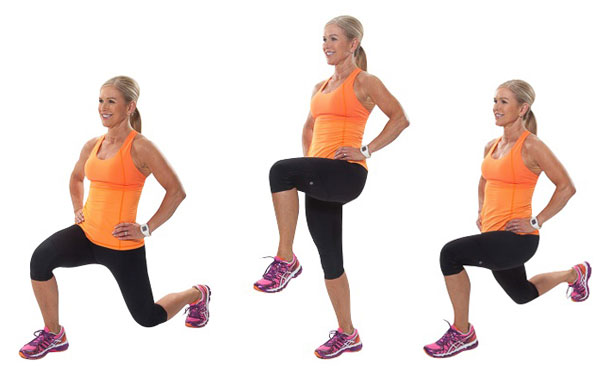
Pass-through Lunge
A. Stand with feet hip-distance apart. Step the right foot behind and lower slowly to a lunge until both legs are at a 90-degree angle.
B. Lift the right leg up and let it float slowly to the front, lowering again to 90-degrees.
C. Push the right foot up again and float it behind you as you did the first time.
Perform for one minute—30 seconds with the right leg, 30 seconds with the left leg; rest for 30 seconds.
2. Globe Hops
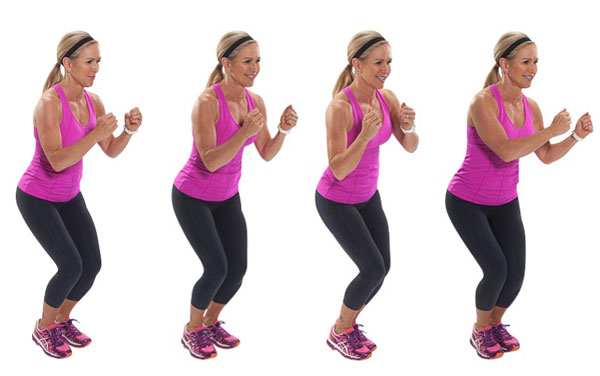
Globe Hops
A. Start standing with feet a few inches apart, arms in guard position at the chest and knees slightly bent.
B. Jump forward, back, right and then left (like the directions on a globe: north, south, east, west). Continue jumping NSEW for 30 seconds and then switch directions to NSWE or front, back, left, right for the next 30 seconds.
Jump for one minute and then rest for 30 seconds.
3. Shoulder Tap Push-up
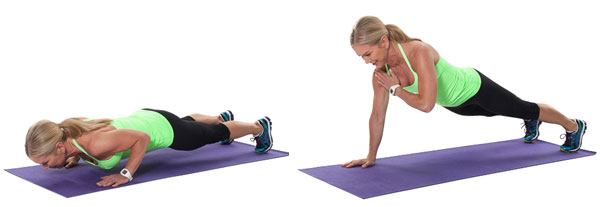
Shoulder Tap Push-up
A. Begin in a plank position with the hands directly under the shoulders and feet hip-width apart. Keep the abdominals and legs tight as you slowly lower the chest toward the ground with the elbows bending and pointing behind you.
B. Exhale as you push back up to lengthen the arms into high-plank position. Lift the right hand to tap your left shoulder at the top and then repeat with the other arm.
Do as many repetitions as you can for one minute and then rest for 30 seconds.
4. Burpees
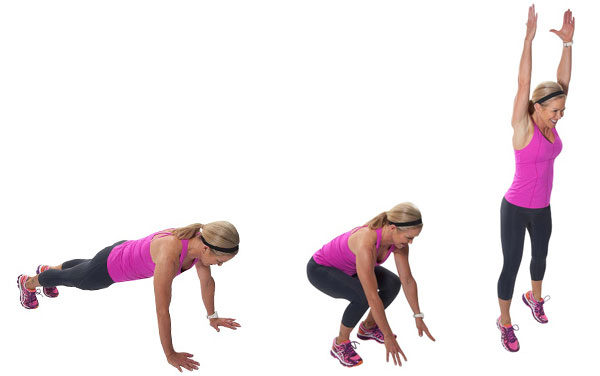
Burpees
A. Start in a plank position with arms and legs long, and hands shoulder-distance apart.
B. Walk or jump both feet between your hands, coming into a low squat position. Jump straight up as high as possible, land, and come back to your plank position.
Do as many burpees as you can for one minute and then rest for 30 seconds.
5. Side Squat
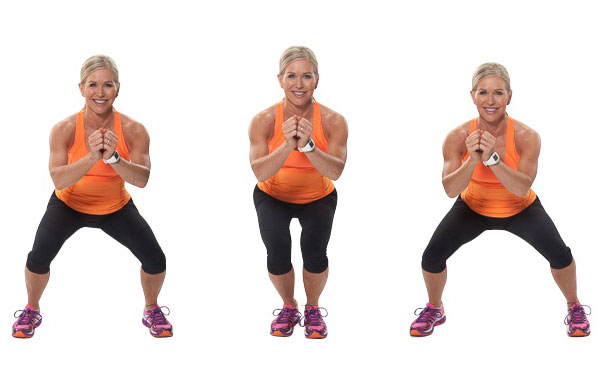
Side squat
A. Start standing with feet hip-distance apart and sit back into a squat position by bending the knees.
B. Keep your abs tight and back straight. Step to one side, staying in your squat position. Return to your starting position and then side squat in the other direction, using all your lower-body muscles.
Perform for one minute and then rest for 30 seconds.
6. Army Crawl Plank
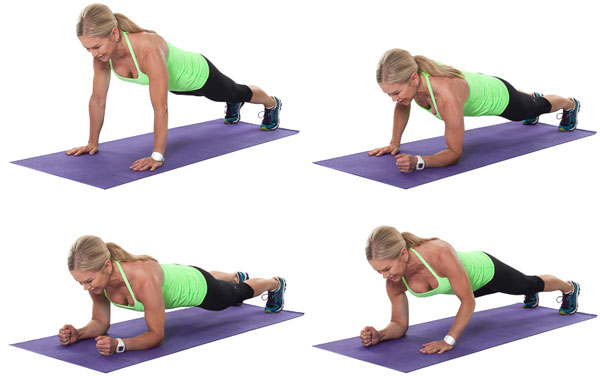
Army Crawl Plank
A. Begin in a plank position with your shoulders over your wrists, feet together and your body in a straight line.
B. Bend your left arm and then your right to assume forearm plank position.
C. Lift your left hand and place it on the mat directly below your shoulder as you push through your palm to lift back up into plank position.
D. As you reach the top, place your right palm on the floor under your right shoulder and push back into a full plank. Repeat, leading with the right arm. 
Perform for one minute, leading first with the left arm for 30 seconds and then with the right for the remaining 30 seconds. Rest for 30 seconds.

Source

Tuesday, 18 November 2014

8 Benefits of High-Intensity Interval Training (HIIT)

And why it needs to be part of your regular workout routine

High-intensity interval training (HIIT) describes any workout that alternates between intense bursts of activity and fixed periods of less-intense activity or even complete rest. For example, a good starter workout is running as fast as you can for 1 minute and then walking for 2 minutes. Repeat that 3-minute interval five times for a 15-minute, fat-blasting workout. It sounds too simple to be effective, but science doesn't stretch the truth. Read on for eight proven benefits of HIIT:

Super-efficient HIIT is the ideal workout for a busy schedule—whether you want to squeeze in a workout during your lunch break or to get in shape for a fast-approaching event. Research shows you can achieve more progress in a mere 15 minutes of interval training (done three times a week) than the girl jogging on the treadmill for an hour. (Watch and try this video of a 10-minute fat-blasting cardio routine that burns more calories than a half hour on the treadmill!) And according to a 2011 study presented at the American College of Sports Medicine Annual Meeting, just 2 weeks of high-intensity intervals improves your aerobic capacity as much as 6 to 8 weeks of endurance training.
That's not even the best part! Using the Tabata training method, you can complete an effective HIIT workout in just 4 minutes.
 Burn More Fat
Not only do you burn more calories during a HIIT workout, but the effect of all that intense exertion kicks your body's repair cycle into hyperdrive. That means you burn more fat and calories in the 24 hours after a HIIT workout than you do after, say, a steady-pace run.


Healthier Heart

Most people aren't used to pushing into the anaerobic zone (that lovely place where you can't breathe and you feel like your heart is trying to jump out of your chest). But in this case, extreme training produces extreme results. One 2006 study found that after 8 weeks of doing HIIT workouts, subjects could bicycle twice as long as they could before the study, while maintaining the same pace.


No Equipment Necessary

Running, biking, jump roping, and rowing all work great for HIIT, but you don't need any equipment to get it done. High knees, fast feet, or anything plyometric like jumping lunges work just as well to get your heart rate up fast. In fact, some equipment like dumbbells can make HIIT less effective because you want the focus to be on pushing your heart to its max, not your biceps.

Lose Weight, Not Muscle

Anyone who has been on a diet knows that it's hard to not lose muscle mass along with fat. While steady state cardio seems to encourage muscle loss, studies show that both weight training and HIIT workouts allow dieters to preserve their hard-earned muscles while ensuring most of the weight lost comes from fat stores. Win/win!


Increase Metabolism

In addition to increased fat burning and more muscle preserved, HIIT stimulates production of your human growth hormone (HGH) by up to 450 percent during the 24 hours after you finish your workout. This is great news since HGH is not only responsible for increased caloric burn but also slows down the aging process, making you younger both inside and out!

Do It Anywhere

You can do it in a boat, you can do it with a goat. You can do it here or there, you can do it anywhere! Dr. Seuss would have loved HIIT. Since it's such a simple concept—go at maximum effort for a short period of time followed by a recovery period and repeat—you can adapt it to whatever time and space constraints you have.


Challenging
This is not a workout you can do while reading a magazine or chatting with your friend. Because it's so short, you will be working hard the whole time. The trade-off is this format offers seasoned exercisers a new challenge and new exercisers a quick way to see results. You may be in pain, you may be sucking wind, but you definitely won't be bored!
 Source


Sunday, 16 November 2014

IFBB Bikini Pro Anna Virmajoki Talks

Quick stats:

Age: 27
Weight: 135lbs.
Height: 5’8”
Anna Virmajoki

How did you get started?

I discovered the world of fitness when I was in high school. At first I did aerobics classes, and little by little after I gained more confidence I moved to the weight room. I remember flipping through a fitness magazine and thinking that “One day I want to look like these girls!” At that time my English wasn’t that good so I needed to use a dictionary to translate all the workouts. It took some time but it was well worth it! I started competing back in 2008 when I lived in Canada. I did smaller local shows, and did well as I won 2 competitions. After living in Canada for 4 years I moved back to Helsinki Finland and started competing with the IFBB in bikini (when it arrived to Finland) in 2011.
I found the perfect team that helped me to achieve my best physique ever “Team Bombshell” and the rest is history!
Anna Virmajoki

Where does your motivation come from?

I like setting goals. Having a goal motivates me to work out harder and I always follow my workout and nutrition plans 100%. I also like the challenge that reaching a goal brings. I am one of those people who love to exceed and accomplish new things. I am a very visual person as I draw inspiration from motivational photos that I find on the internet and fitness websites.
When it comes to discipline, I’m hardcore. I’ve found my sport and to do even better in the future I want to put all my heart in to it and give it all I have got.
Anna Virmajoki

What workout routine has worked best for you?

Monday: Legs

  • 5 X 15 Leg Extensions
  • 5 X 20 Shoulder Width Leg Press
  • 5 X 15 Switch (Jump) Lunges
  • 4 X 15 Narrow Stance Squats
  • 4 X 10 Walking Lunges

Tuesday: Shoulders/Triceps

  • 4 X 10 Shoulder Press
  • 4 X 10 Barbell Press
  • 4 X 10 Rear Lateral Raises
  • 3 X 8 Arnold Press
  • 3 X 8 Lateral Raises
  • 3 X 15 Rope Pushdowns
  • 3 X 10 DB Skull Crushers
  • 3 X 15 DB Kick Backs

Wednesday: Back/Biceps

  • 6 X 8 Pull Downs
  • 6 X 8 Seated Cable Rows
  • 4 X 12 Barbell Rows
  • 4 X 12 One Arm Pull Downs
  • 5 X 15 Hyperextensions
  • 5 X 15 Supermans
  • 4 X 8 Preacher Curls
  • 4 X 12 Seated DB Curls
  • 4 X 15 Incline DB Curls

Thursday: Legs

  • 5 X 15 Leg Curls
  • 5 X 12 Squats
  • 5 X 12 Weighted Step Ups On Bench
  • 5 X 12 Seated Leg Curls
  • 5 X 12 Stiff Legged Deadlifts

Friday: Chest/Shoulders/Legs

  • 5 X 12 Pullovers
  • 5 X 12 Incline Chest Press
  • 8 X 8 Side Lateral Raises
  • 5 X 15 Leg Press
  • 5 X 12 Walking Pump Lunges
  • 5 X 15 Cable Squats
  • 4 X 20 Hyperextensions

Saturday: Off

  • Rest day

Sunday: Off

  • Rest day
Anna Virmajoki

Top 3 favorite exercises and why?

  1. Squats: They’ve given me nice and round glutes and very strong and fit legs. I absolutely love squats to death.
  2. Box Plyometric Jumps: This a great way to challenge yourself. It works my legs and glutes and gets my heart beat up. So it´s a quick cardio and weight movement in one.
  3. Military Shoulder Press: Nice round shoulders give width to my physique and creates the “X” shape which is what I am aiming for. Wide shoulders, tiny waist and muscular round legs.
Anna Virmajoki

Favorite form of cardio?

I’m a big fan of High Intensity Interval Training. I like pushing myself to my limits with every cardio session. While I do cardio you would find me with my headphones on sweating and huffing and puffing like a crazy person. I also find this a great way to vent. I add HIIT training to my cardio routine about 3 times per week.
Anna Virmajoki

What is your diet like?

I never starve myself! Advice for the ladies – to get a nice muscular and toned looking body you need to eat quality food and get enough calories from your daily diet. I normally get 40% of protein, 30% of carbs and 30% of fat. My calories vary from 1400-2200 calories per day.
Full Diet:
  • Meal 1: 4 Egg Whites, 1 cup of Spinach Leaves, 1/2 cup of Oatmeal
  • Meal 2: 3 oz. Tilapia, 2 oz. Cottage Cheese & 1 Rice Cake
  • Meal 3: Whey Protein, 2 cups of Spinach Leaves with 1 tsp. of Olive Oil & Balsamic Vinegar & 1/4 cup of chopped Broccoli
  • Meal 4: 3 oz. Chicken Breast, 1 slice Ezekiel Bread
  • 1/3 slice Cucumber & 2 thin slices of Tomato soaked in Balsamic Vinegar
  • Meal 5: 3 oz. Chicken & ¼ Grapefruit, 1/3 cup of Peas, 3 oz. Sweet Potato
  • Meal 6: 3 oz. Turkey Breast, 1/4 cup of Green Beans & 3 oz. Squash
Anna Virmajoki

What supplements do you use?

I’m a Mass Nutrition sponsored athlete so I’ve used their products for the past year. I use the following products throughout the year:
  • Glutamine
  • Whey Protein
  • BCAA
  • Multivitamins
  • Omega 3
  • Probiotics
  • MSM Powder for my joints
  • CLA and Fat Burners
Anna Virmajoki

What is it like competing? How does it feel to win?

I love being on the stage! That is my moment to shine! Before I hit the stage I give myself a little pep talk, bring a huge smile to my face, take a deep breath and prepare myself to dazzle the judges. The feeling that I have before I hit the stage is almost euphoric.
I’ve won two huge international shows, 2012 European Championships and the 2012 World Championships. The moment they announce the second place and you know that you have won, it feels amazing. I never know whether I should cry or laugh from all the excitement. The best feeling must be when they play your national anthem!
It takes some time to really understand what you have accomplished. The whole experience is truly something special and something that I will never forget.
Anna Virmajoki

Favorite Quote

“I bust mine so I can kick yours”
 Source