Whether
you want to build strong, powerful quadriceps and hamstrings or just
tone up your legs for summer, the best way to strengthen and firm your
lower body is by adding leg exercises to your workout routine.
From classic powerlifting exercises like the barbell squat to
endurance-building leg exercises like the bodyweight lunge, this blog
post lists the nine best leg exercises for developing a strong, firm and
highly athletic lower body.
Do you want to get stronger, slimmer and more athletic? Enroll in
No Bull Fitness: Build Muscle, Lose Fat and Be Healthy to discover a proven workout and nutrition routine that will help you gain muscle and lose fat.
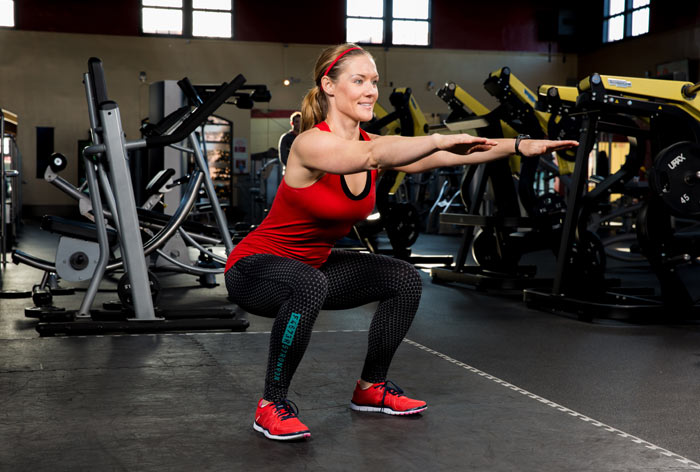
Bodyweight Squat

Are
you just getting started with personal fitness? The bodyweight squat is
a simple but effective exercise that will help you strengthen your
quadriceps, hamstrings and glutes for a firmer, stronger lower body.
Bodyweight squats are easy to perform, and you can safely do them at
home with no workout equipment. Lift your arms in front of you to
balance your body and squat to the point at which your thighs are
parallel with the ground.
If you want to make bodyweight squats more of a challenge, try
squatting using only one leg at a time. You can also hold dumbbells at
your side and perform two-legged squats for a more challenging workout.
Barbell Squat

The
barbell squat is a classic powerlifting and Olympic weightlifting
exercise. You’ll need a gym membership or a power rack in order to
perform this exercise safely, as doing squats without a rack to sit the
weight on can be dangerous.
Balance the barbell on your upper back and shoulders – it should fit
naturally onto the top of your trapezius muscles. Keep your legs at
least shoulder width apart and squat down gradually to the point at
which your thighs are parallel to the ground.
Barbell squats are one of the best leg exercises for building strong
quadriceps and glutes, especially when performed with a heavy weight for
five to ten reps. They’re also one of the ‘big three’ powerlifting
lifts, along with the bench press and deadlift.
There are two different ways to perform barbell squats: the
high bar stance and the
low bar stance. Learn more about the difference between the squat techniques and learn which is best for you in our blog post on the
high bar and low bar squat.
Leg Extension

Bodyweight
and barbell squats are compound exercises that work more than one
muscle group. Squats work the quadriceps – the big muscles on your
thigh’s front side – as well as the hamstrings, glutes and lower back
muscles.
Leg extensions, on the other hand, are an isolation exercise. Rather
than targeting your whole lower body and posterior chain, they isolate
your quadriceps to target the four muscle groups on the front side of
your thigh.
You’ll need a gym membership or leg extension machine to perform leg
extensions as part of your workout. Try to perform two to four sets at a
moderate weight after you’ve finished your bodyweight or barbell
squats.
Don’t want to train in the gym? Learn alternative leg exercises that
you can perform at home to strengthen your muscles, build your body and
burn away fat with our
No Equipment, No Excuses Home Workout course.
Leg Press

The
leg press is another lower body compound exercises. Unlike the barbell
squat, it uses a supportive machine – in this case, the leg press
machine – to reduce stress on your lower back while maximizing the
amount of quad and hamstring involvement.
Performing the leg press is simple. Sit down in the leg press machine
and gently lift the sled off the rack. You’ll need to pull the safety
levers on the side of the machine out to allow the weight sled to travel
down the machine.
Bring the weight sled down until your knees are at a 90 degree angle,
then push up into the soles of your feet to return the sled to its
starting position. If you’re doing leg press after squats, try
performing two to four sets of eight to ten reps.
Hamstring Curl

So
far, all of the leg exercises we’ve listed target the quadriceps and
glutes first and the hamstrings second. The hamstrings are the other
major muscle of your thighs – the ‘leg biceps’ that run from the back of
your knees to your buttocks.
Many people focus on squats and leg press in their training and build
strong quads but weak hamstrings. The hamstring curl isolates your
hamstrings and forces them to work independently of other muscle groups.
Hamstring curls can be performed in two positions: sitting, using a
machine that’s similar to the leg extension machine, and from a lying
position. Keep the weight as low as possible and focus on technique and
endurance for this exercise.
Do you want to learn how to increase your endurance and become stronger, fitter and better at sports? Check out our
Muscle-Up Fitness course to learn exercises and workout routines that give you functional strength and a major performance boost.
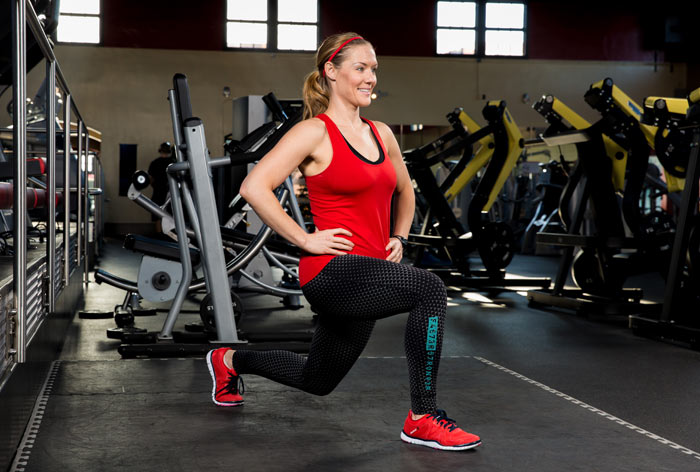
Bodyweight Lunge

The
bodyweight lunge is a great quadriceps, hamstring and glute exercise
that you can perform without any weights. Put your legs in a running
position and gradually lower your body towards the ground, placing your
weight on your front leg.
Push up using your front leg and bring yourself back to a standing
position. Switch legs and repeat. Bodyweight lunges target all of the
muscle groups in your thigh for stronger, firmer legs.
Dumbbell Lunge

Are
bodyweight lunges too simple for you? Make your lunges more challenging
by holding dumbbells on either side of your body. Hold a small dumbbell
in each hand and perform the same lunge motion as you would using just
your bodyweight.
Dumbbell lunges are a great addition to a workout routine build
around squats and other heavy leg exercises. Keep the dumbbells light
and focus on your technique, as overdoing the weight can result in
injuries to your knees.
Need more of a challenge? Switch to dumbbell lunges using a smith
machine or the squat rack for a more challenging, controlled leg
workout. Stick to light weights and perform sets of eight to ten lunges
using each leg for optimum muscle development.
Lunges are some of the best exercises for building core strength.
Learn more about how to train your core for overall athletic performance
and wellness with our blog post on
strength training workouts for health and wellness.
Deadlift

Like
the squat, the deadlift is one of the most challenging exercises you
can perform for your lower body. It’s also one of the most rewarding,
working all muscle groups in your lower body, as well as several in your
back and arms.
The deadlift is an incredibly challenging exercise, and it’s best
performed on days in which you aren’t performing barbell squats, leg
presses and other heavy lower body movements. Stick with short sets of
five to eight reps, focusing on good technique.
Learning how to deadlift can be tough, but once you’ve mastered this
exercise you’ll have no trouble building a strong, great looking lower
body. Learn the basics of the deadlift in our course,
How to Deadlift: The Ultimate Strength Exercise.
Calf Raise

So
far, we’ve covered your quadriceps, glutes and hamstrings, as well as
the various muscle groups targeted by deadlifts in your lower and upper
back. What we haven’t targeted is your calves – the muscles in your
lower legs, near your shin bone.
Calves are notoriously hard to develop, but one of the best exercises
for developing strong, chiseled calf muscles is the calf raise. Stand
on a raised platform and lift your body to stand on your toes, using one
leg at a time and only your calf muscles.
Switch legs and repeat, aiming for high reps and good technique. If
you need extra resistance, hold small dumbbells in your hands to give
your calf muscles more of a challenge. Perform two to four sets of calf
raises at the end of your workout.
Source


 Starting Position:- Hold a dumbbell in each hand and allow them to
hang down at your sides. Stand with your feet shoulder width apart, toes
pointed slightly outward. Distribute your body weight equally between
both feet. Movement:- Inhale, keeping your heels in contact with the
floor at all times, slowly lower into a squat position. Exhale as you
slowly straighten your legs, keeping your head and chest up, returning
to the starting position. Repeat as required. 5 lb dumbbells work well,
but you can start with 2 lbs and then work your way up to 5 lbs within
3-5 weeks.
Starting Position:- Hold a dumbbell in each hand and allow them to
hang down at your sides. Stand with your feet shoulder width apart, toes
pointed slightly outward. Distribute your body weight equally between
both feet. Movement:- Inhale, keeping your heels in contact with the
floor at all times, slowly lower into a squat position. Exhale as you
slowly straighten your legs, keeping your head and chest up, returning
to the starting position. Repeat as required. 5 lb dumbbells work well,
but you can start with 2 lbs and then work your way up to 5 lbs within
3-5 weeks. Starting Position: – Assume a standing position with your feet
slightly less than shoulder width apart. Grasp a barbell with a wider
than shoulder width grip and place it across your shoulders. Movement: –
Inhale, keeping your back vertical and slightly arched, slowly step
forward with one leg making a long stride, lowering your body down
slowly until your rear knee lightly touches the floor (if you cannot go
as low as this, then work your way up to it over 2-3 weeks). Exhale and
shift your weight backwards, taking one step (or 2-3 small steps if that
sounds difficult) to return to the starting position. Repeat on the
other side. Remember to consult your doctor before this or any other
knee exercises if you have had any knee trouble!
Starting Position: – Assume a standing position with your feet
slightly less than shoulder width apart. Grasp a barbell with a wider
than shoulder width grip and place it across your shoulders. Movement: –
Inhale, keeping your back vertical and slightly arched, slowly step
forward with one leg making a long stride, lowering your body down
slowly until your rear knee lightly touches the floor (if you cannot go
as low as this, then work your way up to it over 2-3 weeks). Exhale and
shift your weight backwards, taking one step (or 2-3 small steps if that
sounds difficult) to return to the starting position. Repeat on the
other side. Remember to consult your doctor before this or any other
knee exercises if you have had any knee trouble!