Showing posts with label group fitness class. Show all posts

Tuesday, 4 August 2015

Prenatal Workout Recommendations

In part 1 of this two-part series, prenatal precautions and specific exercises to counteract some of the common physical issues of pregnancy were presented. This second and final installment covers recommendations for cardio and the importance of social support. 

Prenatal Cardiovascular Fitness

What is comfortable during pregnancy varies from mother to mother. Water fitness is my personal favorite. Getting in the pool eases the aches and pains that come with increased weight and a shifted center of gravity. Exercises in these classes are also easily modified based on the amount of energy you have on any given day.
Other great cardiovascular options include:

Walking

Being a runner most of my life, I had to embrace the fact that walking can actually be a wonderful workout. If your client needs more of a challenge, encourage her add some hills to her route.

Group Indoor Cycling

Body weight does not play a major factor in this type of workout, which makes it a good option for those who want to continue exercising throughout the duration of their pregnancy. Others, however, may find the seat and positioning a little uncomfortable.

Swimming

Floating in the water can give the pregnant exerciser a sense of relief and freedom. If your client’s low back feels at all strained while swimming, recommend adding a pull buoy between the ankles to help keep the body aligned.

Cardiovascular Machines

The elliptical, stationary bike, Stairmaster and treadmill are all great options, particularly because they offer less impact on the body than other forms of cardiovascular exercise.  

Mind/Body

I cannot emphasize the importance of taking a prenatal yoga and/or meditation class during pregnancy. These classes can provide the expecting mother with many exercise options to alleviate pain and can help her become more comfortable with her changing body. Plus, the relaxation techniques will come in handy during labor and throughout stressful new-mom moments.

Putting it All Together

During pregnancy, a woman should aim for a minimum of three, 30- to 60-minute workouts per week, featuring a combination of cardiovascular fitness, strength training and mind/body exercise.

The Importance of Social Support

I love spending time chatting with other pregnant women, whether it is complaining about the latest pregnancy symptom, or reviewing which jogging stroller we like the best. Most communities have prenatal exercise classes, including prenatal water fitness, and prenatal yoga. Encourage your pregnant clients to sign up for at least one of these classes as a way to get some exercise and meet other women going through the same life-changing experience. On top of all of the support, many playgroups and lifelong friendships are formed in these classes.

Source

Wednesday, 6 May 2015

Know the Exact Definition of Circuit Training Workouts for Women

Circuit training workouts for women comprises short weight-bearing exercises and women needs to carry medium weights and perform many repetitions to achieve great results. 
 
 Circuit training workouts for women are composed of short weight-bearing exercises that require women to use medium weights and do many repetitions to attain great results. Each of the designed exercises is immediately followed by another set of routine that targets a different muscle group, which is also performed at a different station having 9 to 12 exercises that will make up a complete circuit. Circuit training workouts for women allow the exerciser to avoid waiting her muscles to rest between sets by changing muscle groups. The routine will allow the exerciser’s heart rate up all throughout the workout. 

Over the past years, circuit training exercises for women has become popular because of its great results for both weight loss and general self-esteem. These workouts are designed specifically for maximum flexibility by allowing women to create a resistance circuit by using free weights, exercise machines, resistance bands and even their own weight. The nine to twelve stations that complete the circuit focuses on all the major groups such as: legs, arms, chest, arms, back and abs. The workouts that complete the circuit can be performed in any order as long as the woman switches her muscle group between each exercise she performs and she does not take breaks. Some other circuit training workouts for women includes added routines that are effective in burning calories, which are usually jogging and jumping k jacks. These added calorie-burning burst is incorporated in 15- to 30-second cardio circuits that will allow a woman to attain great results. 

Since a lot of muscles are being used in every circuit, circuit training workouts for women usually have cross-training workout that will give less strain on the joints, making the workouts to have smaller chance of injury that the traditional weightlifting exercises. The program’s adherence rate is also good because it will not bore the exerciser as it has quick changes in the routine. 

However, all workouts have limitations and circuit training for workouts for women is not an effective way of building bulk muscles or increasing someone’s strength because of its design where more repetitions are done with lighter weight. That is why such program is not advisable for weightlifters who aim to increase their strength and muscles. 

 
In addition, people who wish to try these circuit training workouts and are not informed of weightlifting are more likely to injure themselves during the program than performing several programs of traditional weight lifting. An instructor will also find it difficult to emphasize form because of the quick changes between the exercises. 

In the United States, where such program is very popular for women because of its flexibility, circuit training workouts for women can be found in such titles: Muscle WorkFree Articles, Body Sculpt and Burn and Firm. 

Source Along Parker | AF 
 

Wednesday, 14 January 2015

The Mistakes You Might Be Making In Your Group Fitness Classes

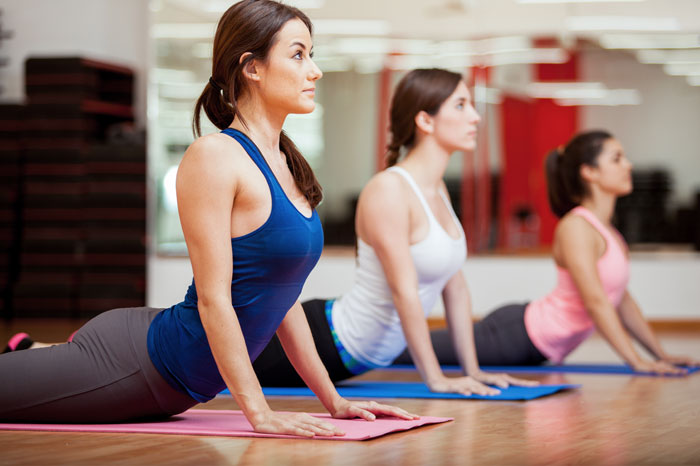
yoga


If you love group fitness classes you’re probably already familiar with some of the golden rules of being a good student, such as arriving to class on-time and putting your equipment away when you’re done. However, there are some additional considerations that will help you maximize your results. Four of the country’s top group fitness instructors share the mistakes they commonly see students make in different group fitness classes and offer tips to help you get more out of your next sweat session.

Aquatic Fitness
The mistake: Going in too deep
One of the great benefits that a shallow water aquatic fitness class offers is a joint-friendly fitness experience. However, positioning your body too deeply in the water can actually lead to a less effective workout, shares Stephanie Thielen, certified aquatic instructor and training specialist with the Aquatic Exercise Association. “It’s very common to see participants in the water at shoulder depth. A body immersed to the waist bears approximately 50 percent of its bodyweight, whereas a body immersed to the chest bears approximately 25 to 35 percent of its bodyweight.” The downside to performing exercises at shoulder depth is that the body cannot maintain vertical alignment, which means the strength-based benefits begin to diminish.
The fix: Thielen recommends positioning yourself in waist- to chest-deep water to maximize effectiveness. “This will help to ensure you have control and strength to perform exercises at a moderate pace and that the buoyancy properties of the water do not take over, allowing you to experience the muscular strength benefits aquatic exercise classes offer.”

Yoga
The mistake: Waiting for instructions to become mindful
With a plethora of research-supported physiological and psychological benefits of mind-body exercise formats like yoga, it’s clear that there is much to be gained from a class experience. However, don’t wait for an invitation from the instructor to become more mindful or depend on mirrors to see where you are, urges Lawrence Biscontini, mindful movement specialist and award-winning international fitness educator based in Mykonos, Greece.
The fix: To get more out of the time spent on your mat, Biscontini recommends practicing closing your eyes at will throughout your yoga practice to heighten your own kinesthetic sense, without the need to wait for instructions to do so. “This improves balance, helps you to ‘work in’ and overall increases your self-awareness in time and space, enabling you to know where you are by feeling where you are instead of seeing where you are. This is one of the true goals of mindful disciplines.”

CrossFit
The mistake: Assuming the only approach to warming up is the one the instructor provides
Just as there is not a one-size fits all approach to exercise, there’s also no such thing as a perfect warm-up for all class participants, especially when it comes to CrossFit. While much thought and consideration goes into designing a warm-up for a WOD, it’s important that individuals spend time working to address their own personal needs, says Sabrena Merrill, ACE master trainer and CrossFit coach in Kansas City, Mo. “While I try to address everyone’s needs in a warm-up, some participants might need to take care and spend more time mobilizing an area than what is allotted for. In these instances, I want participants to not always do exactly what I say in the warm-up and instead modify the warm-up and spend time addressing their individual needs.”
The fix: Don’t feel obligated to follow the coach’s warm-up exactly. Instead, Merrill recommends respecting your uniqueness and approaching the warm-up—and the entire WOD for that matter—accordingly, as doing so will help to ensure a safe and effective CrossFit experience. “For example, someone with stiff ankles might need to spend more time foam rolling and stretching their calves. If that means the participant spends less time on the other mobility exercises that are programmed in the warm-up, then so be it.”

Indoor Cycling
The mistake: Pedaling too quickly without enough resistance
One of the most common mistakes people make when in the saddle is pedaling too fast with little-to-no resistance. Many people opt to ride without resistance because they mistakenly believe that too much resistance will result in big, bulky legs, which is completely untrue, according to Keli Roberts, Schwinn indoor cycling master trainer and competitive cyclist. “Riding with adequate resistance produces a higher level of wattage, and because wattage is most closely paralleled with caloric expenditure, adding resistance can help make your legs smaller, stronger and more well-defined.”
The fix: To maximize the benefits of this class format, Roberts recommends pedaling between 70 and 100 RPMs (revolutions per minute)—which equates to how many times one of your legs makes a complete pedal cycle per minute—using adequate resistance. “By using appropriate resistance you increase the wattage,” explains Roberts, “meaning you’ll burn more total calories.” 

Source