Showing posts with label muscle tone up. Show all posts

Thursday, 23 July 2015

Woman's Health and Workout Ideas

Fitness, muscle-building and gym work-outs have gone beyond the traditional all-male club. With the hype over fitness and health and a healthy lifestyle, women have joined the club as well. However, men and women have different fitness needs.
Women's fitness and exercise needs are focused on the muscles of the upper back. Most of their exercise work-outs are also designed for the stomach muscles, especially those who have just given birth. At the same time, exercises for women are usually designed for weight loss. And while men tend to focus on muscle building whereas women work on toning their muscles, strength training is important for both.
Here are a few things to make you women out there go out and start building up your muscle strength.
Make the performance of your usual tasks easier with a physically strong body. Chores will be easier, lifting your kids, the grocery or the laundry will be a piece of cake. Consequently, it will reduce possible strain on the muscles and injury. Training can increase a woman's strength by 30 to 50 percent.
Lose fat at the same time. A strength training done 2 to 3 times a week for a span of two months can result to two pounds of muscles and would mean a reduction of 3.5 pounds of fat. The more muscles and less fat, the faster is the metabolism, which ultimately means your body burns calories faster than normal.
Fight osteoporosis. Weight training increases spinal bone mineral density which means lesser chances of the risk of osteoporosis.
Fight heart disease and diabetes. Weight improvement improves cardiovascular health by lowering the bad cholesterol and blood pressure. It also improves glucose use in the body by 23 percent which reduces the risk of diabetes.
The road to a healthier you. Not only does it promote a healthier body, but it also develops a healthier attitude and a healthier heart. Women who engage in regular strength training are more confident, with a more positive outlook in life.

So how do you get started?
For those who lead very busy lifestyles, hitting the gym and starting on a regular fitness plan may seem the perfect way to keep fit. But for most, starting out on a regular walking exercise is the way to go. Start at a manageable rate. A 10 to 15 minute walk is a good way to start. Prior to a workout, make sure to stretch your major muscles.
Work your muscles on the front of your thighs. Stretch your shoulder muscles by standing straight and rolling the shoulders backward in a circular motion. And of course, don't forget to observe proper nutrition. Load up on water to prevent dehydration. Consume carbohydrates before starting on your work-out.
For those with joint and bone diseases, swimming may prove to be a less stressful activity for your muscles.
But the most important is, make time for your exercise. If you can't hit the gym or start on a regular work-out plan, make sure that your day is filled with enough physical activity that keeps you going and always on the go. Women's fitness is the key to your beauty!
When you ask someone to workout with you, you will usually hear the word "no". Besides, working out is boring. Maybe even you will consider that working out is boring and rather do fun things than spending time at the gym doing some boring workout routines.
However, you have to consider that more and more people are putting up with the boring workout routines because of the alarming increase of heart related diseases and obesity. You have to consider that you have to take care of your body in order to live a happier and more satisfying life.
You and only you are responsible for maintaining your body's health. This is why you have to do fitness workouts in order to keep your body in top working condition. Failing to do so will result in a disease-ridden life where you and your family will suffer.
So, while you are still not experiencing diseases because of being overweight, such as diabetes and heart diseases, you have to start doing fitness workout in order to keep your body healthy plus give you the benefit of having a great looking body that you can show off during summers at the beach.
However, if you find regular fitness workout routines very boring, there are quite a lot of fitness workouts that you can do to make workout more fun. There are fun activities that you can do where you can definitely enjoy and at the same time, give you a great quality fitness workout experience.
First of all, most people consider that fitness workouts are only limited at the gym. However, you have to consider thinking out of the box and start being creative. Active sports such as swimming, golf, tennis, football, and basketball are a fun sport that can give you great quality fitness workout experience.
For example, if you like to play tennis, there are quite a lot of tennis schools available that can teach you how to play. You can even include your family in this fun activity and all of you can have fun while at the same time, promote fitness.
If you are not sports minded or you can't think of any sport that can be fun for you, you can also consider dancing as a great fitness workout experience. You can try and enroll in dance classes. Although some people think that dancing is easy, you have to consider that it's not.
Dancing is quite difficult and can be very stressful for your body as it will require you to run, walk, and jump around in the dance floor to do those dance moves. Dancing can definitely be a great fitness workout alternative if you find regular gym workouts boring. Plus, dancing is also fun especially if both you and your significant other enroll in the same classes.
These are just some of the examples that can make fitness workout more fun and more enjoyable. There are still quite a lot of activities out there that you can do for fun and at the same time, give you a great quality workout.

There are belly dancing activities, there are hiking and camping activities, there are rock climbing activities and a lot more. All you need to do is find one that interests you and be creative.

Source

Thursday, 25 June 2015

10 Things to Know About Muscle Fibers


Toning up, or improving muscle definition, is one of the most common goals of individuals starting an exercise program. The term tone comes from “tonus,” which is the technical term for a state of contraction of a muscle fiber. If all of the fibers within a muscle contract, it creates the shape commonly associated with a well-defined muscle.
The primary purpose of muscle fibers is to control physical forces moving through the body. Muscle-shortening actions can generate a force to move a resistance; for example, when moving from a seated to a standing position, the quadriceps and gluteus maximus shorten to help the body stand up against gravity. Muscle-lengthening actions can be applied to control and decelerate a force; for example, the quadriceps and glutes lengthen to control the motion of the body as it returns to a seated position. If you are interested in designing exercise programs that produce results, it is important to have a good understanding of how muscle fibers work and respond to exercise.
To more effectively help your clients achieve their fitness goals, keep in mind these important facts about muscle fibers and how they are affected by exercise:
1. Muscle fibers adapt to the specific type of exercise stimulus imposed during training. Mechanical stress refers to the physical stresses applied during resistance training, which cause microtrauma to muscle fibers. As fibers are damaged from exercise, they signal the biochemical reaction to produce new satellite cells responsible for repairing the mechanical structure of the muscle cell and for building new muscle proteins.
2. Muscle fibers are activated by a motor neuron, which is the connection between the central nervous system and the specific muscle required to perform a particular activity. A muscle motor unit is the motor neuron and the attached muscle fibers. Think of a motor unit as a light switch for the muscle—as a muscle is required to generate a force, the motor units will “light up” to stimulate the fibers to shorten in order to produce that force. There are a number of different muscle unit types, which are typically organized into three general categories: type I, type IIA and type IIB
3. According to the all-or-none theory, a motor unit is either active or inactive. When it is signaled to contract, it activates all of its attached muscle fibers. Slow-twitch motor units have a low threshold for activation and low conduction velocities, and are attached to type I muscle fibers. Fast-twitch motor units have a higher activation threshold, are attached to type II muscle fibers and are capable of conducting signals at higher velocities, resulting in greater amounts of muscle force.
4. Type I fibers are known as aerobic fibers. These fibers have a higher density of mitochondria, which are efficient at aerobic metabolism (the process of creating energy to fuel muscle activity with oxygen). The mitochondria give the cell a darker color, which is why these are known as red muscle fibers. Type I fibers use oxygen to create energy for lower-intensity, long-term, endurance-oriented activities like walking, running, swimming, cycling or standing for extended periods of time.
5. Type IIB fibers are known as anaerobic muscle fibers. Type IIB fibers store energy that is released for short, explosive, extremely high-intensity activities. Type IIB fibers do not have mitochondria and have a colorless appearance, which is why they are known as white fibers. Because they have a limited supply of stored energy, and thus fatigue quickly, Type IIB fibers are used for strength and power activities requiring a high amount of force in a short period of time.
6. Type IIA fibers have mitochondria, so they can be involved in aerobic activities; however, they can also be used to produce force rapidly during activities requiring a high amount of strength or power. Fast-twitch muscle fibers also have a greater diameter than type I fibers and play a more significant role in hypertrophy (the technical term for muscle growth). Recruiting and innervating type II muscle fibers requires creating enough mechanical overload to fatigue the involved muscle by the end of the set
7. Muscle fibers work according to the size principle. As a muscle requires force, it will start by activating the smaller type I motor units. When these type I motor units can’t provide the necessary force (or fatigue), the larger type II motor units and muscle fibers are recruited to perform the work. A muscle has a finite number of motor units and the higher-threshold type II motor units are not “turned on” unless a high level of force is needed. The most common way to increase motor unit activation is to lift heavier weights, because an increased load placed on a muscle will cause a greater number of motor units to activate more fibers to generate the force necessary to overcome the resistance. This is why your muscles shake when you try to lift a heavy weight for the first time—muscle motor units not previously used are being “woken up” and called into action.
8. Muscle fibers experience two specific types of hypertrophy. Myofibrillar hypertrophy refers to the increase in size or thickness of individual actin and myosin protein filaments, which can improve the force-production capacity of individual fibers. Myofibrillar hypertrophy does not lead to larger muscles; rather, it results in thicker muscle fibers capable of generating more force. Sarcoplasmic hypertrophy is an increase in the volume of the semifluid interfibrillar substance surrounding an individual muscle fiber. This fluid contains the proteins used to promote tissue repair and growth. The muscle “pump” that bodybuilders work to achieve is actually sarcoplasmic hypertrophy—the cross-section of muscle fibers will increase, but most of the enhanced muscle size is due to an increased volume of the sarcoplasm and non-contractile proteins not directly involved with force production.
9. One of the long-term adaptations of muscle to resistance training is an increase in muscle fiber cross-width. As the cross-sectional area increases in size, the fibers have more surface tension and become capable of generating higher amounts of force. Muscles with a larger cross-sectional area of individual muscle fibers are capable of producing greater amounts of force. In addition to being responsible for producing the force necessary for dynamic movements, type II muscle fibers have a greater diameter (cross-width) than type I fibers and are responsible for the hypertrophy, or increased size, of a particular muscle.
10. Type IIA and IIB muscle fibers are responsible for generating movement as well as muscle size and definition. Both classifications of type II muscle fibers create higher levels of force to produce human movement and are known as phasic muscles. Type I fibers are responsible for maintaining postural and joint stability, and can be categorized as tonic muscles.
If your client has a fitness goal related to improving muscle definition or building strength, the only way to achieve this is by activating the type II motor units and muscle fibers. There is a common misconception that developing muscle tone (“toning up”) is best achieved by using lighter weights for higher repetitions. While it is possible to achieve definition with lighter weights, it requires doing a high volume of repetitions. Using light weights for high repetitions can improve the aerobic efficiency of type I fibers, but unless the exercise is performed to fatigue which occurs only after recruiting the type II fibers, it will not result in the desired goal of definition. However, if time is an issue (as it is for many people), using a heavier weight for fewer repetitions is an effective technique for stimulating growth and definition from the type II fibers. It is important to note that exercising with higher repetition ranges will result in muscle growth from sarcoplasmic hypertrophy, while using heavier loads for fewer reps induces myofibrillar hypertrophy, which increases strength without necessarily inducing significant gains in muscle growth.

Source

Tuesday, 23 June 2015

Weight Training for Beginners: Lifting Basics


weight training for beginnersWeightlifting is not just for body-builders…regular people can also benefit from these muscle training exercises.  By adjusting the weight, repetition and techniques, weightlifting can be scaled to an appropriate level to suit anyone’s exercise goals.  Including the proper use of weight training in your exercise regime provides unparalleled ability to increase strength and target particular muscle groups, but it is important to know what you’re doing because it is also an easy way to injure yourself.
Excessive weight, poor technique, and inadequate warm-up are all serious risks, and far from improving fitness, they can contribute to the kinds of chronic injuries that prevent people from exercising at all.  But this is no reason not to take advantage of weightlifting, with a few basic guidelines and the appropriate equipment you can safely enjoy the benefits of lifting weights.

First things first, how does weight training fit into your life?  While belonging to a gym offers the most equipment options and resources, not having access to a gym membership does not mean that you can’t lift weights.  It is easy to find inexpensive used dumbbells on Craigslist, and there are a lot of exercises you can perform with just a set of dumbbells.  Even if you can’t get your hands on any equipment there are still plenty of exercise for home that take advantage of weight training principles.  If you are new to weightlifting and muscle training, it might be useful to have a trainer plan out a routine that meets your needs and helps you become familiar with the exercises involved.  Most gyms offer both classes and personal trainers to help you get going and stay motivated, but there are also exercise classes online and on DVDs.  All it takes is a bit of research to find the plan that fits your needs and experience. Whether you are working out at home or hitting the gym, you are going to use the same set of muscles, and the importance of the warm up cannot be overstated.
The keys to a good pre-workout are getting warm, and stretching out.  Aerobic exercises that get the blood pumping are the first step.  With increased blood flow your muscles perform better, recover faster and are less likely to be injured.  Along with aerobic exercises you should do some light pre-workout stretching to increase your range of motion and lengthen the muscle fibers so they are less likely to tear while lifting.  Dynamic stretching is preferable, that is stretches that involve movement, as opposed to static stretches where you hold a position.  Focus you stretching on the areas that are most likely to be injured, such as your rotator cuff, shoulder and back muscles, neck, and knees.  Warming up for ten to twenty minutes is perfect, with most of the time spent on aerobic work.

Once you are all warmed up and ready to lift there are a few considerations that will maximize your benefits and decrease your risk of injury.  Check them out:
  1. Start off with light weights.  No, even lighter.  Especially if you are just getting into lifting, it is important not to push yourself at first.  Pick a weight that allows you to do more than 10 repetitions, without too much strain or fatigue.  Even most serious weight lifters often begin their routine with a set of low weight reps and then progress to heavier weights in later sets.  Better to wish you’d lifted more than wish you’d lifted less.
  2. Concentrate on performing each exercise with correct technique.  This is important both for maximizing the benefit to the muscle you are working out and minimizing the risk of injury.  Avoid swinging weights around while using them.  You want to maintain good posture, take a firm stance and lift with only the essential muscles- don’t compensate with other muscles.  Be careful with shoulder and knee exercises.  If you are holding a weight at arm’s length don’t lift it above your shoulder, and if you are performing weighted squats don’t bend lower than where your thigh is parallel to the ground.
  3. Go for high reps, full range, and multiple sets.  It is most beneficial for strengthening muscles to perform exercises that engage them at every point along the range of motion.  Additionally there is more benefit in gradually fatiguing your muscle, by performing three sets of fifteen repetitions for each exercise, for example, than in trying to lift as much as you can all at once.
  4. Go slowly.  Take time between exercises to keep stretch and staying warm.  Your muscles will improve the most if you give them a chance to recover after each exercise and then do another set.  Also it is important to lift in a slow and controlled motion.  Jerking the weights around is a good way to injure yourself, but lifting them slowly will make every exercise more challenging.
  5. Stay hydrated so you can keep sweating but bring a towel to wipe down equipment.  Water is essential to muscle recovery and it is important to stay hydrated during and after working out, but it is also important not to drip sweat all over the place, especially if you are in a gym sharing equipment with everyone else.
  6. Be sure to cool down properly.  After lifting it is a good idea to get a bit more cardio work in and do some more stretching, making sure that as your muscles cool they are not contracting and cramping.  Find some time to get in a few more quick stretching or yoga sessions in the hours following your workout to keep loose.
As you become familiar with weight training and want to get even more out of your exercises, look into improving your diet, creating a schedule that includes sufficient rest and recovery periods between workouts, and if you are training for something specific, do some research or seek advice on how to tailor your workout to your needs.

Sourse 

Thursday, 30 April 2015

Womens Arm Secrets Review - Easiest Guide to Know Arm Exercises for Women

Dumbells provide a multitude of approaches to strengthen and tone your arms. Arm strength and definition improve women's appearance in tank tops and bathing suits. Strong arms also help women perform day to day activities such as carrying groceries and lifting kids. Barbells and dumbbells produce an edge on weight machines simply because they need you to use more synergistic and stabilizing muscles, allowing you to achieve a far more effective workout, based on fitness expert Anthony Ellis in Iron Magazine. For all of these exercises, start with one group of 10 to fifteen repetitions. Soon after weeks, work up to two or three sets. Once you perform multiple sets, make sure you rest at least one minute together.

Overhead Triceps Extension

Perform the overhead triceps extension while standing, sitting on a stability ball or over a workout bench. This exercise works the triceps--the three-part muscle on the back with the upper arm. In addition, it secondarily uses the abdominals, most muscles of the shoulders and also the upper back. Grab a dumbbell from the shaft with both of your hands. Draw your navel for your spine gently and pull your shoulders down your back while standing tall to keep the pinnacle, neck and spine aligned. Bring the dumbbell overhead, fully extending your arms with elbows forwarded to leading with the room. While you inhale, bend your elbows with a 90-degree angle minimizing the dumbbell behind your mind. Maintain your elbows from bowing out to the sides with the room. Exhale and go back to straight arms overhead.
 
 Bicep Curl

Focus on the within the upper arm--the bicep--with the bicep curl. The American Council on Exercise indicates that, when performed from the stand using a barbell, the bicep curl also activates the muscles of the shoulder, the upper back, the spine and also the abdominals. Grip your barbell having an underhand position and extend the arms and so the weight rests facing your thighs. When you stiffen your abs and relax the shoulders, draw the weight up toward the shoulders by bending your elbows. Work against gravity as you lower the weight back for the starting position. Try to keep your arms alongside your body through the exercise.


Triceps Kickback

The kickback effectively addresses the triceps while forcing you to definitely engage the top of back and abdominals as stabilizers. Using dumbbells, stand while holding a dumbbell in each hand. Bend the knees slightly and lean forward from the hips while engaging your abdomen. Draw top of the arms parallel to the rib cage with elbows bent to 90 degrees. Fully extend your elbow as you exhale, keeping the upper arm against your torso and your back straight. Return the elbow for the 90-degree angle for one repetition. To include variety towards the kickback, try performing from a kneeling position or with one arm at a time.
 

Now, let’s discuss about Womens Arm Secrets created by Melissa Wall and how it may help you. I hope this simple Womens Arm Secrets Review will assist you to differentiate whether Womens Arm Secrets is Scam or perhaps a Genuine.

Women are only not built exactly the same way as men and we just do not have sufficient with the appropriate hormones to build huge muscles. If you're just starting out with a regular exercise routine, you might want to try something low impact. This will be much easier on your own joints, especially the knees and ankles. You still get yourself a great workout but there's nothing more stressful than setting up an exercise routine that's too hard and becoming frustrated so in early stages.

Women who've been doing bicep exercises for a couple of weeks, will definitely notice a marked improvement in the definition of their upper arms. As the developing muscle requires extra calories for growth, it will be burning fat from other regions of the body in the meantime.

Source Melissa Wall

Saturday, 21 March 2015

5 Strength Training Exercises That Also Burn The Most Fat

If you want to get strong, tone those muscles AND burn fat, then you need to pick the exercises that give you the most bang for your buck.
These exercises are all compound exercises, meaning they work more than one muscle at a time – unlike isolation exercises (think bicep curls, triceps kick backs) that only work one muscle. Because of the physical demands these compound exercises put on the body, they are the best at putting on muscle while stripping away fat.

1. Squats – you’ve probably heard it before – it is the king of all exercises. It works the quads, hamstrings, glutes, and depending on the variation you are doing, it also uses a lot of upper body strength. Back squats use your back muscles, Front squats use you shoulder and upper back muscles, Zercher squats also use your bicep muscles as do Goblet Squats.
Squat form how to do squats_thumb[3]

2. Deadlifts – another one that people often call the king of all exercises. This works much of the posterior chain of the body – the hamstrings, glutes as well as the lats and traps, your forearms, and even the shoulders to a smaller degree.
deadlift-good-form-girl

3. Pull-ups or Chin-ups – works the upper body better than almost any exercise including the muscles of the back, the biceps as well as your abdominals to far greater degree than you might think.
pullups

4. Bench Press – works much of the upper body muscles as well, mostly on the front side, including the chest muscles, shoulders and triceps.
5-SH-Bench-Press_shutterstock_ss

5. Push press – an overhead press that uses the muscles of the shoulders, triceps, as well as using your legs to push the weight overhead.
Woman Lifting Weight
There you have it. Make sure you include these exercises in your workout program to build the most muscle while burning the most fat.

Source 

Thursday, 29 January 2015

What are the benefits of weight lifting for woman?


So many woman truly do not understand the positive impact weight lifting can have when introduced into their training. By adding weight lifting into your exercise routine, you’ll be able to feel and see the benefits quickly, by losing weight, gaining muscle, and toning and sculpting until you get the body you’ve always wanted.

Most people shy away from weight lifting because they are afraid they will bulk up and appear too masculine. This is simply not the case, although I do understand some females out there do build muscle very quickly and are afraid of weight training for that reason, it all comes down to what type of weight lifting you are doing. *If you are one of those people that builds muscle quickly ask your trainer directly how you can transform that amazing muscle into lean and toned muscle.
Adding weight lifting into your exercise routine can help dramatically increase your metabolism, tone and sculpt your body and strengthen your bones. It can also help you lose weight faster, this is because the more muscle you build the more calories you lose throughout the day even when you are resting. To put it bluntly woman who lift weights burn more calories than woman who don’t. What more motivation do you need!
Here’s a list of all the benefits to encourage you to get started!
You will lose body fat – Weight lifting helps with weight loss because the more lean muscle a woman has, the more calories she burns. Strength training increases your metabolic rate by increasing the calories you burn on a daily basis. The more calories you burn, the more chance you have to drop body fat.
You will be physically stronger – Being stronger can benefit in many ways, day to day activities will become easier.Lifting your kids, doing the groceries or lifting heavy objects will become easier and you will be far less likely to injure yourself. Through weight training you can expect substantial increase in your strength. Quality of life is better because you can perform activities with more ease and less pain.
Your mood will be improved, and it can fight depression – Weight training can make you feel more confident and capable. It can also significantly improve a person’s mood.
Injury prevention – Strength training strengthens our muscles and tendons. The stronger we are the less chance we have of an injury. This is especially important as we grow older. Strengthening the muscles around our joints is one of the best ways to prevent and recover from injury. For example: The best way to recover from a knee injury is to strengthen the quads and calves. I have also seen lots of study proving that weight training can ease the pain of osteoarthritis and weight training can also increase spinal bone mineral density. This coupled with an adequate amount of dietary calcium can be a woman’s best defense against osteoporosis.
You will reduce your risk of diabetes – Weight training can improve the way the body processes sugar which reduces the risk of diabetes.
I hope I have encouraged some of you ladies out there to push past your insecurities of weight training and decide to try it out and reap the benefits.
Please remember that before you start your weight lifting routine make sure you are taught on proper lifting techniques. Ask a professional at the gym to show you the proper technique so you’re lifting the right way. If your using free weights, make sure you’re using weights that are appropriate for you.

Source

Tuesday, 20 January 2015

4 Lower-body Movements for Beginners

If you’re just getting started with a fitness routine, it can be a challenge to know how to properly perform exercises for the various muscles of the body. Here are four introductory lower-body movements for beginners, with advanced options that can be done once you’ve mastered the basic exercises.

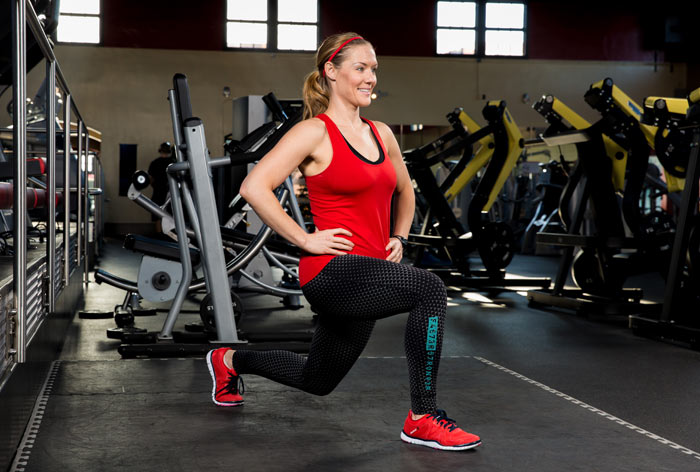
Static-stance Lunge
static stance lunge

Stand with your feet together, shoulders pulled down and away from the ears, and your core engaged. Step forward with one foot and find your balance. Your feet should be far enough apart so that when you go down into the lunge position, your knee is facing directly forward and not going over your toe. If you don’t have enough balance for this exercise, stand by a wall or hold on to a stable chair. Keep your torso erect by continuing to engage your core (don’t lean forward). Drive your hips toward the floor, controlling the movement until your thighs become parallel with the floor. Push with the front leg to come back to the top of the lunge and repeat.
Advanced: Perform an alternating plyometric lunge. After doing one lunge, add a hop before moving into the next one, switching the lead leg each time.

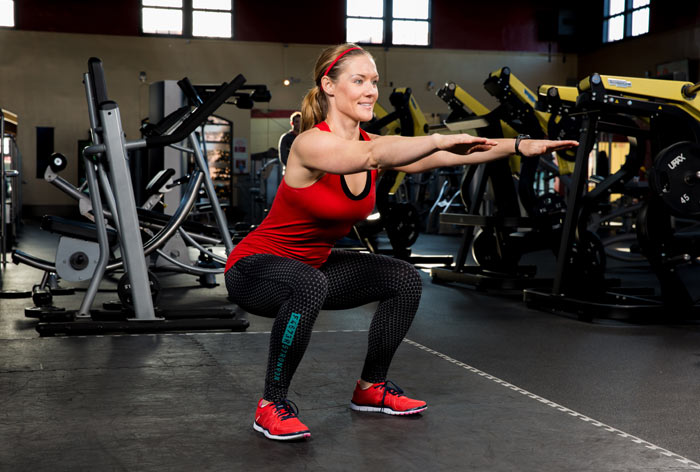
Squat
squat

Stand with your feet a little wider than hip-distance apart and toes pointed slightly outward. Engage the core and lift the chest. Look straight ahead and keep your hands by your sides. Shift your weight back into your heels and push your hips behind you until your thighs become parallel with the floor. Your knees should be moving in the direction of your toes. Do not let your torso become rounded or let your heels come off of the floor during the movement. Lift your hips, torso and chest simultaneously as you return to the starting position.
Advanced: Perform a squat; extend first the right and then the left leg out to the side at the base of the squat. Bring the foot back toward the center and stand back up to the starting position.

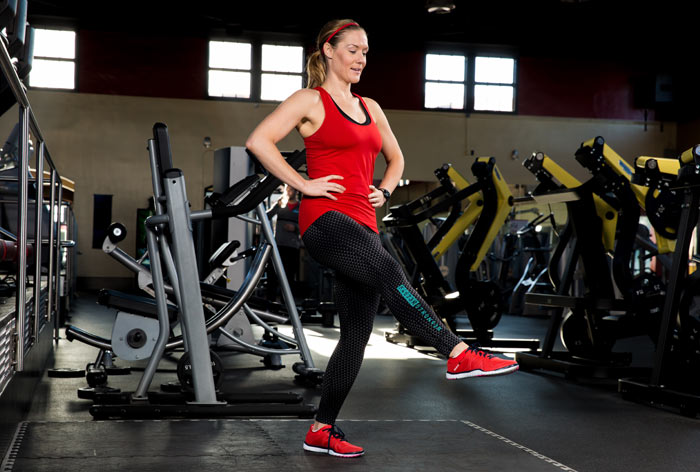
Balance
Balance

Stand on one leg; use a chair or stand by a wall for support, if needed. Lift one leg off the ground and write the alphabet in the air with your toe; repeat with the opposite leg. This can be a great exercise to do while standing in the kitchen cooking or while folding laundry.
Advanced: Stand on one leg and extend your arms straight out from your body. Rotate your arms so that your right arm is pointing toward your toes and your left arm is extended to the ceiling. Next, switch so that the left arm is pointed toward the ground and the right arm is extended toward the ceiling.

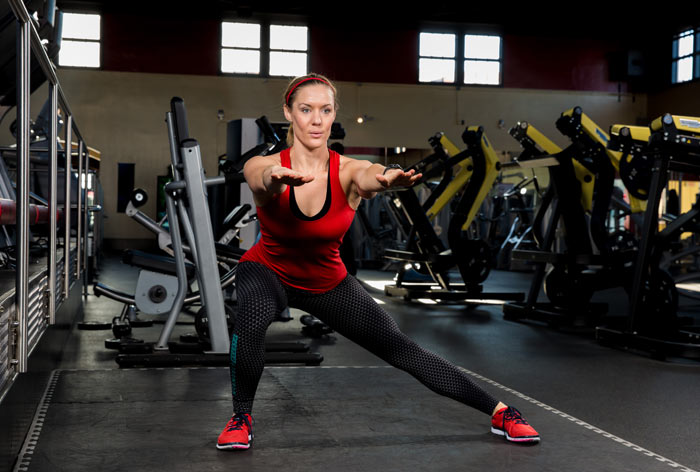
Lateral Lunge
Lateral lunge

Stand with your feet parallel, hip-width apart. Look straight ahead and keep your hands in a comfortable position to help you maintain your balance during the exercise.
Inhale and slowly step to the right while keeping your weight in your left heel; keep both feet facing forward. Once your right foot is firmly placed on the floor, begin to shift your weight toward the right foot, bending the right knee and pushing the hips back. Continue to lunge until your shinbone is vertical to the floor and your right knee is aligned with the second toe of your right foot. Your left leg should be as straight as possible and your body weight should be distributed into the right hip. Keep the heels of both feet flat on the floor.
Advanced: Perform a lateral lunge as described above, but after the lunge, bring the knee up and place a small ball or med ball underneath the leg and then return to the lateral lunge.

Source

Sunday, 18 January 2015

Best Leg Exercises for Strength and Muscle Development


bestlegexercisesWhether you want to build strong, powerful quadriceps and hamstrings or just tone up your legs for summer, the best way to strengthen and firm your lower body is by adding leg exercises to your workout routine.
From classic powerlifting exercises like the barbell squat to endurance-building leg exercises like the bodyweight lunge, this blog post lists the nine best leg exercises for developing a strong, firm and highly athletic lower body.
Do you want to get stronger, slimmer and more athletic? Enroll in No Bull Fitness: Build Muscle, Lose Fat and Be Healthy to discover a proven workout and nutrition routine that will help you gain muscle and lose fat.

Bodyweight Squat

bodyweight squatsAre you just getting started with personal fitness? The bodyweight squat is a simple but effective exercise that will help you strengthen your quadriceps, hamstrings and glutes for a firmer, stronger lower body.
Bodyweight squats are easy to perform, and you can safely do them at home with no workout equipment. Lift your arms in front of you to balance your body and squat to the point at which your thighs are parallel with the ground.
If you want to make bodyweight squats more of a challenge, try squatting using only one leg at a time. You can also hold dumbbells at your side and perform two-legged squats for a more challenging workout.

Barbell Squat

Fitness Trainer Doing Squats With BarbellsThe barbell squat is a classic powerlifting and Olympic weightlifting exercise. You’ll need a gym membership or a power rack in order to perform this exercise safely, as doing squats without a rack to sit the weight on can be dangerous.
Balance the barbell on your upper back and shoulders – it should fit naturally onto the top of your trapezius muscles. Keep your legs at least shoulder width apart and squat down gradually to the point at which your thighs are parallel to the ground.
Barbell squats are one of the best leg exercises for building strong quadriceps and glutes, especially when performed with a heavy weight for five to ten reps. They’re also one of the ‘big three’ powerlifting lifts, along with the bench press and deadlift.
There are two different ways to perform barbell squats: the high bar stance and the low bar stance. Learn more about the difference between the squat techniques and learn which is best for you in our blog post on the high bar and low bar squat.

Leg Extension

bestlegexercisesBodyweight and barbell squats are compound exercises that work more than one muscle group. Squats work the quadriceps – the big muscles on your thigh’s front side – as well as the hamstrings, glutes and lower back muscles.
Leg extensions, on the other hand, are an isolation exercise. Rather than targeting your whole lower body and posterior chain, they isolate your quadriceps to target the four muscle groups on the front side of your thigh.
You’ll need a gym membership or leg extension machine to perform leg extensions as part of your workout. Try to perform two to four sets at a moderate weight after you’ve finished your bodyweight or barbell squats.
Don’t want to train in the gym? Learn alternative leg exercises that you can perform at home to strengthen your muscles, build your body and burn away fat with our No Equipment, No Excuses Home Workout course.

Leg Press

bestlegexercisesThe leg press is another lower body compound exercises. Unlike the barbell squat, it uses a supportive machine – in this case, the leg press machine – to reduce stress on your lower back while maximizing the amount of quad and hamstring involvement.
Performing the leg press is simple. Sit down in the leg press machine and gently lift the sled off the rack. You’ll need to pull the safety levers on the side of the machine out to allow the weight sled to travel down the machine.
Bring the weight sled down until your knees are at a 90 degree angle, then push up into the soles of your feet to return the sled to its starting position. If you’re doing leg press after squats, try performing two to four sets of eight to ten reps.

Hamstring Curl

Leg CurlSo far, all of the leg exercises we’ve listed target the quadriceps and glutes first and the hamstrings second. The hamstrings are the other major muscle of your thighs – the ‘leg biceps’ that run from the back of your knees to your buttocks.
Many people focus on squats and leg press in their training and build strong quads but weak hamstrings. The hamstring curl isolates your hamstrings and forces them to work independently of other muscle groups.
Hamstring curls can be performed in two positions: sitting, using a machine that’s similar to the leg extension machine, and from a lying position. Keep the weight as low as possible and focus on technique and endurance for this exercise.
Do you want to learn how to increase your endurance and become stronger, fitter and better at sports? Check out our Muscle-Up Fitness course to learn exercises and workout routines that give you functional strength and a major performance boost.

Bodyweight Lunge

bestlegexercisesThe bodyweight lunge is a great quadriceps, hamstring and glute exercise that you can perform without any weights. Put your legs in a running position and gradually lower your body towards the ground, placing your weight on your front leg.
Push up using your front leg and bring yourself back to a standing position. Switch legs and repeat. Bodyweight lunges target all of the muscle groups in your thigh for stronger, firmer legs.

Dumbbell Lunge

bestlegexercisesAre bodyweight lunges too simple for you? Make your lunges more challenging by holding dumbbells on either side of your body. Hold a small dumbbell in each hand and perform the same lunge motion as you would using just your bodyweight.
Dumbbell lunges are a great addition to a workout routine build around squats and other heavy leg exercises. Keep the dumbbells light and focus on your technique, as overdoing the weight can result in injuries to your knees.
Need more of a challenge? Switch to dumbbell lunges using a smith machine or the squat rack for a more challenging, controlled leg workout. Stick to light weights and perform sets of eight to ten lunges using each leg for optimum muscle development.
Lunges are some of the best exercises for building core strength. Learn more about how to train your core for overall athletic performance and wellness with our blog post on strength training workouts for health and wellness.

Deadlift

bestlegexercisesLike the squat, the deadlift is one of the most challenging exercises you can perform for your lower body. It’s also one of the most rewarding, working all muscle groups in your lower body, as well as several in your back and arms.
The deadlift is an incredibly challenging exercise, and it’s best performed on days in which you aren’t performing barbell squats, leg presses and other heavy lower body movements. Stick with short sets of five to eight reps, focusing on good technique.
Learning how to deadlift can be tough, but once you’ve mastered this exercise you’ll have no trouble building a strong, great looking lower body. Learn the basics of the deadlift in our course, How to Deadlift: The Ultimate Strength Exercise.

Calf Raise

Thats How You Train Legs CalvesSo far, we’ve covered your quadriceps, glutes and hamstrings, as well as the various muscle groups targeted by deadlifts in your lower and upper back. What we haven’t targeted is your calves – the muscles in your lower legs, near your shin bone.
Calves are notoriously hard to develop, but one of the best exercises for developing strong, chiseled calf muscles is the calf raise. Stand on a raised platform and lift your body to stand on your toes, using one leg at a time and only your calf muscles.
Switch legs and repeat, aiming for high reps and good technique. If you need extra resistance, hold small dumbbells in your hands to give your calf muscles more of a challenge. Perform two to four sets of calf raises at the end of your workout.

 Source