Showing posts with label upper body workout. Show all posts

Saturday, 5 September 2015

At Home Cardio Workout with No Equipment - Fat Burning Cardio Intervals

No equipment, and no reason to not jump right into this quick cardio interval workout that will have you sweating in a hurry but won’t take up more than 30 minutes of your day.

This is a mid range difficulty routine (maybe a 3.5/5 on the difficulty scale, what do you guys think?) that’s a good option for just before or after a strength routine for the upper or lower body. It’s also good paired with a long stretching or yoga routine or as a standalone recovery cardio workout - just make sure to check out the options for a cool downs below if this is the only workout you’re doing for the day.

As shown, it’s not a low impact workout, but I’ve provided low impact modifications all throughout the video (I apologize that a couple of times it took me a bit into the interval to remember to do so!). Whatever your fitness level, make sure that you’re pushing yourself relative to your own strengths and weaknesses. You can make this easier by moving more slowly, taking out the jumping motions, and keep the range of motion more shallow. On the other hand, you can make this harder by adding jumps or jumping more powerfully for each movement, moving faster, using a deeper range of movement, or even holding onto weights or wearing a weighted vest. You can also take shorter or longer breaks as you need to, and more or less frequently; it's all up to you to make the changes that you need to in order to properly push yourself. If you ever find yourself getting discouraged because it seems too difficult, remember that everyone has a starting place, and just make it your main goal to push yourself a little further each time.


Note:
All information provided by Fitness Blender is of a general nature and is furnished only for educational/entertainment purposes only. No information is to be taken as medical or other health advice pertaining to any individual specific health or medical condition. You agree that use of this information is at your own risk and hold Fitness Blender harmless from any and all losses, liabilities, injuries or damages resulting from any and all claims.

Thursday, 9 July 2015

5 Upper-body Power Moves

The term plyometrics is usually used to refer to explosive lower-body exercises such as skips, hops, jumps and bounds. However, plyometric training is also important for the upper body as well. According to the principle of specificity, muscles adapt to how they are trained. Therefore, doing jumps can improve lower-body power, but it will not have any affect on the muscles of the upper body. If the goal is to help improve upper-body power for activities like swinging a racquet, bat or club, or simply to have more strength to handle common tasks like picking up a child or carrying a heavy bag, then it can be important to do plyometric training specifically for the upper body.
Plyometric training was originally called “shock training” by the Soviet sport scientists who developed the technique. Plyometric training works by initiating a rapid contraction of the muscle fibers, which places tension on the elastic connective tissue. The faster the elastic tissue lengthens, the faster and more explosively it can shorten, which leads to higher levels of muscle power output.
When starting a plyometric training program, whether for upper- or lower-body muscles, it is important to start with a low volume of low-intensity exercises because of the magnitude of forces placed on the muscle and connective tissue. For best results, plyometric training should focus on only a few repetitions at a time so the maximum amount of force can be applied with each rep.
Upper-body plyometric exercises can be performed using body weight only or equipment such as medicine balls, sandbags, dumbbells, barbells and kettlebells. Medicine balls, in particular, are an excellent tool for developing upper-body power because they can be both thrown and caught. When catching a medicine ball, the muscles are rapidly lengthened, which allows them to explosively shorten during the throwing phase, thus providing the elastic energy for the plyometric effect. Throwing a medicine ball allows you to accelerate all of the way through the movement to create the highest level of force possible as the ball leaves the hands.
It is important to note that there are two specific types of medicine balls: live and dead. Live medicine balls bounce and are good for exercises requiring an explosive return. Conversely, dead balls are filled with gel or sand and do not bounce when hitting the ground. When learning explosive upper-body exercises, it is recommended to start with dead balls or sandbags to teach proper throwing form before learning how to catch and decelerate a ball. It is also important to allow enough time between sets for the muscles to fully rest and recover to prepare for the next set of explosive actions.
To develop optimal levels of upper-body power, it is important to involve the entire body and generate force by keeping the legs firmly planted on the ground. Pushing through the ground with the lower body can use the ground-reaction forces to rapidly accelerate the object being thrown from the hands. The following workout is effective for developing upper-body power. An additional benefit is that muscular power is generated by the larger type II muscle fibers responsible for creating shape and definition in a muscle, which means these exercises can help improve an individual’s physique as well.

Exercises

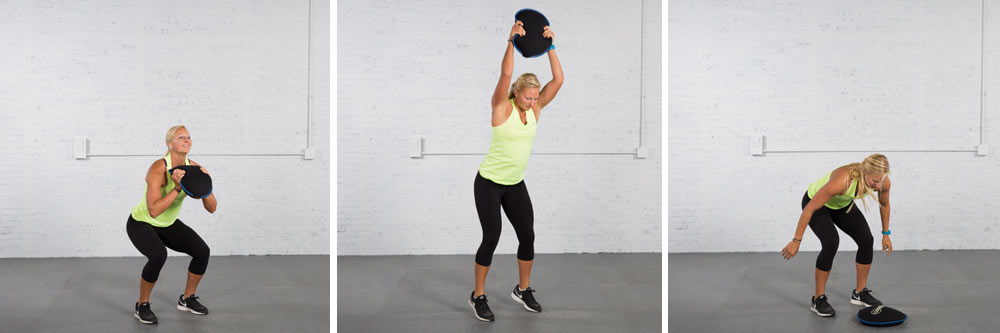
Dead Ball Slam

(6-8 reps, 2-4 sets, 45-60 second rest interval)

Use a dead ball (or sandbag) so it doesn’t bounce. When throwing the ball down, sink into the hips (like dropping in to a squat), then scoop the weight up and quickly perform the next rep.

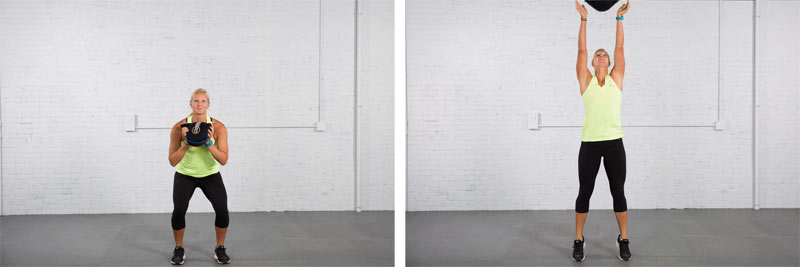
Push Press

(6-8 reps, 2-4 sets, 45-60 second rest interval)

Sink into the hips (like preparing to jump), explode up and push the ball straight up in the air. Allow the ball to fall to the ground before picking it up for the next rep.

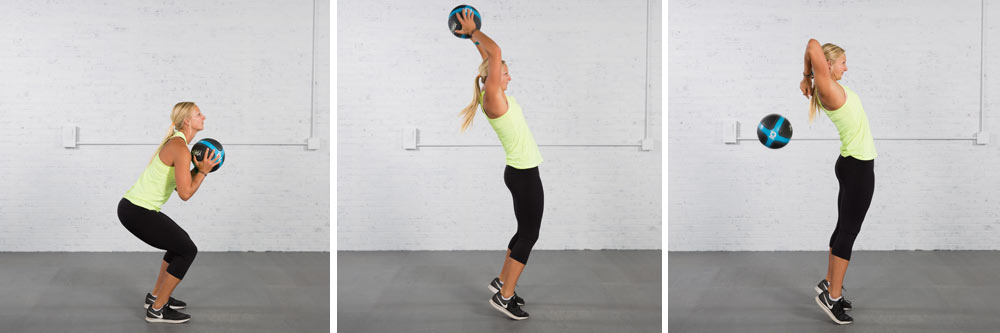
Reverse Overhead Slam

(6-8 reps, 2-4 sets, 45-60 second rest interval)

Sink back into the hips and hold the ball in the hands with the arms straight. Explosively drive the feet into the floor and press the hips forward while extending the body. Complete the move by releasing the ball behind the head.

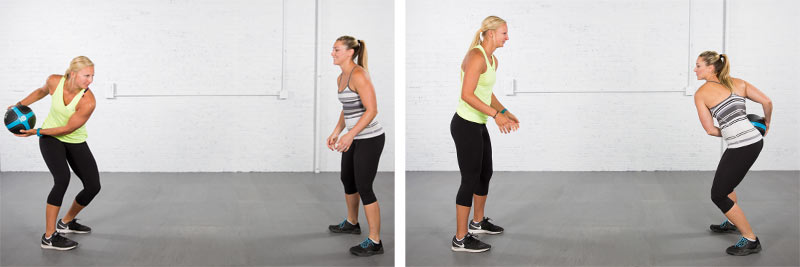
Rotational Throw

(6-8 reps, 2-4 sets, 45-60 second rest interval)

This exercise requires a rebounding wall or a partner. Stand with the feet approximately shoulder-width apart (if throwing from the right side, the left foot should be forward). Hold the ball in both hands and rotate over the right hip (allowing the left foot to turn in). Next, push the right foot into the ground to start the rotation. As the shoulders face forward release the ball from in front of the hip, angling it so that it either goes to the partner’s right hip (when facing each other) or, if using a wall, so that the ball bounces back to the right hip.

Chest Pass

(6-8 reps, 2-4 sets, 45-60 second rest interval)

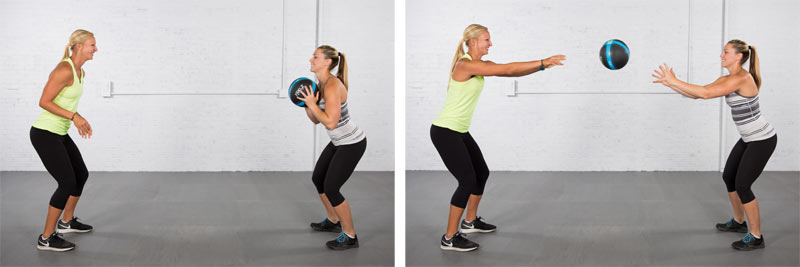
This exercise requires a rebounding wall or a partner. Stand with the feet hip width-apart and hold a ball in both hands at chest level. Sink into the hips and drive the feet into the floor while exploding the ball forward away from the body. If working with a partner, allow enough space for the ball to travel between partners. If using a wall, don’t stand too close to it.

Source 

Sunday, 14 June 2015

Seven Exercises For A Hot Upper Body

Why Women Store Fat
If you've been grabbing the extra fat in your thighs and triceps and wondering where it came from, your hormones could hold the answer. Yup, that's right. Hormones. Estrogen could be responsible for packing the fat cells in the back of your arms and thighs.
Estrogen also plays an important role in building muscle mass, preventing heart disease, bone breakdown, and may even stimulate bone formation. We simply need the right level of estrogen to look and feel great.
If our estrogen levels get too high, we can suffer from a number of negative side effects including cyclical headaches, anxiety, breast tenderness, water retention, irregular bleeding, and weight gain. Unfortunately, a blood test is the only way to know what your hormone levels are but there are other ways to keep your estrogen under control. Increasing the amount of exercise you perform daily can significantly lower estrogen levels.

Total Body Fat Loss Is Key
Isolated movements such as tricep exercises can help build muscle, increase strength, and boost your metabolism. But, spot training isn't enough. If you want results, you need to do the right combination of exercises and lose fat from all over your body before worrying about those so called "problem areas".
To burn fat, your exercise program requires three basic elements:
Cardio Exercise -- Your fitness program should have the right combination of slow cardio and intense interval training.
Strength Training -- Your workout week should also include 3-5 days of strength training per week. It's impossible for a female to bulk up, unless she is intentionally doing so. This part of your fitness routine will tone your muscles, build up your strength, and increase your metabolism. You'll burn fat more efficiently and use the fat you take in through your diet more wisely.
Proper Nutrition -- Without proper nutrition you won't lose fat. Knowing what to eat and when to it it is crucial to achieving your goals.

Exercises To Get That Hot Upper Body
Tricep Dip -- This strength exercise targets your triceps, but it also works your anterior delts, pecs, and rhomboids. The triceps consist of three heads that run from your humerus and scapula to your forearm: the lateral, medial, and long head. The lateral head is found on the top of your arm. The medial head comes down your midline, and the long head runs along the bottom of your arm. These heads allow you to straighten your elbow, and they also work in conjunction with your latissimus dorsi to bring your arm toward your body.
To perform a tricep dip:
1. Position yourself in front of a bench, chair, dip bar, or a set of rings with your hands shoulder width apart.
2. With your legs bent and your feet hip-width apart, elevate yourself so your arms are straight and your elbows slightly bent. (This will keep the tension on your triceps, instead of the joints in your elbows.)
3. Keeping your back close to the support, lower your upper body to the floor by slowly bending your elbows into a 90-degree angle.
4. Continue the movement until you reach the bottom, before pushing yourself back into the starting position. Just be sure to avoid bending your neck or moving your ears close to your shoulders.

Strong, Sensuous Shoulders

If you want a hot upper body, you'll need to work your shoulders.

These usually aren't what women consider sexy, but they are vital! They're the start of the hourglass figure we fight so hard to achieve. But strong shoulders will give you more than just good looks.
When you're exercising your shoulders, you're helping fight the natural ageing process by keeping them strong and building bone density. You're also decreasing your chance of suffering a shoulder injury. Sadly, unlike males, women aren't born with naturally shapely shoulders, so we have to work at it.
Lateral Raises
To really give your delts a workout, try an exercise like the cable lateral raise. This movement focuses on your lateral delt, but it actually works all three.
To perform a lateral raise:
1. Stand with your feet shoulder-width apart and a dumbbell in each hand.
2. Slowly raise them level with your shoulders while keeping your hands in front of your hips and your wrists facing each other. Pause before returning your arms to the start position.
Lats and Traps
When you work your back, you're actually working the latissimus dorsi muscles, or "lats". They start at the top of the humerus and fan down your back to the vertebrae and pelvic girdle.
Your lats make it possible for you to lean back or sit straight. They give your body some stability, but they also allow you to pull your arm toward your pelvis and bring your body toward your arm (like during a chin-up, for example).
Your trapezius muscles, or "traps", run along your spinal column, from the base of the skull to your middle to lower back. Their function? To pull up, down, and towards the centre of your body. They also make it possible for you to shrug your shoulders, lower your shoulder blades,
and bring them together.
Pull-Ups
To get your traps and lats into shape, try pull-ups as a simple way to work a lot of muscles. In addition to working your lats and pectoralis major, pull-ups also work your posterior delts, traps, rhomboid, and your levator scapulae, as well as your teres major, pectoralis minor, and serratus anterior muscles. The biceps, rectus abdominis, erector spinae, transverse abdominis, and obliques are also involved.
To get started, try a standard chin-up. To perform one of these, use an underhand grip to pull your chest toward the bar. Once you've reached the top, hold the position. Then, lower your body into a dead hang.
When you're ready to move beyond a chin-up, switch to a pull-up by using an overhand grip. Then, there are several other variations you can try, including pulsating at the top of the movement or hanging onto the bar for as long as you can.

Importance of Chest Exercises

If you want to have a sexy upper body, you need to focus on the balance between your joints, tendons, target muscles, and their opposing muscles. Referred to as the planes of motion, this balance is a vital component for any quality exercise program. And if you want a strong upper body and back, you'll need to work your pectoral muscles.
The planes of motion is based on the fact that, even though you're working the target muscle (the agonist), you need to be working the opposite muscle (the antagonist) the same amount. If you're doing squats to work your quads, you'll also want to do exercises that work your hamstrings, calves, glutes, and lower back to avoid an imbalance. Hence, the need for chest exercises.
Your pectoral major muscles, or pecs, run from the humerus to the sternum and rib cage. And they work with your back muscles to pull your arm toward your body. Alone, they allow you to pull your arm forward.
Cable Flys
1. Step forward with your chest out and stomach tight to put resistance on your pecs.
2. Bend your elbow slightly and pull the cables toward each other in front of you by straightening your arms. Think of it like there's a stability ball on your chest and you're pulling the cables around the ball.
3. Once you've reached the top of the movement, pause, and return to the starting position.

Sexy Six-Pack Abs
Everyone wants the gorgeous ¬‚at stomach and the famous six-pack. But these stunning 'bumps' aren't separate muscles. They're two muscles called your 'rectus abdominis', and they're found between your ribs and pubic bone, joined in the centre by the linea alba.
It's these muscles that move the trunk of your body, ¬‚ex your spine during movements such as a crunch, and bring your pelvis to your ribcage during leg-hip raises or posterior pelvic tilts. They do more than just help you move, however.
Your rectus abdominis helps

 Source

Saturday, 4 April 2015

Jillian Michaels: No More Trouble Zones Workout- Circuit 3

Jillian Michaels: No More Trouble Zones Workout- Circuit 3 is an intense
strength-building circuit that is designed to sculpt lean muscle, burn
fat, and tone stubborn problem areas using Jillian's surefire formula
that combines dynamic upper and lower body-toning exercises. Grab a
light set of hand weights and get ready to sweat as America's Toughest
Trainer, Jillian Michaels takes you through the third workout circuit of
her "No More Trouble Zones" Fitness DVD Series that will shape strong
arms, toned legs and buns, and chiseled shoulders. Blast away calories
and melt off the extra pounds as you tone your entire body with this
highly-effective strength training workout that will leave you looking
and feeling your best for summer.

Tuesday, 31 March 2015

How to Beat Flabby Arm Jiggle

Just because you're holding excess body fat on your arms doesn't mean you can't get rid of it. Altering your exercise regimen and making a few simple dietary changes can help you beat arm jiggle.

Add 30 Minutes of Aerobic Exercise

If you're not doing cardiovascular exercise on a regular basis, it's time to start. Aim for 30 to 60 minutes of cardiovascular exercise most days of the week to beat arm jiggle and burn fat all over your body. A study published in 2012 in the American Journal of Physiology found that study participants lost about the same amount of body fat whether they participated in 30 or 60 minutes of aerobic exercise daily.

Participate in Interval Training

Adding interval training to your workout regimen may result in significant arm-fat loss. A study published in 2011 in the Journal of Obesity found that high-intensity interval training, which is alternating short stints of high-intensity exercise with recovery bouts at lower intensities for just 20 minutes, three days weekly is an effective fat-loss strategy.

Perform Upper-Body Resistance Exercises


While it's difficult to reduce body fat in just one area of your body, participating in upper-body resistance training on a regular basis reduces arm fat, according to a study published in 2007 in Medicine and Science in Sports and Exercise. Work each muscle group two to three days weekly, and perform two to four sets of 8 to 20 repetitions for each exercise, suggests the American College of Sports Medicine.

Upper body exercises that help you beat arm jiggle and work your biceps, triceps, shoulders and upper back include arm curls, triceps extensions, triceps kickbacks, push-ups, chest press, shoulder press, front raises, lateral raises, bent-over deltoid raises, bent-over rows and upright rows.

Make Subtle Dietary Changes

Lowering your overall caloric intake, cutting out extra sugar, and boosting dietary protein are subtle dietary changes you can make to help beat arm jiggle. A study published in 2011 in The Journal of Nutrition found that study subjects who exercised regularly, ate slightly fewer calories than usual, and consumed 30 percent of their total calories from protein, including protein from calcium-rich dairy foods, lost more weight and body fat and maintained more lean muscle than participants who consumed lower amounts of protein.

Foods to include in a fat-loss diet include those rich in protein, such as low-fat milk, low-fat cottage cheese, plain Greek yogurt, reduced-fat cheese, lean poultry, seafood, egg whites, soy products, nuts, seeds and legumes. Pick plenty of fiber-rich vegetables, such as leafy greens, broccoli, cucumbers, tomatoes, asparagus, peppers and green beans. Choose whole grains like quinoa, brown rice, oatmeal, and whole-grain couscous instead of white bread, white rice, crackers, commercial baked goods and other sweets.

Considerations if You Have Loose Skin

If you've lost a considerable amount of weight, have reached your goal weight, and your arm jiggle is due to loose, saggy skin, talk with your doctor about ways to get rid of it. In some cases, people with significant weight losses require skin removal surgery to get rid of excess skin caused by extreme weight loss.

source

Monday, 9 February 2015

4 Upper-body Movements for Beginners

While you might be tempted to focus on cardio to help get rid of those extra holiday pounds, don’t skip your strength-training workouts. In addition to great exercises like squats and lunges, be sure to focus on strengthening your upper body as well. If you’re new to exercise, or if it’s been some time since you performed resistance-training exercise, here is a quick review of some basic—but very effective—upper-body exercises. And if you’ve already mastered the basics, options are given to increase the challenge.

Modified Push-ups
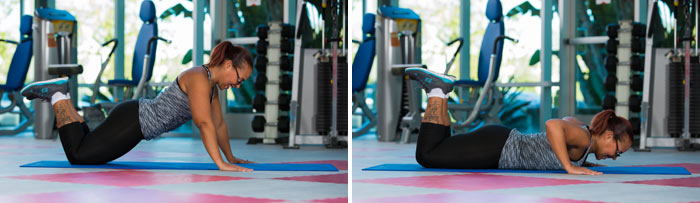
modified push-up

Lie on your stomach and place your hands directly under your shoulders. Engage your core and bend your knees so your feet are pointed up toward the sky. As you get ready to push yourself to the top position of the push-up, make sure there is a straight line from the top of the head to the knee. Do not allow your back to sway or your hips to bend. Slowly bend the elbows to 90 degrees, pause, and then press back up to the starting position.
Note: If wrist pain is a problem, hold a dumbbell in each hand. This will help neutralize your wrist position.
Advanced: Perform the push-up from your feet instead of your knees. You can also place a resistance band beneath both hands. When you reach the top of the push-up, lift one elbow up to the sky in a rowing movement. Drop the hand back to the floor and repeat with the other arm; complete another push-up and repeat.

Front Press
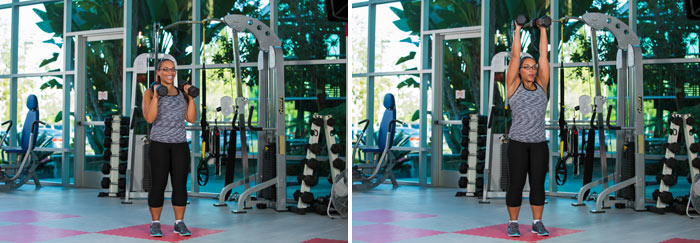
front press

Stand with feet a little wider than hip-distance apart; hold a dumbbell in each hand. Elbows should be bent and hands with the dumbbells should be directly under your chin. Wrist should be in neutral alignment with your palms facing one another. Keeping your shoulders down and away from your ears press the dumbbells over but not behind your head. Keep the core and glutes engaged to help prevent excessive arching of the lower back.
Advanced: Increase the challenge of this exercise by standing on one leg. As you press, twist your torso toward the leg you are standing on and come back to the starting position; repeat with the other leg.

Biceps Curl
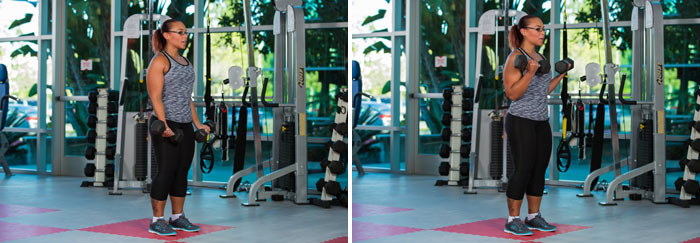
Biceps Curl

Stand with legs a little wider than hip-distance apart; hold dumbbells by your sides. Pull your shoulders down and away from your ears; keep your core tight and maintain a straight line from the top of your head to your feet. With palms facing forward, bend the elbows and lift the dumbbells toward your shoulders. Keep your elbows close to the sides of your body throughout the movement
Advanced: Perform the biceps curl while doing an alternating reverse lunge.

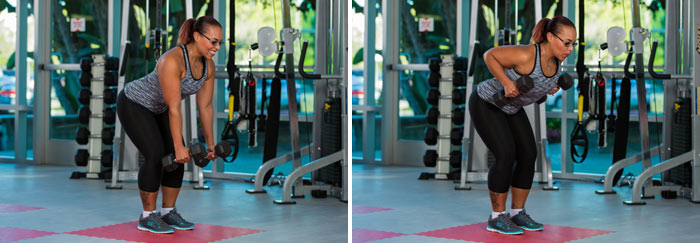
Bent-over Row
Bent Over Row

Stand with your feet slightly wider than shoulder-distance apart; keep a slight bend in your knees and hold a dumbbell in each hand, palms facing each other. With the core engaged and torso in a straight line from the top of the head to the hips, hinge at the hips. Bend your elbows and slowly pull the dumbbells toward your torso until they touch your abdomen; slowly lower the dumbbells back to the starting position.
Advanced: To increase the challenge, perform the row while standing on one leg. Bend forward until torso is parallel with the floor and the back leg is raised in the air. Repeat on the other leg.

Source