Showing posts with label strength training. Show all posts

Monday, 14 December 2015

Make Your Gym Sessions More Productive And Comfortable In The Right Gym Shoes

Getting a gym membership can be exciting whether you are looking forward to losing weight and shaping up, building muscles or simply getting fit. Whatever your reasons for going for some gym activities, you ought to remember that the shoes you select can have effects on how comfortable and productive you remain. A good gym shoe is one that does not keep reminding you that you are wearing it probably because it is too hot, too tight too heavy or because it pinches. You need to choose the right shoe to make sure that you give maximum concentration on  the gym workout.

Grip – This is very important especially when you are looking for weight lifting shoes. Shoes that offer a flat firm grip on the floor or ground gives you proper form and they keep you safe from skidding when lifting heavy weights. It is important to avoid thick soled high tech shoes when in the weight room for safety and effectiveness in the activity. Always look at the sole of your shoes and the anti-skid features it has to ensure that you select a pair that is bound to offer firm grip regardless of the gym floor that you get exposed to.

Support – This is another very important aspect of gym shoes especially for strength training and cardio sessions. Remember these are activities that consist of side to side shuffling and jumping and you therefore should look for a shoe that has ample support. Wide toe box high top sneakers can be great choices when you are looking for optimal movement. Look for shoes that offer ankle support and arch support as well to keep the aerobic movements swift and safe for you. Shoes that are able to keep your feet from inward rolling are best for treadmill time  so make sure you pay attention to this supportive feature as well.
Comfort – It is definitely something you must pay attention to. Choose high top sneakers that have ample cushioning to keep your feet comfortable whether you are strength training or lifting weight. A comfortable gym shoe should not only be cushioned but also light enough and breathable for your feet so that they don't end up feeling overheated and heavy as this can slow you down. Comfort also relies on the shoe size that you select. Make sure your workout shoes fit comfortably. Avoid choosing very tight shoes or very large ones because either way you will have a hard time keeping up with the gym demands.

Style – You might be going to the gym but you definitely do want to look stylish. There are so many stylish sneakers you can choose for your gym workouts so you do not have to compromise your sense of style just because you are hitting the gym, go for workout high tops! When you take time to weigh your options, you will find a gym shoe you love and one that matches your personality. Love the shoe to enjoy wearing it to the gym.
Bodybuilding sneakers are very important for any gym workout. Ensure you remain safe, productive and comfortable by selecting excellent gym shoes that have all important features included and get the right fit for your feet.

Source 

Thursday, 17 September 2015

Resistance Band Guide

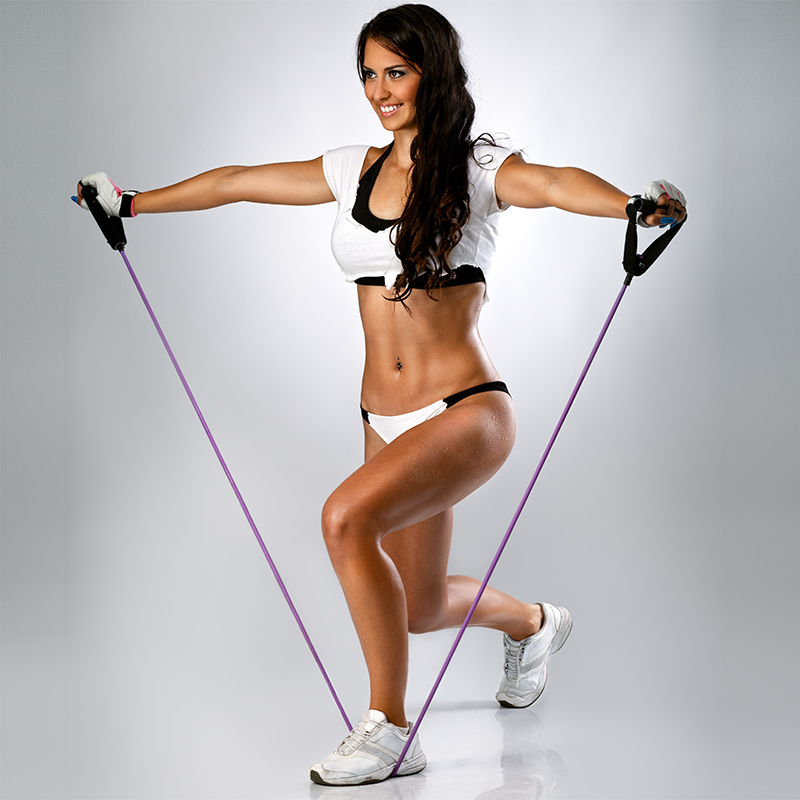
Resistance bands, also called resistance tubing, are an exercise accessory made of rubber. Common exercises can be maximized with resistance bands, as the bands increase the load requirement put on your muscles. Because of their versatility, exercise bands are an appropriate exercise tool for people of all fitness levels. Talk with your doctor before starting a new exercise routine, particularly if you have an existing health condition or injury.

Types

The thicker your resistance band is, the more resistance it will provide. Lighter colors are generally for lighter resistance levels, and as the thickness increases, the colors of tubing get darker. You should use a resistance band that you’re able to stretch, but that is still challenging for you. When stretching your band is no longer demanding, you should advance to the next level of thickness. The varying muscles in your body have different levels of strength, so buy a variety of bands so you’ll be prepared for different exercises. Resistance bands with padded handles are usually more comfortable than non-padded, interchangeable ones.

Usage

Resistance bands are used to gain strength, flexibility and balance. Depending on the exercise, the band can either be fastened to an object such as a door knob, or you can use the band while holding onto the handles. Muscle strengthening exercises such as hamstring curls, bicep curls, squats and reverse crunches are enhanced when a resistance band is incorporated because of the force you exert when attempting to pull the band. You should perform eight to 12 reps of each exercise and two to three sets of each rep.


Benefits

Resistance bands are inexpensive, lightweight and easy to pack into luggage or a gym bag. You can use them with most calisthenic-type exercises, and their versatility will help you concentrate on your targeted muscle groups. For example, if your goal is to strengthen your hamstrings, use your resistance band around both ankles and perform single leg butt kicks while holding on to a secure surface. The resistance from the band will increase the work done by your hamstrings.

Precautions

If a resistance band is joined together at the ends to make one continuous band, the bond where it is joined can be faulty and break, leading to injury while exercising. Choose a band that is a continuous piece of rubber. When performing an exercise that requires the band to be attached to an object, be sure it is fastened securely to avoid slippage. If the rubber on your resistance band shows sign of wear, aging or weather damage, replace it with a new one. If you experience sudden or sever pain while working out with resistance bands, seek medical help immediately.
Source : Susan Presley has been a health care journalist since 2006. Her articles have been published by "Current Health" and the "American Journal of Nursing." With a Bachelor of Arts in communication from Truman State University, she is pursuing a Master of Divinity at Louisville Seminary in Kentucky.


Tuesday, 15 September 2015

What is Crossfit

“CrossFit is a strength and conditioning programme built on constantly varied, if not randomised, functional movements executed at high intensity” – Founder Greg Glassman


You haven't heard of CrossFit? Let me tell you about CrossFit.

CrossFit is a lifestyle in which you are prioritizing your health. The ability to do many different things at a high level of intensity.
I think it's the absolute best way to help you reach your fitness goals.

For me, it's making me happy. A fun way to get fit with a lot of people. The last person finishing is the just as important as the first one.

It's this team atmosphere that ends up making you better as an individual. It's camaraderie, that family that you end up building and the energy that you get back from it yourself, that's CrossFit to me.
You come to a CrossFit gym everybody knows your name, everybody loves you and you're a part of something bigger than just getting a workout.

CrossFit gave me that something extra that I kinda needed in life.

It's my outlet, I love it. It's my passion. It's commitment. CrossFit is a sport now.

I like the challenge, I compete with myself, I'm healthier, I am stronger. Even though I was sore, I was, you know, getting a little discouraged, you know ... I felt accountable because my community, or I felt accountable to my class because they were looking for me there.

Finding CrossFit and then having to work really dang hard for whatever your goal is ... whether its to compete or just get a damn pull-up. I love it 'cause the workout's different everyday, I can come in and I don't know what I'm doing.

Everyone is welcoming, everyone is cheering you on. They don't let you quit even if you wanna quit.
We all share this experience, which is emotional. It doesn't look emotional, it looks like people working out ... but it's emotional. I mean it's raw, it's intense, it's incredible, it's freakin' awesome. I'm  gonna keep doing it for a long time, I hope.

CrossFit, to me, is a fitness program where the reward for doing well is the ability to express your fitness in everyday life in as many different planes or as many different activities that you can possibly imagine.

People walk through the door and say, 'Hey, where's all the machines?' We're the machines!

Source: http://journal.crossfit.com/start.tpl
 

Monday, 14 September 2015

TRX Workout for beginners

This TRX workout is designed for beginners. One of the things I hear most often when I talk about TRX, including in response to my TRX beginner tips, is that people want to try it, but aren’t sure what to do and don’t want to look silly . My goal with this workout is to introduce you to some basic moves and give you something you can pull up on your phone at the gym so you know what to do. This workout is an interval workout, which is very common for TRX. Each move is performed for 30 seconds. Move as quickly as you can from one move to the next. They are staggered to focus on upper body, lower body, and core so you shouldn’t need to rest in between (but of course, if you do need a rest, take it). As you advance, feel free to increase the interval. I typically do 30-60 second intervals depending on what I’m doing. The exercises are split into two mini circuits and you’ll repeat each circuit three times. Form notes for the exercise appear below the graphic.


Form Notes:
Most of these notes reference the non-TRX version of the exercise (squat, lunge, plank, etc) and they assume you are familiar with the proper form for those exercises. If you are not familiar with the non-TRX version, please please please make sure you understand the proper form before you attempt the TRX versions.
  • Chest press - For me, the easiest way to think about this move is to think of it as a push-up with your hands in the straps. Your elbows should come along your sides at roughly a 45 degree angle. The straps should be outside your arms. Keep your wrists straight.
  • Squat - The form here is almost identical to a normal squat but your weight is further in your heels since you have the TRX for support. Make sure you are using your legs, not pulling with your arms.
  • Rows - Keep your wrists straight. When your arms are extended, your palms should be facing the ground. As you pull your bodyweight up, rotate your hands so that at the top of the movement, your palms are facing inward. Keep your elbows in so they are shaving along your ribs.
  • Plank - This is just like a normal forearm plank, but your feet are in the straps. If you’re anchored to a wall, make sure your feet aren’t touching the wall (that’s cheating).
  • Reverse lunges - Again, this is similar to a reverse lunge. However, you aren’t really stepping back on your back leg, you are floating it back. When you first start, tap your back toe to the ground as lightly as possible. Work up to the full version where you hover the back leg without touching the ground. Remember to use your legs, the straps are just for balance. Do 30 seconds on your right leg first, then switch to your left.
  • Bicep curls - Hold the straps with your arms extended out in front of you, palms up. As you perform the bicep curl, keep the 90 degree angle between your upper arms and your torso (this is harder than it sounds). Control the movement as you lower back down, don’t just drop.
  • Hamstring curls - With your heels in the straps and your toes pressing against the handles, press up into a reverse plank with your shoulders on the ground. Your body should be in one long line from your shoulders, through your hips and legs, to your feet. From this position, pull your heels in towards your butt without changing the position of your torso.
  • Tricep press - Face away from the anchor point holding the straps above your head and your palms facing forward. The motion is similar to a normal overhead tricep press. Keep your elbows just at the edge of your peripheral vision. Your upper arms should not be moving, your elbows should be anchored in place, the only motion should be your forearms
  • Knee tucks - Start in plank position, top of a push-up, shoulders over wrists, feet in the loops. Pull your knees in toward your chest, return to start, repeat.
 Source : http://busy-bod.com

Monday, 7 September 2015

The 5 Key Dimensions of Physical Fitness Exercises You Should Know About

When you properly engage in physical fitness exercises, your body will attain a high level of mental and physical health.
In fact, suitable aerobic fitness exercise will help you remove 'bad cholesterol' and increase 'good cholesterol'. Moreover, the network that control blood supply in your body will get strengthened; the risk of many grave diseases will drastically reduce; the duration of existing illnesses will be significantly shortened; and infections will be prevented.
Yet, the 5 key dimensions of physical fitness exercises have different effects on different aspects of the body though they generally help the body achieve better state without taking drugs.

Strength (Muscular) Building Exercises
Here, the ability of muscles to carry heavy objects - lifting, pushing, and pulling - are developed as well as the basic walking, standing and general posture-related activities.
Usually, you can develop these muscles by engaging them in overload exercise and gradually increasing the amount of load you carry during exercise. For example, isometric exercise involves trying to lift or pull immovable objects (though it is not advisable for people with hypertension); isotonic exercise involves the use of dumbbells and other regular objects used in weight lifting; and isokinetic exercise is usually done by athletes and professionals.

Endurance (Muscular) Exercise
You can decide to improve the endurance of some groups of muscles in your body e.g. the leg muscles, abdominal mass, etc. This closely resembles cardio-respiratory endurance; it actually focuses on the ability of the muscles to withstand continuous, long term activities.

Flexibility Exercise
Joints are subject to 'the law of use and disuse' whereby they function less efficiently when not used regularly. This is particularly important to dancers. In physical fitness exercises, flexibility improves the efficiently of joints in the body. It also improves balance and posture.

Body Composition Exercise
The ratio of healthy body fat to body mass is a primary concern in physical fitness training. Body composition exercise tackles overweight, obesity and related concerns.

Cardio-Respiratory Fitness Exercise
Specifically, cardio-respiratory fitness exercise forms the groundwork for other workouts by increasing your ability to endure work for longer periods and work more intensely. When the body draws on oxygen to perform activities, it would not have to (an-aerobically) produce lactic acid that causes muscle fatigue. More so, it has been reported that cardio-respiratory physical fitness exercise enhances lifespan and greatly reduces the risk of infections.
Consequently, it is advisable to pay a higher premium on cardio-respiratory fitness exercise since it supports your body fitness and enhances your well-being. Nonetheless, any of the other fitness exercises are alright depending on your own goal.