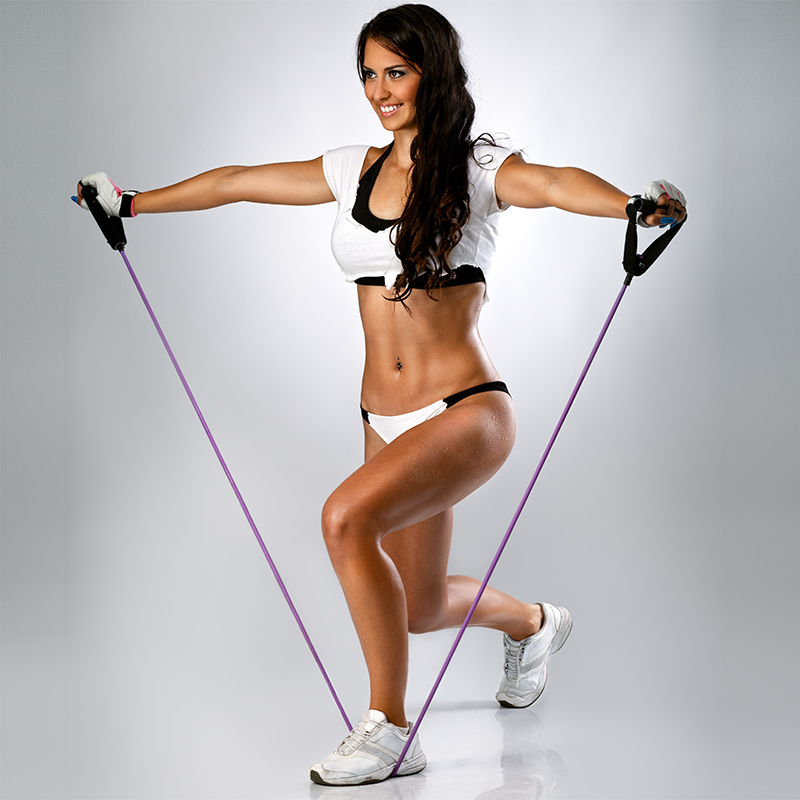
Spice up your workouts
When it comes to strength training, most of
us stick to the usual free weights and machines or, if we're feeling
frisky, we may venture over to the cable or free motion machines at the
gym. What you don't see a lot of is work with resistance bands or
tubing.
We're often confused about what resistance bands do and how to
use them, but they're a great way to workout while you travel or add
variety to your usual routine.
Resisting Resistance Bands
Some of the problems people often have with resistance bands:

- The resistance feels different. When you use free
weights, gravity decides where the weight comes from, so you get more
resistance during one part of the movement (such as the upswing of a
bicep curl) than the other (the downswing). With bands, the tension is
constant, which makes it feel harder. Bands work much like a cable
machine, allowing you to keep constant tension on the muscle. You'll
also incorporate more stabilizer muscles to keep the band in alignment
throughout each exercise, adding a different dynamic to the same old
moves.
- Resistance bands aren't as challenging as machines or dumbbells.
With weights, you know exactly how much you're lifting. With bands, you
can only go by how it feels and the tension on the band. That doesn't
mean you're not getting a good workout, though. If you use good form and
the right level of tension, your muscle fibers won't know the
difference between weights or bands. Plus, bands offer more variety
because you can create the resistance from all directions--the side,
overhead, below, etc.
- You don't know how to use them. It can be confusing
trying to figure out how to use a band. Keep in mind that you can
perform the same exercises as you do with free weights--the difference
lies in positioning the band. For example, you can stand on the band and
grip the handles for bicep curls or overhead presses. You can attach it
to a door and do lat pulldowns or tricep pushdowns. You can wrap the
band around a pole for chest exercises or shoulder rotations. The
possibilities are endless and you'll find there are a number of exercises and workouts available to you.
Why You Should Try Resistance Bands

- They travel well. You can easily pack them in your suitcase for travel and do exercises in the car or in your hotel room.
- They increase coordination. Because there's tension
throughout the exercises, you have to stabilize your body. This helps
with coordination, balance and it also helps you involve more muscle
groups.
- They add variety. With weights, you're often limited
as to how many exercises you can do. But, the resistance band allows you
to change your positioning in multiple ways. This changes how your body
works and how an exercise feels.
- They're inexpensive. Bands range anywhere from $6 to
$20, depending on how many you get and where you buy them, which is nice
for the budget-conscious exerciser.
- They're great for all fitness levels. Depending on
how you use them, bands can be great for beginners as well as more
advanced exercisers. You can use them for basic moves or to add
intensity to traditional moves.
Buying Resistance Bands
You'll find that there are a variety of
resistance bands available and you can usually find them almost anywhere
including discount stores (like Walmart or Target), at most sporting
goods stores. You can even sometimes find them at stores that also sell
exercise DVDs like Borders or other book stores.
You can always buy resistance bands in stores, but if you're
looking for more options and, sometimes, more quality, you may find you
have to order them online.
A few tips for buying bands:

- Buy a variety of bands. Most bands are color-coded
according to tension level (e.g., light, medium, heavy, very heavy).
It's best to have at least three - light, medium and heavy since
different muscle groups will require different levels of resistance.
- Buy comfortable, easy to use bands. Some bands you
find in stores offer interchangeable handles, which means you have to
take them off and on to use different bands. Some have handles that are
larger than normal or made of hard plastic. These are minor issues, but
they can make using your bands more difficult than it needs to be. Try
to buy bands with padded handles and make sure you don't have to change
them out.
- Buy accessories. One key to using bands is having
different ways to attach them. If you have a sturdy pole or stair rail
in your house to wrap the band around for exercises like chest presses
or seated rows, you may not need much more than bands. But, if you
don't, you may want a door attachment. You can also buy ankle cuffs, different handles and other accessories.
- Keep it simple. There's a wide variety of bands
available - figure 8's, double bands, circular bands, etc. If you're
just getting started, stick with your basic long tube with handles. Once
you figure out how to use it, you may want to buy other types later for
variety.
My all-time favorite resistance bands are
SPRI Deluxe Xertubes. They're high quality, have padded handles and SPRI also offers a huge variety of other types of bands if you're interested.
Exercises and Workouts for Resistance Bands
If you're ready to try your resistance bands,
below is a list of basic moves to get you started. I've provided tips
for each exercise and you can click on the links to view the exercises.
All of these moves are shown in full detail with instructions at
Resistance Band Workouts for Beginners:
- Chest Press.
For this exercise, wrap the band around a pole or rail behind you or
use the door attachment to secure the band in the door. The resistance
band should be right at about chest level and you should step far enough
away from the door that you get constant tension on the band. Keep your
elbows in a 'goal-post' position (parallel to the floor) throughout the
movement.
- Seated Row.
For this move, you can keep the band where it is and simply turn around
so that you're facing the band. This exercise targets the large muscles
on either side of the back, so make sure you squeeze the back without
arching or pulling the elbows too far back.
- Bicep Curls.
For the bicep curl, you can stand on the band with both feet (harder)
or with one foot (easier). Hold the handles in each hand and curl up in a
bicep curl, just as you would with dumbbells. You can make this move
harder by stepping the feet wide or by using a heavy band.
- Squats.
For squats, stand on the band and hold the handles up towards the
shoulders (elbows bent) to create more tension. You'll probably want to
use heavy resistance here since your leg muscles are large and will
usually require more tension to fatigue them.
These are just a few examples of band exercises. Below is a list
of full workouts you can try or, if you don't like the idea of using
bands for your entire workout, try incorporating some of the exercises
with your traditional weight routine for variety and challenge.
source

 Resistance bands, also called resistance tubing, are an exercise accessory made of rubber. Common exercises can be maximized with resistance bands, as the bands increase the load requirement put on your muscles. Because of their versatility, exercise bands are an appropriate exercise tool for people of all fitness levels. Talk with your doctor before starting a new exercise routine, particularly if you have an existing health condition or injury.