Showing posts with label energy performance. Show all posts

Monday, 14 September 2015

TRX Workout for beginners

This TRX workout is designed for beginners. One of the things I hear most often when I talk about TRX, including in response to my TRX beginner tips, is that people want to try it, but aren’t sure what to do and don’t want to look silly . My goal with this workout is to introduce you to some basic moves and give you something you can pull up on your phone at the gym so you know what to do. This workout is an interval workout, which is very common for TRX. Each move is performed for 30 seconds. Move as quickly as you can from one move to the next. They are staggered to focus on upper body, lower body, and core so you shouldn’t need to rest in between (but of course, if you do need a rest, take it). As you advance, feel free to increase the interval. I typically do 30-60 second intervals depending on what I’m doing. The exercises are split into two mini circuits and you’ll repeat each circuit three times. Form notes for the exercise appear below the graphic.


Form Notes:
Most of these notes reference the non-TRX version of the exercise (squat, lunge, plank, etc) and they assume you are familiar with the proper form for those exercises. If you are not familiar with the non-TRX version, please please please make sure you understand the proper form before you attempt the TRX versions.
  • Chest press - For me, the easiest way to think about this move is to think of it as a push-up with your hands in the straps. Your elbows should come along your sides at roughly a 45 degree angle. The straps should be outside your arms. Keep your wrists straight.
  • Squat - The form here is almost identical to a normal squat but your weight is further in your heels since you have the TRX for support. Make sure you are using your legs, not pulling with your arms.
  • Rows - Keep your wrists straight. When your arms are extended, your palms should be facing the ground. As you pull your bodyweight up, rotate your hands so that at the top of the movement, your palms are facing inward. Keep your elbows in so they are shaving along your ribs.
  • Plank - This is just like a normal forearm plank, but your feet are in the straps. If you’re anchored to a wall, make sure your feet aren’t touching the wall (that’s cheating).
  • Reverse lunges - Again, this is similar to a reverse lunge. However, you aren’t really stepping back on your back leg, you are floating it back. When you first start, tap your back toe to the ground as lightly as possible. Work up to the full version where you hover the back leg without touching the ground. Remember to use your legs, the straps are just for balance. Do 30 seconds on your right leg first, then switch to your left.
  • Bicep curls - Hold the straps with your arms extended out in front of you, palms up. As you perform the bicep curl, keep the 90 degree angle between your upper arms and your torso (this is harder than it sounds). Control the movement as you lower back down, don’t just drop.
  • Hamstring curls - With your heels in the straps and your toes pressing against the handles, press up into a reverse plank with your shoulders on the ground. Your body should be in one long line from your shoulders, through your hips and legs, to your feet. From this position, pull your heels in towards your butt without changing the position of your torso.
  • Tricep press - Face away from the anchor point holding the straps above your head and your palms facing forward. The motion is similar to a normal overhead tricep press. Keep your elbows just at the edge of your peripheral vision. Your upper arms should not be moving, your elbows should be anchored in place, the only motion should be your forearms
  • Knee tucks - Start in plank position, top of a push-up, shoulders over wrists, feet in the loops. Pull your knees in toward your chest, return to start, repeat.
 Source : http://busy-bod.com

Friday, 11 September 2015

Seven Habits of Highly Successful Athletes

They say a habit takes 21 days to form. That’s three weeks of constant, recurrent, focused activity – or inactivity. The differences between good and bad habits lie in the details, but they both exist as an end to the same means: repetition.
“We are what we repeatedly do,” Aristotle said, once upon a time. Essentially, we are our habits. For  athletes, those habits determine their game, their success, their production, their relevance. Elite athletes carefully develop the habits that define them well past the 21-day qualifying point.
Most of us aren’t built to be elite athletes, at least not genetically, but our choices are within our control, and can elevate our game at any level. Choosing to adopt these seven habits of successful athletes is a sure-fire way to find success for yourself. If you can’t beat ‘em, join ‘em.

THE LIST:

1. They set attainable goals and track them

Tim HippsAs athletes, we all have ambitious goals. We want to win that 3-on-3 tournament next month. We want to compete in that triathlon at the end of the year. We want to hoist that trophy at the end the season. That victorious moment is a driving force we all share.
Successful athletes have those goals, but they also create their own moments of victory in parallel to their pursuit of the endgame. While they’re training for that championship, they’re simultaneously working toward attainable goals to check off their list.  While they’re training for that marathon, they’re also working toward that six-minute mile. While they’re pursuing that Gold medal, they’re also locking down tournament MVPs.
Achieving a goal, no matter the size of the prize, is a powerful incentive. It’s a reminder that following through pays off.


2. They discipline and reward themselves


It’s a simple concept, just a matter of application.
Motivation is all about incentive. What’s the payoff? What’s the punishment? Successful athletes make it a point to take themselves seriously, and that means calling themselves out and holding themselves accountable.
Didn’t get out of bed this morning for that run? Skipped breakfast? That’s ok, but yeah, you’re grounded. Ran an extra mile at the end of practice today? Grounding revoked.


3. They sleep

An even simpler concept. Successful athletes make sure to clock at least seven hours of sleep every night to aid in rest and recovery. For optimal performance, sleep is crucial in maintaining energy and endurance.


4. They feed their competitive nature

Sir MervsAverage isn’t okay for elite athletes. The successful ones go out there and compete every time, no matter who they’re with, what they’re doing or where they are. Competition is fuel to athletic fire, and the best in the game are out there burning it up every day.
Successful athletes are constantly pushing to be better than the guy next to them, better than they were yesterday, better than the standard. Pushing forward with intensity and a competitive drive keeps you on your toes and dynamic as an athlete.
Too many people mistake competition for comparison. Successful athletes know the difference. One will make you, one will break you.


5. They take instruction and criticism constructively 


Successful athletes can take advice and apply it usefully to their game. Coaching is crucial in sports, but absorbing the information they provide is even more important.
The best athletes are willing to make adjustments and set their pride aside to better themselves and their teammates.


6. They let things go

They follow the 24-hour rule. 24 hours after a failure, the misstep has long since moved into nonexistence. Bye-bye blunder.
Holding onto negativity can be detrimental to athletes. Mentally, it’s crippling. It gives pitchers the yips, it turns a basketball into a brick, it makes a wide receiver’s fingers all buttery.
The successful ones take 24 hours to reflect on what went wrong and then they let go of that heavy weight and move on without flinching.

7. They aren’t afraid to fail

The most distinctive habit of a successful athlete is their ability to stare a challenge in the eye and attack it without hesitation. The fear of failure builds the walls of that box you’re supposed to be thinking outside of and seals you up inside. When you’re scared of failing, the best option is to avoid trying at all – right?
Chicken.
Fearing failure is a mental state successful athletes don’t acknowledge. Everyone will fail at one point or another – it’s inevitable. The best athletes are fully aware of this, but attach no value to it. They fall and they get up. The ends outweigh the means. Success outweighs failure.
Plus, chicks dig scars.

Source By: Morgan Urtso Seven Habits of Highly Successful Athletes

Tuesday, 25 August 2015

5 Whole Foods to Replace Ergogenic Aids

Supplements are a significant component of the sports nutrition industry, and many manufacturers claim their products can assist with everything from sport performance and weight loss to energy production and muscle recovery. These products are commonly referred to ergogenic aids, which are any external influences believed to enhance physical activity or performance. Nutritionally, these products include sport powders, pills, gels, bars, drinks, jellybeans or any other substance used to boost performance, and a majority of athletes have tried one or more ergogenic aid at one time or another.
While the research is unclear (or nonexistent) regarding the benefits of many of these products, whole foods can provide as much, if not more, power to performance without the added sugars, chemicals or artificial flavors.

What are Whole Foods?
Whole foods are those that are eaten in or close to their natural state. Kory DeAngelo M.S., R.D., a clinical nutrition supervisor at the Bastyr Center for Natural Health, recommends eating whole foods “in their natural form, including an abundance of fruit, vegetables, whole grains and healthy proteins, to give the body an array or vitamins, minerals, fiber and other phytonutrients.”
DeAngelo believes that nature provides the body’s essential nutrients in the whole foods package, and that supplements should not replace healthy eating. In fact, she says, many whole foods cost less and can be used as ergogenic aids. Here are some examples of healthy, whole food alternatives to nutritional supplements.
 
Coconut Water
A growing body of research suggests that coconut water, which some have dubbed “nature’s Gatorade,” is an effective rehydration beverage. One study, for example, showed that fresh young coconut water could be used as a post-exercise rehydration beverage because it doesn’t cause nausea or upset stomachs and is easier to consume in larger quantities compared to plain water and an carbohydrate-electrolyte beverage (Saat et al., 2002).

Beet Juice
Studies examining the benefits of pharmacological sodium nitrate supplementation have found that it can reduce the oxygen cost of submaximal exercise. Bailey et al. (2009) examined the effects of sodium nitrate naturally derived from beetroot juice. In this double-blind study, eight men ingested either beetroot juice or black currant cordial for six consecutive days and completed a “step” progression of moderate to severe exercise. Researchers found that beetroot juice enabled the men to perform the same amount of work with 19-percent less oxygen. When the severe cycling bout occurred, time to exhaustion was extended by approximately 90 seconds, a 16 percent improvement.
Beetroot juice also appears to have cognitive benefits, as well. One study of 40 healthy adults found that those who consumed beetroot juice performed better on cognitive tests than those who drank apple or black currant juice (Ji, 2015).
Beetroot juice is best ingested from freshly juiced beets or in whole form.

Raisins
Carbohydrates are classified as high- or low-glycemic index foods. In terms of exercise, ingesting certain carbohydrates at certain times (before, during and after) may help or hinder performance, nausea and fatigue. Raisins have been shown to be a good plant-based replacement for sport gels and jellybeans for the long-distance cycler and athlete.
One study, for example, compared the effects of eating sun-dried raisins vs. jellybeans during a 10-kilometer time trial. The results showed that raisins are just as effective as jellybeans in maintaining blood glucose levels. In fact, raisins produced the same respiratory exchange ratio, energy expenditure and fat oxidation (Rietschier, 2013).

Ginger
Ginger contains the same analgesic and pharmacological properties as a non-steroidal anti-inflammatory drug. One study tested ginger supplementation for attenuating muscle damage and delayed onset muscle soreness (DOMS). The study tested 20 non-weight-trained participants who trained high intensity elbow flexor eccentric exercise to induce muscle damage. This occurred after a five-day supplementation period of ingesting either 4 grams of ginger or a placebo. The results showed that the 4 grams of ginger may be used to accelerate the recovery of muscular strength following intense exercise. The ginger did not help muscle damage or DOMS, but accelerated the recovery of muscle strength (Matsumura et al., 2015).
Another study compared raw and heat-treated ginger supplementation for muscle pain for 11 days. Results showed that daily ginger supplementation reduced muscle pain caused from eccentric exercise. The study showed that both forms of ginger reduced pain 24 hours after eccentric exercise compared to the placebo (Black et al., 2010).

Green Tea
Caffeine is found in many sport foods, beverages, gels and weight-loss pills. While caffeine is not essential for healthy living, many people consume it as an ergonomic aid. One theory on why caffeine is used as an aid includes that caffeine spares muscle glycogen and enhances fat oxidation. Though more research is needed to prove that theory, caffeine does create a favorable intracellular ionic environment in active muscles. Caffeine does not improve maximum oxygen output directly, but can allow an athlete to train longer with resistance to fatigue and/or with a greater power output. Drinking green tea in its natural form provides the body with both caffeine and antioxidant properties. Plus, the consumer controls how much to consume with the body’s intuitive response to the beverage.

Why Eat Whole Foods?
Kory suggests eating whole foods consistently over time to optimize performance and recovery.  DeAngelo agrees. “When we consistently eat whole foods as the basis for our diet,” she says, “the nutrient density helps to decrease inflammation and can help us recover faster. When we eat a well-balanced whole-foods diet, we maintain better energy levels, which helps with endurance.”
The key is to eat clean and incorporate as much variety as possible. In part two of this series, we’ll further examine whole food research that benefits the human body for exercise pursuits.

References
Bailey et al. (2009). Dietary nitrate supplementation reduces the O2 cost of low-intensity exercise and enhances tolerance to high-intensity exercise in humans. Journal of Applied Sciences, 4, 1144-1155. 
Black et al. (2010). Ginger reduces muscle pain caused by eccentric exercise. The Journal of Pain, 11, 9, 894-903.
Ji, S. (2015). Beet juice boosts cognitive function in one dose. Green Med Info.
Matsumura et al. (2015). The effects of pre-exercise ginger supplementation on muscle damage and delayed onset muscle soreness. Phytotherapy Research, 29, 6, 887-893.
Rietschier, H.L. (2001). Sun-dried raisins are a cost-effective alternative to sports jelly beans in prolonged cycling. Journal of Strength and Conditioning, 25, 11. Retrieved 11 July 2015.
Saat, M. et al. (2002). Rehydration after exercise with fresh young coconut water, carbohydrate-electrolyte beverage and plain water. Journal of Physiological and Anthropology and Applied Human Sciences, 21, 2, 93-104.

Monday, 17 August 2015

7 Reasons Why You Should Be Using Coconut Oil

It is a common misconception that coconut oil is bad for you. People all over the world are experiencing the healthy benefits of using coconut oil. It is actually one of the healthiest oils you can consume. Here are the top seven reasons why you should use coconut oil as an alternative to other common cooking oils.
 
 1. Coconut oil doesn't turn to fat in your body.

Unlike many other common oils, like soy (vegetable) and corn, coconut oil won't make you fat. Coconut oil contains medium-chain triglycerides (MCT), which are an easy fuel for the body to burn, without turning to fat. Most other cooking oils and fats contain long-chain triglycerides (LCT). LCT's are usually stored as fat. Since coconut oil is a MCT, it is more easily absorbed and converted to energy quicker.

People in the tropics have relied on coconuts as a traditional staple in their diet for centuries. They consume large amounts of coconut oil every day. Instead of getting fatter, it helps them stay healthy, lean and trim. When they switch from coconut oil to our modern oils, they develop obesity and the health problems that our modern society faces.

Some other people who have known this truth for a long time are people who are in the animal feed business. When livestock are fed vegetable oils, they put on weight and produce more fatty meat. When they are fed coconut oil, they become very lean.

2. Coconut oil increases your metabolism.

Not only does coconut oil convert to energy quicker in your body, it increases your metabolism, which promotes weight loss. Because it boosts your metabolism, it helps your body burn fat more effectively.

Coconut oil may triple your calorie burn. Since coconut oil is a MCT, it is converted to energy so quickly that it creates a lot of heat. In a study published in the American Journal of Clinical Nutrition, MCT's burn three times more calories for six hours after a meal than LCT's.

The February 15, 2005 issue of Woman's World magazine stated that coconut oil is the "underground high-metabolism secret."

This is great news for people who have thyroid problems, since coconut oil improves sluggish thyroids by stimulating the production of extra thyroid hormones. Most other common oils, like vegetable (soy) and corn have been shown to inhibit thyroid function.

3. Coconut oil has omega 3 fatty acids.

Most cooking oils contain omega 6 fatty acids, something we get way too much of in the United States. Our omega 6 to omega 3 ratio should be 1:1 but it is more like 50:1. We need to drastically cut back our omega 6 oils and consume much more omega 3 oils to be healthy. And coconut oil is filled with these healthy omega 3 fatty acids.

4. Coconut oil gives you energy.

Because of the healthy omega 3 fatty acids and the fact that it increases the metabolism, most people that switch to coconut oil feel a burst of added energy in their daily life.

This is because coconut oil is nature’s richest source of medium-chain triglycerides (MCT's), which increase metabolic rates and lead to weight loss. MCT's promote thermogenesis, which increases the body's metabolism, producing energy.

This is because coconut oil is nature’s richest source of medium-chain triglycerides (MCT's), which increase metabolic rates and lead to weight loss. MCT's promote thermogenesis, which increases the body's metabolism, producing energy. Many people with chronic fatigue syndrome and fibromyalgia have found that adding coconut and coconut oil to their diet was helpful to them.

5. One of the best things you can use on your skin and hair is coconut oil.

Coconut oil one of the best things you can apply directly on your skin and hair. It gives temporary relief to skin problems like rashes. It aids in healing and restoring skin to a younger appearance. It has also been known to help with people who suffer from yeast infections in the skin, as well as many other skin problems.

Not only does is soften and smooth your skin, coconut oil has antioxidant properties that protect the skin from free radical damage. Coconut oil makes excellent massage oil too.
 
 6. Coconut oil has healthy benefits that most other oils do not.

Evidence is mounting that coconut oil has anti-fungal, anti-bacterial and anti-viral effects when both consumed and used topically on the skin.

Most oils oxidize and turn rancid very quickly causing free radical damage in our bodies. Coconut oil is not easily oxidized and does not cause harmful free radical damage like polyunsaturated vegetable oils. Free radical damage is thought to be responsible for many ailments in our body from arthritis to increased susceptibility to cancers.

Coconut oil also helps our bodies absorb other nutrients more effectively, such as Vitamin E.

7. Coconut oil is one of the best oils you can use for cooking.

It has a higher smoke point than olive oil, which means it can take higher temperatures better. There are several healthy omega 3 oils we can choose to consume, such as flax and olive oil, but they don't do well under the high heat we use for cooking. Coconut oil can be used in higher cooking temperatures.

It is harder for coconut oil to go rancid, unlike other cooking oils, which are usually rancid long before you even bring them home. Rancid oils cause free radical damage in the body, which is a leading cause of cancer. Coconut oil is stable for over a year at room temperature.

Because of the misinformation we have been given for years, we have lost out on the healthy benefits that coconut oil has given the people of the tropics for centuries. But now it has been rediscovered! Coconut oil is so effective, it won't be long before we see coconut oil supplements promoted, but you can get the jump on the popular crowd and start consuming and cooking with coconut oil today!

Source B@Dream Health 4 Fitness


Saturday, 21 February 2015

How Much Protein Do We Actually Need?


proteinNutrients in food are critical for building and repairing body tissues and for regulating digestion, energy production and muscle contraction. The human body needs fuel in the form of calories from all three macronutrients—protein, carbohydrates and fat. Each macro plays an important role in the body and has specific functions. With all the hype around macros, and how much or little we really need of each, it seems that following a higher-protein, lower-carbohydrate diet is the way to go. Or is it? Should we be eating more protein than carbohydrates or fat? What are the best sources of protein—animal or plant based? Let’s break it down.
What does protein do for the body?
Protein is made up of amino acids, some of which your body can make (called “nonessential” amino acids), and some which you must obtain from food (called “essential” amino acids). Protein is the principal component of every cell in the body and is needed to build and repair tissues. It provides the building blocks for important hormones and digestive enzymes. Your body uses protein to carry oxygen in the blood and is needed for a healthy immune system. Protein is also important for blood sugar control and keeping you feeling fuller for longer periods of time. That’s why we recommend that every meal and snack contain some form of protein.
How much protein does the body need?
There's a lot of conflicting information about how much protein your body needs. The Recommended Dietary Allowance (RDA) states that you need 0.8 grams of protein for every kilogram of body weight. So, a 145-pound person (65.9 kg) would need 52.7 grams of protein a day. It has been argued that this is the minimum to prevent deficiency, and nitrogen balance studies have shown that there is a higher need for athletes, regardless of their sport. The joint American College of Sports Medicine and Academy of Nutrition and Dietetics position statement calls for 1.2 to 1.7 g/kg for strength athletes and 1.2 to 1.4 g/kg for endurance athletes.
While the body has the capacity to store carbohydrate and fat, there is no such storage for protein, which is why it must be consumed daily. When too much protein is consumed, it is either used as an inefficient source of energy or converted to fat. Excessive protein consumption, whether from food sources or by liquid or powder supplements, may cause dehydration, as well as negatively impact the kidneys and bones. When protein is consumed in the range of 1.4 to 2.0 g/kg, there does not appear to be any negative effect on the kidneys and bones.
Some people don’t want to do the math and calculate their protein needs based on body weight. Instead, you can calculate your protein needs based on a percentage of your total calorie intake. We recommend protein to comprise 15 to 35 percent of your total calorie intake. That’s a pretty big range and there are a few factors that determine your requirements, including:
1. Activity level (sedentary, athlete, recreational athlete, etc.)
2. Weight
3. Goals (maintain muscle mass, build muscle mass, lose weight, etc.)
4. Age

Special Considerations
Children and Teens
For most adults, protein plays a role in performance, recovery and injury prevention. For children and teens, a healthy, balanced diet is important for the same reasons, as well as to provide for proper growth. Most children don’t prefer protein-rich foods, opting instead for carbohydrates in the form of cereal, chips, bread and pasta. It’s important that adults (parents and caregivers) provide a wide array of protein foods and encourage their inclusion at every meal and snack. Although protein bars and powders are popular with young athletes, children and teens should be encouraged to reach for real food, including yogurt, cheese, nuts, nut butters, turkey and soybeans. 
Vegetarians
According to the Institute of Medicine, the protein needs of vegetarian athletes are no different than that of an omnivore, provided they consume a varied diet that includes complementary proteins. Because most plant-based foods are incomplete proteins (they are missing one essential amino acid), it is recommended that vegetarians consume a blend of protein-rich foods during the course of the day to provide all the essential amino acids. Some researchers and professional groups put the protein needs of vegetarian and vegan athletes higher due to the digestibility of plant-based proteins. Vegan athletes, whose primary sources of protein are nuts, seeds, soy and legumes, should aim for an additional 12 grams of protein each day.
Best Types of Protein
As mentioned earlier, protein is made up of amino acids, some of which are considered “essential” because our bodies cannot make them and must be obtained from food. However, that doesn’t mean that all of our protein choices must come from foods that have all of the essential amino acids. Instead, be aware of what foods contain protein and choose a variety of them each day.
Animal–derived Proteins
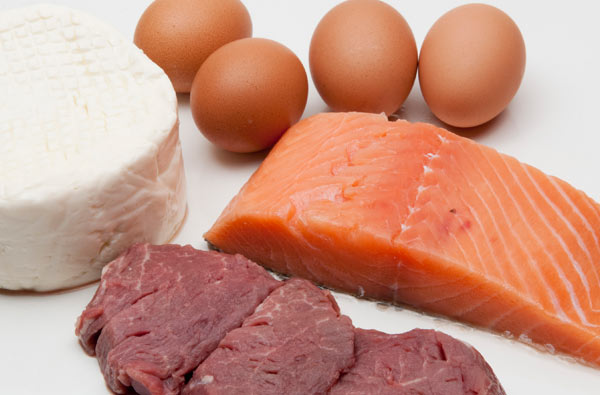
Animal protein foods include fish, chicken, turkey, meat (from cow, lamb, pig or goat), milk, yogurt, cheese and eggs. These are considered high-quality proteins because they contain all of the essential amino acids.
Plant-based Proteins
Most plant-based proteins are missing at least one essential amino acid and are therefore considered “incomplete” proteins. Exceptions include soy, quinoa, amaranth and buckwheat, which contain all of the essential amino acids. Other plant-based proteins, including vegetables, legumes, grains, nuts and seeds, are incomplete but when eaten during the same day (i.e., beans and rice) all the essential amino acids are available to the body.
Protein-rich Meals
Every meal should contain a protein, a healthy carb, vegetables and a healthy fat. Here are some of our favorite combinations that are easy to prepare and delicious!
-2/3 cup cooked black beans served over 1/2 cup cooked quinoa and topped with salsa and guacamole
-4 to 5 oz. wild Alaskan salmon, sautéed asparagus and wild rice, topped with slivered almonds
-2 poached eggs served on top of 2 slices whole-grain bread and 1/2 smashed avocado
-8 oz. plain Greek yogurt mixed with 1/2 cup berries, 1 Tbsp. each of chia, hemp and ground flax seeds
-1 banana spread with 2 Tbsp. all-natural almond butter and topped with 1 Tbsp. chia seeds
-4 turkey meatballs served over whole-grain pasta or spaghetti squash with marinara sauce and parmesan cheese


Source