Showing posts with label flexibility. Show all posts

Tuesday, 8 December 2015

Reasons Why Plank Exercises Are Great

Some of the best exercises are the least complicated, and plank exercises I think fall into that category. These have recently become an important part of my exercise routine because they are great for core conditioning. In fact, they may look too easy to be beneficial, but especially if you have irritation in the lower back this exercise might be your answer. But it also gives the hamstrings, glutes and shoulders a good workout, and will support proper posture and improved balance.
It should be noted, however that there are some common mistakes made when people do planks, and perhaps even more so than most exercises doing improperly could lead to injury. These exercises will tax the upper and lower regions of the spine. If these areas are weak it will normally cause the spine to sway. This can put compression pressure in the vertebrae and can cause back injuries. It is important especially when starting out, to know just where your limits are and not to exceed them. If you feel any pain in the back area, don't push it, but work your time up little by little.

Besides trying to hold the position for too long, other common faults are placing the hands too close together, allowing the hips and head to drop, and holding your breath. And what should your goal be? You are considered to be fairly fit in the core area if you can hold the abdominal plank position for at least two minutes. But again, you should build up to that point slowly.

That said, here are some reasons why you should be looking to plank exercises as part of your fitness program
1. Posture and balance improvement. By merely staying in the plank position for the period of time requires you to work on your balance. This can be enhanced further by doing planks on a BOSU ball, or by doing side planks. If we do lose our balance and posture position as we age, it is normally because of the weakening in the core area. Planks are great for this.

2. Alleviates back pain. Whatever you do to strengthen your core area is probably going to make your lower back stronger. The reason is because plank exercises require minimal movement while contracting all the layers of the abdominals.
 
3. Tones the stomach region. These exercises will be in our core muscles of the belly area. This is the foundation of the outer abdominals, or six-pack abs. This will be helped further by pulling in the area of your belly button, which will contract those deep inner transverse abdominal muscles.

4. Builds flexibility. The first time get into the plank position you will probably feel how the body becomes stretched. Not only in your posterior muscles but also in the shoulder area, the hamstrings and even the arches of your feet down to your toes. Plank exercises are a natural for stretching the body.

5. Mood enhancement. All of the above reasons for doing planks will help to improve a person's mood. Stretching and releasing the tension from muscles throughout the body are going to invigorate anyone who does these wonderful exercise routines.
 
Where you carry your weight has a lot to do with your overall health, as it is a  marker for issues having to do with the kidneys and liver. Read more about how to put on good weight through diet and exercise on our website  http://muscle4weightloss.com/. Rich Carroll is a writer and avid health advocate now living in Chicago.

Thursday, 17 September 2015

Resistance Band Guide

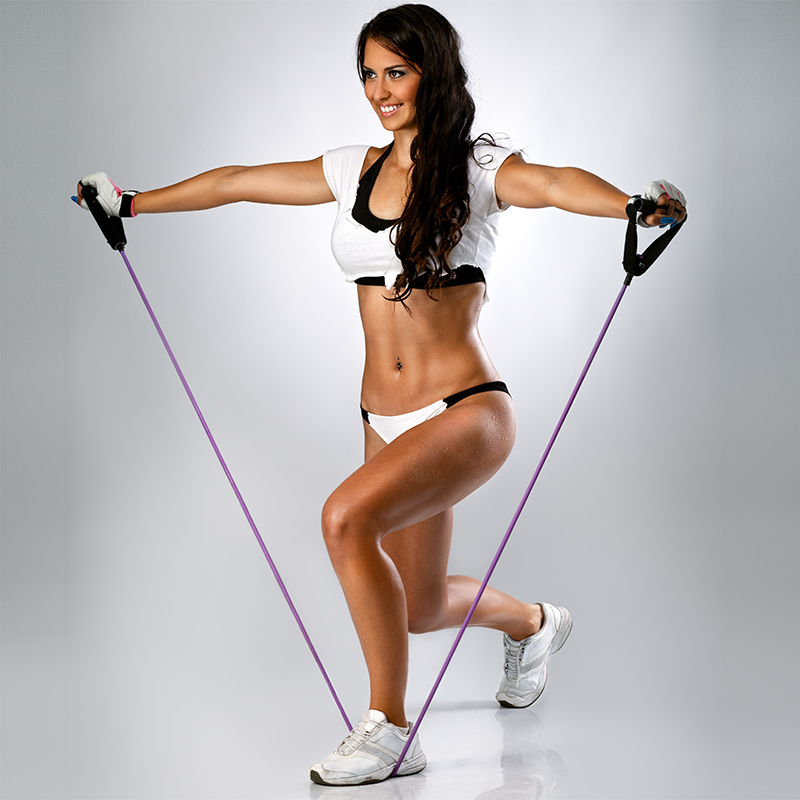
Resistance bands, also called resistance tubing, are an exercise accessory made of rubber. Common exercises can be maximized with resistance bands, as the bands increase the load requirement put on your muscles. Because of their versatility, exercise bands are an appropriate exercise tool for people of all fitness levels. Talk with your doctor before starting a new exercise routine, particularly if you have an existing health condition or injury.

Types

The thicker your resistance band is, the more resistance it will provide. Lighter colors are generally for lighter resistance levels, and as the thickness increases, the colors of tubing get darker. You should use a resistance band that you’re able to stretch, but that is still challenging for you. When stretching your band is no longer demanding, you should advance to the next level of thickness. The varying muscles in your body have different levels of strength, so buy a variety of bands so you’ll be prepared for different exercises. Resistance bands with padded handles are usually more comfortable than non-padded, interchangeable ones.

Usage

Resistance bands are used to gain strength, flexibility and balance. Depending on the exercise, the band can either be fastened to an object such as a door knob, or you can use the band while holding onto the handles. Muscle strengthening exercises such as hamstring curls, bicep curls, squats and reverse crunches are enhanced when a resistance band is incorporated because of the force you exert when attempting to pull the band. You should perform eight to 12 reps of each exercise and two to three sets of each rep.


Benefits

Resistance bands are inexpensive, lightweight and easy to pack into luggage or a gym bag. You can use them with most calisthenic-type exercises, and their versatility will help you concentrate on your targeted muscle groups. For example, if your goal is to strengthen your hamstrings, use your resistance band around both ankles and perform single leg butt kicks while holding on to a secure surface. The resistance from the band will increase the work done by your hamstrings.

Precautions

If a resistance band is joined together at the ends to make one continuous band, the bond where it is joined can be faulty and break, leading to injury while exercising. Choose a band that is a continuous piece of rubber. When performing an exercise that requires the band to be attached to an object, be sure it is fastened securely to avoid slippage. If the rubber on your resistance band shows sign of wear, aging or weather damage, replace it with a new one. If you experience sudden or sever pain while working out with resistance bands, seek medical help immediately.
Source : Susan Presley has been a health care journalist since 2006. Her articles have been published by "Current Health" and the "American Journal of Nursing." With a Bachelor of Arts in communication from Truman State University, she is pursuing a Master of Divinity at Louisville Seminary in Kentucky.


Monday, 7 September 2015

The 5 Key Dimensions of Physical Fitness Exercises You Should Know About

When you properly engage in physical fitness exercises, your body will attain a high level of mental and physical health.
In fact, suitable aerobic fitness exercise will help you remove 'bad cholesterol' and increase 'good cholesterol'. Moreover, the network that control blood supply in your body will get strengthened; the risk of many grave diseases will drastically reduce; the duration of existing illnesses will be significantly shortened; and infections will be prevented.
Yet, the 5 key dimensions of physical fitness exercises have different effects on different aspects of the body though they generally help the body achieve better state without taking drugs.

Strength (Muscular) Building Exercises
Here, the ability of muscles to carry heavy objects - lifting, pushing, and pulling - are developed as well as the basic walking, standing and general posture-related activities.
Usually, you can develop these muscles by engaging them in overload exercise and gradually increasing the amount of load you carry during exercise. For example, isometric exercise involves trying to lift or pull immovable objects (though it is not advisable for people with hypertension); isotonic exercise involves the use of dumbbells and other regular objects used in weight lifting; and isokinetic exercise is usually done by athletes and professionals.

Endurance (Muscular) Exercise
You can decide to improve the endurance of some groups of muscles in your body e.g. the leg muscles, abdominal mass, etc. This closely resembles cardio-respiratory endurance; it actually focuses on the ability of the muscles to withstand continuous, long term activities.

Flexibility Exercise
Joints are subject to 'the law of use and disuse' whereby they function less efficiently when not used regularly. This is particularly important to dancers. In physical fitness exercises, flexibility improves the efficiently of joints in the body. It also improves balance and posture.

Body Composition Exercise
The ratio of healthy body fat to body mass is a primary concern in physical fitness training. Body composition exercise tackles overweight, obesity and related concerns.

Cardio-Respiratory Fitness Exercise
Specifically, cardio-respiratory fitness exercise forms the groundwork for other workouts by increasing your ability to endure work for longer periods and work more intensely. When the body draws on oxygen to perform activities, it would not have to (an-aerobically) produce lactic acid that causes muscle fatigue. More so, it has been reported that cardio-respiratory physical fitness exercise enhances lifespan and greatly reduces the risk of infections.
Consequently, it is advisable to pay a higher premium on cardio-respiratory fitness exercise since it supports your body fitness and enhances your well-being. Nonetheless, any of the other fitness exercises are alright depending on your own goal.