Showing posts with label burn fat. Show all posts

Tuesday, 24 November 2015

Building a Home Gym in the Garage

Having a home gym is very attractive idea for anybody who likes to regularly exercise at home. Home gym has many benefits when compared with commercial gyms. In the home gym, one can exercise whenever one wants, there is no time lost trafficking, there is no time lost waiting for some other guy or girl to finish, there are no gym fees, it can be accustomed to personal needs etc. On the other hand, home gyms require space and money to buy and maintain.
Money for home gyms many consider to be the main problem, but in the long run, you are actually saving money because you are not paying monthly gym fees, you don't spend any money trafficking etc. So, when building a home gym, consider purchasing equipment little by little, month by month or even quarterly or annually.

Cardio Equipment
Depending on your personal preferences, cardio equipment can be in the form of expensive, but durable and sturdy treadmill or elliptical, or if you have ordinary bike, you can purchase a bike stand for just a fraction of cost of good treadmill or elliptical.
Home foldable treadmills cost less, especially self-powered models, and they are great choice for people who prefer walking as the form of low impact, low intensity cardio.
If you have good, heavy rope for rope jumping (and enough high ceiling), you have all necessary equipment for good cardio workout. Ordinary rope can be purchased in any hardware store for cheap.
If you like Martial Arts, good punching bag will build your strength, stamina and burn fat tremendously. Punching bag can be used as warm-up, as main workout, or to burn extra calories after main workout. Note that if you have never used punching bag, it is highly recommendable to find someone to show you how to actually punch.
To save space, punching bag can be stored away and mounted when required.

Exercise Equipment
Pull-up bars can be wall mounted, ceiling mounted, part of dip station or squat cage, doorway mounted etc. Simple pull-up bars are cheap and reliable – fix them somewhere on the wall and use them for great back and biceps workouts with various pull-ups and chin-ups.
With just a few items – bike stand, rope, punching bag and pull-up bar – one can make great full body workout that will increase strength, stamina, increase muscle mass, burn fat etc. And in the case of circular workouts, even full-body workout doesn't have to last more than 60 minutes. List of exercises that can be done using such equipment is rather long: cycling, running, walking, rope jumping, bag punching and kicking, various push-ups, various squats, various pull-ups and chin-ups, burpees, various abs exercises etc. As one can see, plenty of these exercises are bodyweight exercises and even if you are gym rat, don't underestimate them.
Next piece of equipment that one should consider for home gym are dumbbells – variable or adjustable dumbbells with proper stand. Variable dumbbells save space and even money in the long run when compared with ordinary dumbbells, but their initial price is relatively high.
Note that with the pair of adjustable dumbbells only one person can exercise at one time – with modern variable weight dumbbells this is not great issue, since weight can be changed often in just a few seconds. Variable or not, dumbbells are great for many exercises and it is nice to have them.
Variable bench is often next piece of equipment to be purchased. This bench must be capable of several decline and incline positions and of course, flat position. When buying a bench for home gym, it is good to choose a bench which have a stand for barbell and extension for leg exercises (for quads and hamstrings). Such benches cost little bit more, but in the end, they are worth that extra money.
After bench, one needs good, solid barbell with some weights according to your needs. When considering weights, choose weight plates with rubber coating. Rubber coating prevents rust to occur, they are much quitter when used, protects walls and plates from getting damaged etc. Also, consider weight stand to store your weights and some rubber mats to put around your bench – your floors will last longer.
As one progress, squat rack is next to be obtained – it requires space and strong floors, but for various squats, it is a must have equipment.
On the other hand, if you don't have much room for various weights, bars, barbells, racks etc., and you just need 'something' to work out on, consider all-in-one home gym exercise machine. There are several types of them and most of them look like medieval torturing devices, but in the end, they get their job done. Just don't expect levels and type of resistance as if you are working out with regular weights.
 
Home Gym Maintenance
Maintaining a home gym is rather easy. Each exercise machine must be maintained as recommended by their manufacturer. This often includes lubrication, changing pulleys, cables, batteries and similar.
Good AC unit is required for keeping proper temperature and humidity levels. Be sure to regularly clean air filters on your AC unit, since filters decrease amount of dust and other airborne particles in the gym.
Strong vacuum cleaner with various cleaning attachments for reaching corners and tight areas is great thing to have. Such vacuums doesn't have to cost much and can be a general home vacuum, like ordinary Shark NV356e or any similar vacuum cleaner. Once a week, clean entire area and if you have time, clean the equipment with wet, disinfecting wipes. Maybe this sounds too much, but clean home gym is more pleasant environment for regular workouts than a dirty one.

Source 

Saturday, 26 September 2015

30-Minute Cardio - The CafeMom Studios Workout

Work up a sweat and burn fat and calories with this 30-minute workout.
This workout uses high intensity exercises to get your heart going,
followed by lower intensity exercises to lower your heart rate. This is a
great workout for moms to relieve stress and keep your energy levels
high. Don't quit! The more you do this workout, the easier it will get.

Wednesday, 19 August 2015

Heart-pumping Plyometrics Workout

It is widely accepted that two of the most efficient ways to burn fat and get lean are strength training and high-intensity interval training. Plyometrics, a form of strength training that requires jumping and repetition, is really a combination of the two. It increases heart rate and therefore often results in a high-intensity interval.
Plyometric training uses explosive movements to build strength and to condition the muscles and heart. The exercises are typically jumping movements—both feet need to leave the ground at the same time. During each landing the muscles get a stretch, which allows the exerciser to jump with even more power on the next one. The continual stretching and contracting of the muscles quickly whips muscles into shape.
At one time, plyometrics were primarily used by athletes to improve power for their sports, but now they are solid part of the fabric of the fitness world. Fitness professionals and enthusiasts everywhere use plyometrics as either a stand-alone workout or in parts of other workout regimens. Plyometrics boost muscle power, strength, balance and agility.

How Often Should My Clients Do Plyometrics?

Plyometrics should not be performed every day because muscles need a break from all that high impact. Similar to other types of strength training, a 48-hour rest between intense plyometric sessions is recommended. For beginning clients, help them work on building a solid foundation of fitness before adding plyometric moves to their programs.

Can I Modify With Low-impact Moves?

While it is possible to modify high-impact activities to make them low-impact, this takes away the benefits of plyometric activity. In other words, you might be doing a great exercise, but it won’t be a plyometric workout. That being said, don’t hesitate to modify your clients’ workouts—it’s better to start slowly and take more recovery time as needed.

Are Plyometrics Primarily Strength or Cardio?

Plyometrics are used primarily to build strength, but they also are a great way to introduce anaerobic interval training to your clients’ programs. Anaerobic intervals increase cardiovascular capacity and will get your clients into shape quickly.
Here is a 15-minute plyometric workout to use with your clients. Perform each exercise for 30 seconds with a 30-second rest in between. Have clients perform the series of five exercises, rest for two minutes and then repeat the series a second time. Don’t forget to have your clients cool down and stretch at the end of the workout.
Begin with one minute of light jogging and stationary squats to warm up.

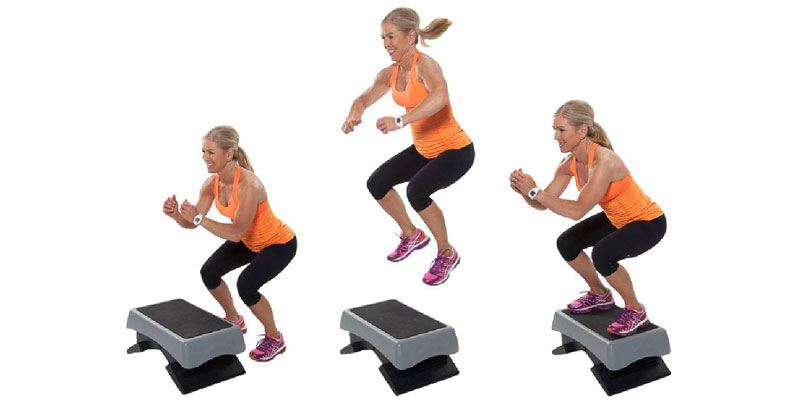
BOX OR STEP JUMPS


Begin in a deep squat position with a step or sturdy platform or box in front and arms bent next to the sides of the body.
Swing the arms and jump as high as possible, landing quietly and with control in a squat position on the step. Both feet should land at the same time and weight should stay in the heels.
Jump down, landing in start position and repeat quickly. Do as many as possible for 30 seconds.
Rest for 30 seconds.

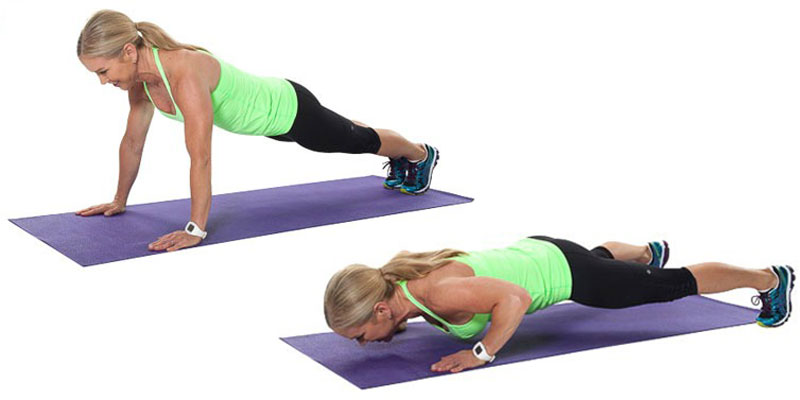
PUSH-UP JACKS


Begin in a plank position with the shoulders over the wrists, feet together, and the body in a straight line.
Lower to a push-up while jumping the feet to a wide position. Keep the abdominals tight and land with the spine straight and chest close to the floor.
Jump the feet back together while straightening the arms to push up to the starting position. Repeat as many times as possible for 30 seconds.
Rest for 30 seconds.

SPLIT JUMPS

Start in a stationary lunge position, with the right foot in front and the left foot behind resting on ball of foot. Both legs should be bent at a 90-degree angle at the bottom of the lunge.
Swing the arms and jump as high as possible, switching foot positions while in the air. When landing, the left foot will be in front. Land in a bent-knee lunge. Note: Be sure that the feet leave and land at the same time.
Repeat quickly but get a full range of motion each time. Do as many as possible in 30 seconds.
Rest for 30 seconds.

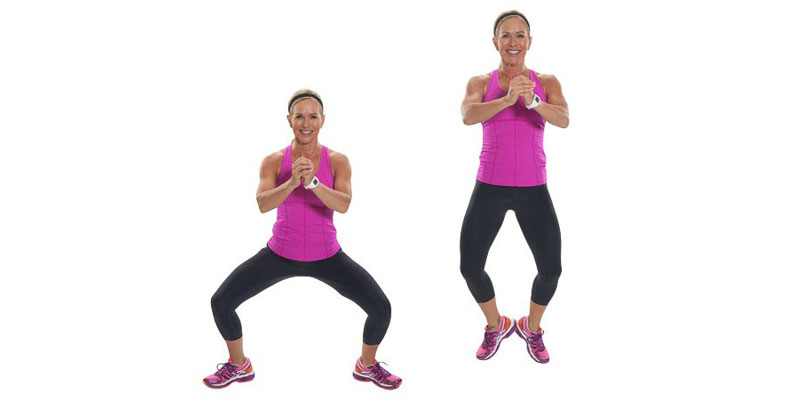
DIAMOND JACKS


Start with the legs wider than shoulder-distance apart. Turn the toes slightly out and bend the knees in a wide pliƩ position; hold the hands in front of the chest.
Using the lower-body muscles, jump up as high as possible and touch the heels together before landing in the starting starting position. Repeat quickly and perform as many as possible in 30 seconds.
Rest for 30 seconds.

CORE BODY HOPS


Begin in a plank position with the shoulders over the wrists, feet together and the body in a straight line.
From this position, bend the knees and hop both feet up to the left hand while keeping the feet together. Hop back to the starting position and repeat to the right.
Perform as many as possible in 30 seconds. Be sure to keep the core tight and don’t let the back sag.
Rest for two minutes and repeat from the entire series from the beginning.

Source 

Monday, 17 August 2015

7 Reasons Why You Should Be Using Coconut Oil

It is a common misconception that coconut oil is bad for you. People all over the world are experiencing the healthy benefits of using coconut oil. It is actually one of the healthiest oils you can consume. Here are the top seven reasons why you should use coconut oil as an alternative to other common cooking oils.
 
 1. Coconut oil doesn't turn to fat in your body.

Unlike many other common oils, like soy (vegetable) and corn, coconut oil won't make you fat. Coconut oil contains medium-chain triglycerides (MCT), which are an easy fuel for the body to burn, without turning to fat. Most other cooking oils and fats contain long-chain triglycerides (LCT). LCT's are usually stored as fat. Since coconut oil is a MCT, it is more easily absorbed and converted to energy quicker.

People in the tropics have relied on coconuts as a traditional staple in their diet for centuries. They consume large amounts of coconut oil every day. Instead of getting fatter, it helps them stay healthy, lean and trim. When they switch from coconut oil to our modern oils, they develop obesity and the health problems that our modern society faces.

Some other people who have known this truth for a long time are people who are in the animal feed business. When livestock are fed vegetable oils, they put on weight and produce more fatty meat. When they are fed coconut oil, they become very lean.

2. Coconut oil increases your metabolism.

Not only does coconut oil convert to energy quicker in your body, it increases your metabolism, which promotes weight loss. Because it boosts your metabolism, it helps your body burn fat more effectively.

Coconut oil may triple your calorie burn. Since coconut oil is a MCT, it is converted to energy so quickly that it creates a lot of heat. In a study published in the American Journal of Clinical Nutrition, MCT's burn three times more calories for six hours after a meal than LCT's.

The February 15, 2005 issue of Woman's World magazine stated that coconut oil is the "underground high-metabolism secret."

This is great news for people who have thyroid problems, since coconut oil improves sluggish thyroids by stimulating the production of extra thyroid hormones. Most other common oils, like vegetable (soy) and corn have been shown to inhibit thyroid function.

3. Coconut oil has omega 3 fatty acids.

Most cooking oils contain omega 6 fatty acids, something we get way too much of in the United States. Our omega 6 to omega 3 ratio should be 1:1 but it is more like 50:1. We need to drastically cut back our omega 6 oils and consume much more omega 3 oils to be healthy. And coconut oil is filled with these healthy omega 3 fatty acids.

4. Coconut oil gives you energy.

Because of the healthy omega 3 fatty acids and the fact that it increases the metabolism, most people that switch to coconut oil feel a burst of added energy in their daily life.

This is because coconut oil is nature’s richest source of medium-chain triglycerides (MCT's), which increase metabolic rates and lead to weight loss. MCT's promote thermogenesis, which increases the body's metabolism, producing energy.

This is because coconut oil is nature’s richest source of medium-chain triglycerides (MCT's), which increase metabolic rates and lead to weight loss. MCT's promote thermogenesis, which increases the body's metabolism, producing energy. Many people with chronic fatigue syndrome and fibromyalgia have found that adding coconut and coconut oil to their diet was helpful to them.

5. One of the best things you can use on your skin and hair is coconut oil.

Coconut oil one of the best things you can apply directly on your skin and hair. It gives temporary relief to skin problems like rashes. It aids in healing and restoring skin to a younger appearance. It has also been known to help with people who suffer from yeast infections in the skin, as well as many other skin problems.

Not only does is soften and smooth your skin, coconut oil has antioxidant properties that protect the skin from free radical damage. Coconut oil makes excellent massage oil too.
 
 6. Coconut oil has healthy benefits that most other oils do not.

Evidence is mounting that coconut oil has anti-fungal, anti-bacterial and anti-viral effects when both consumed and used topically on the skin.

Most oils oxidize and turn rancid very quickly causing free radical damage in our bodies. Coconut oil is not easily oxidized and does not cause harmful free radical damage like polyunsaturated vegetable oils. Free radical damage is thought to be responsible for many ailments in our body from arthritis to increased susceptibility to cancers.

Coconut oil also helps our bodies absorb other nutrients more effectively, such as Vitamin E.

7. Coconut oil is one of the best oils you can use for cooking.

It has a higher smoke point than olive oil, which means it can take higher temperatures better. There are several healthy omega 3 oils we can choose to consume, such as flax and olive oil, but they don't do well under the high heat we use for cooking. Coconut oil can be used in higher cooking temperatures.

It is harder for coconut oil to go rancid, unlike other cooking oils, which are usually rancid long before you even bring them home. Rancid oils cause free radical damage in the body, which is a leading cause of cancer. Coconut oil is stable for over a year at room temperature.

Because of the misinformation we have been given for years, we have lost out on the healthy benefits that coconut oil has given the people of the tropics for centuries. But now it has been rediscovered! Coconut oil is so effective, it won't be long before we see coconut oil supplements promoted, but you can get the jump on the popular crowd and start consuming and cooking with coconut oil today!

Source B@Dream Health 4 Fitness


Saturday, 8 August 2015

Cardio Kickboxing Workout to Burn Fat at Home - 25 Minute Kickboxing Cardio Interval Workout

Workout Details

Blow off stress while burning off calories with this cardio kickboxing workout. Take out any frustration you might have on this kickboxing routine, and you'll feel relieved and accomplished by the time you're done.
I'm relatively new to kickboxing, and trying to learn my basics; keeping my hands up in a defensive position (even though I don't have an opponent), keeping a slight bend in my knees, and not holding my breath. I also tend to flex my wrists when I throw a punch, which would probably break my wrist in the unlikely event that I actually had to connect with something solid. To be clear, and before anyone considers ripping apart techniques pertaining to actual fighting, this is obviously not actual defense training, but instead purely for a little cardio, calorie burn, and fun.


Cardio Kickboxing Workout structure
Quick Cardio Warm Up
50 Seconds of a kickboxing interval
10 Seconds active rest
Groups of 2-3
Quick Cool Down & Stretch

Kickboxing Exercises
Jab + Cross + Kick
Repeat on opposite side
Upper Cut (R), Upper Cut (R), Hook (F), Hook (R), Knee (R)
Repeat on opposite side
Knee (r) + Knee (r) + 3 Uppercuts
Repeat on opposite side
Jab + Jab + Elbow + Elbow
Repeat on opposite side
2 Hooks + 2 Uppercuts + Stance Switch
Repeat  for second interval
Quick Burnout Cardio Round:
- High Knee Holds
- Lateral Lunge Pops
- 2 Jumping Jacks + 3 Uppercuts

This is the perfect routine to squeeze into a busy schedule. In a very short amount of time, you get in a cardio warm up, an incredibly effective bout of bodyweight cardio, and a cool down and stretch. Quick, no equipment, doesn't require a lot of space...it's the kind of workout that leaves you with absolutely no excuses not to try it.
If you're having trouble finding the motivation to workout, try to think ahead to how much better you're going to feel once your workout is over. If you're struggling with motivation, you're spending the energy worrying about it anyways - why not just stop worrying and get it over with? You'll not only feel less stressed, you're also going to give yourself a sense of accomplishment. As an added bonus, you will have burnt off a good number of calories, as well.
Another bonus is that because this is a workout that's easy to do at home in your own living room, you don't even have to get dressed to go to the gym. Workout in your pajamas, your favorite ratty old sweats, or your underwear. No one is going to see you, so who cares? That workout time is yours and yours alone, especially when you're working out in your own house! Realize that this is your "you time", and enjoy it.


Monday, 6 July 2015

HIIT Fitness Cardio Tips For Women

There are essentially two types of cardio: high-intensity and steady-state. Before we go any further, let's make sure we're on the same page as to how we define each of these two.
When most people think of cardio, they think of steady-state cardio. For that reason, I often simply refer to it as regular cardio. Since high-intensity cardio has its' own, cool acronym, let's refer to steady-state cardio as "SSC".
Steady-state cardio is any cardio that's done at an intensity low enough that it can be maintained for a longer period of time. While you may warm-up and cool-down, any cardio session where you keep roughly the same pace throughout your session is steady-state.
Often, when I mention high-intensity cardio to someone, they immediately say, "Yeah, the cardio I do is high-intensity."
Then I ask them how long their intervals are and they either look at me like I'm from another planet, or they think they miss understood what I'm asking and say "I go for 30 minutes".
High-intensity, at least as for purposes of this article, is defined as something so intense that you couldn't keep it up for more than 60 seconds no matter how badly you wanted to! So even though your incline treadmill walk may feel like "high-intensity cardio", it isn't.
Now that we're on the same page as to the definition, you can clearly see that to do high-intensity cardio, you'd have to do it in bursts, rest, then do some more, and so on. That's exactly what we call high-intensity interval training, or HIIT.
Here Are The Facts:
1. You can burn fat 2x FASTER and in HALF the time by incorporating High Intensity Training (HIT) into your exercise routine.
2. Cardiovascular exercise (slow and at a steady pace) burns much fewer calories than HIT.
3. Doing too much cardio is tough on your joints and ligaments.
4. Too much cardio will result in burning muscle instead of fat.
Here Is The Science:
When it comes to weight loss, it doesn't matter what type of fuel (food) you use. What matters is how many calories you burn as opposed to how many calories you take in.
In order to lose fat you must have a negative energy expenditure. Simple!
Energy out -> Energy in
The Basics of Burning Fat
Our energy comes from fat, carbs and protein. Which one our body utilizes depends on the kind of activity we are performing. Most people want to use fat for energy. Sounds legitimate as we assume the more fat we can use as fuel, the less fat we'll have in our bodies. But using more fat doesn't automatically lead to losing more fat.
Understanding the best way to burn fat starts with some basic facts on HOW your body gets its energy:
- The body primarily uses carbs and fats for fuel. A small amount of protein is used during exercise but protein is mainly used to repair the muscles after exercise.
- The ratio of these fuels will shift depending on the activity you are doing.
- Given the metabolic pathways available to break down carbs for energy are more efficient than the pathways available for fat breakdown, the body will rely more on carbs for fuel than fat during HIT. This is good.
- For long, slower exercise fat is used more for energy than carbs.
When it comes to weight loss in female fitness cardio programs, it doesn't matter what type of fuel you use. What matters is how many calories you burn as opposed to how many calories you take in.
That said - you burn WAY more calories during High Intensity Training than your standard fitness cardio aerobic exercise.
Building a HIIT Program
Even if you're a COMPLETE beginner you can introduce yourself to interval training workouts with 3-5 minutes and add 1-2 minutes each week.
You MUST respect the intensity factor involved in interval training and not do too much too soon or else you risk injury.
Here's my step mill interval training workout on the step mill:
30 minutes of 1 minute intervals. I go HARD (80-90% intensity) for 1 minute and then SLOW (30-40% intensity) for a minute. That means I do 15 HARD intervals in total and this revs up your metabolic rate to burn calories for up to 36 hours after your workout is done! WOW!
If you're a beginner you could start with a 6 minute workout. 1 minute hard and 1 minute easy and remember, 1 minute hard is YOUR hard, not MY hard. Work at YOUR level of current fitness cardio level.

Sunday, 14 June 2015

Seven Exercises For A Hot Upper Body

Why Women Store Fat
If you've been grabbing the extra fat in your thighs and triceps and wondering where it came from, your hormones could hold the answer. Yup, that's right. Hormones. Estrogen could be responsible for packing the fat cells in the back of your arms and thighs.
Estrogen also plays an important role in building muscle mass, preventing heart disease, bone breakdown, and may even stimulate bone formation. We simply need the right level of estrogen to look and feel great.
If our estrogen levels get too high, we can suffer from a number of negative side effects including cyclical headaches, anxiety, breast tenderness, water retention, irregular bleeding, and weight gain. Unfortunately, a blood test is the only way to know what your hormone levels are but there are other ways to keep your estrogen under control. Increasing the amount of exercise you perform daily can significantly lower estrogen levels.

Total Body Fat Loss Is Key
Isolated movements such as tricep exercises can help build muscle, increase strength, and boost your metabolism. But, spot training isn't enough. If you want results, you need to do the right combination of exercises and lose fat from all over your body before worrying about those so called "problem areas".
To burn fat, your exercise program requires three basic elements:
Cardio Exercise -- Your fitness program should have the right combination of slow cardio and intense interval training.
Strength Training -- Your workout week should also include 3-5 days of strength training per week. It's impossible for a female to bulk up, unless she is intentionally doing so. This part of your fitness routine will tone your muscles, build up your strength, and increase your metabolism. You'll burn fat more efficiently and use the fat you take in through your diet more wisely.
Proper Nutrition -- Without proper nutrition you won't lose fat. Knowing what to eat and when to it it is crucial to achieving your goals.

Exercises To Get That Hot Upper Body
Tricep Dip -- This strength exercise targets your triceps, but it also works your anterior delts, pecs, and rhomboids. The triceps consist of three heads that run from your humerus and scapula to your forearm: the lateral, medial, and long head. The lateral head is found on the top of your arm. The medial head comes down your midline, and the long head runs along the bottom of your arm. These heads allow you to straighten your elbow, and they also work in conjunction with your latissimus dorsi to bring your arm toward your body.
To perform a tricep dip:
1. Position yourself in front of a bench, chair, dip bar, or a set of rings with your hands shoulder width apart.
2. With your legs bent and your feet hip-width apart, elevate yourself so your arms are straight and your elbows slightly bent. (This will keep the tension on your triceps, instead of the joints in your elbows.)
3. Keeping your back close to the support, lower your upper body to the floor by slowly bending your elbows into a 90-degree angle.
4. Continue the movement until you reach the bottom, before pushing yourself back into the starting position. Just be sure to avoid bending your neck or moving your ears close to your shoulders.

Strong, Sensuous Shoulders

If you want a hot upper body, you'll need to work your shoulders.

These usually aren't what women consider sexy, but they are vital! They're the start of the hourglass figure we fight so hard to achieve. But strong shoulders will give you more than just good looks.
When you're exercising your shoulders, you're helping fight the natural ageing process by keeping them strong and building bone density. You're also decreasing your chance of suffering a shoulder injury. Sadly, unlike males, women aren't born with naturally shapely shoulders, so we have to work at it.
Lateral Raises
To really give your delts a workout, try an exercise like the cable lateral raise. This movement focuses on your lateral delt, but it actually works all three.
To perform a lateral raise:
1. Stand with your feet shoulder-width apart and a dumbbell in each hand.
2. Slowly raise them level with your shoulders while keeping your hands in front of your hips and your wrists facing each other. Pause before returning your arms to the start position.
Lats and Traps
When you work your back, you're actually working the latissimus dorsi muscles, or "lats". They start at the top of the humerus and fan down your back to the vertebrae and pelvic girdle.
Your lats make it possible for you to lean back or sit straight. They give your body some stability, but they also allow you to pull your arm toward your pelvis and bring your body toward your arm (like during a chin-up, for example).
Your trapezius muscles, or "traps", run along your spinal column, from the base of the skull to your middle to lower back. Their function? To pull up, down, and towards the centre of your body. They also make it possible for you to shrug your shoulders, lower your shoulder blades,
and bring them together.
Pull-Ups
To get your traps and lats into shape, try pull-ups as a simple way to work a lot of muscles. In addition to working your lats and pectoralis major, pull-ups also work your posterior delts, traps, rhomboid, and your levator scapulae, as well as your teres major, pectoralis minor, and serratus anterior muscles. The biceps, rectus abdominis, erector spinae, transverse abdominis, and obliques are also involved.
To get started, try a standard chin-up. To perform one of these, use an underhand grip to pull your chest toward the bar. Once you've reached the top, hold the position. Then, lower your body into a dead hang.
When you're ready to move beyond a chin-up, switch to a pull-up by using an overhand grip. Then, there are several other variations you can try, including pulsating at the top of the movement or hanging onto the bar for as long as you can.

Importance of Chest Exercises

If you want to have a sexy upper body, you need to focus on the balance between your joints, tendons, target muscles, and their opposing muscles. Referred to as the planes of motion, this balance is a vital component for any quality exercise program. And if you want a strong upper body and back, you'll need to work your pectoral muscles.
The planes of motion is based on the fact that, even though you're working the target muscle (the agonist), you need to be working the opposite muscle (the antagonist) the same amount. If you're doing squats to work your quads, you'll also want to do exercises that work your hamstrings, calves, glutes, and lower back to avoid an imbalance. Hence, the need for chest exercises.
Your pectoral major muscles, or pecs, run from the humerus to the sternum and rib cage. And they work with your back muscles to pull your arm toward your body. Alone, they allow you to pull your arm forward.
Cable Flys
1. Step forward with your chest out and stomach tight to put resistance on your pecs.
2. Bend your elbow slightly and pull the cables toward each other in front of you by straightening your arms. Think of it like there's a stability ball on your chest and you're pulling the cables around the ball.
3. Once you've reached the top of the movement, pause, and return to the starting position.

Sexy Six-Pack Abs
Everyone wants the gorgeous ¬‚at stomach and the famous six-pack. But these stunning 'bumps' aren't separate muscles. They're two muscles called your 'rectus abdominis', and they're found between your ribs and pubic bone, joined in the centre by the linea alba.
It's these muscles that move the trunk of your body, ¬‚ex your spine during movements such as a crunch, and bring your pelvis to your ribcage during leg-hip raises or posterior pelvic tilts. They do more than just help you move, however.
Your rectus abdominis helps

 Source

Saturday, 4 April 2015

Jillian Michaels: No More Trouble Zones Workout- Circuit 3

Jillian Michaels: No More Trouble Zones Workout- Circuit 3 is an intense
strength-building circuit that is designed to sculpt lean muscle, burn
fat, and tone stubborn problem areas using Jillian's surefire formula
that combines dynamic upper and lower body-toning exercises. Grab a
light set of hand weights and get ready to sweat as America's Toughest
Trainer, Jillian Michaels takes you through the third workout circuit of
her "No More Trouble Zones" Fitness DVD Series that will shape strong
arms, toned legs and buns, and chiseled shoulders. Blast away calories
and melt off the extra pounds as you tone your entire body with this
highly-effective strength training workout that will leave you looking
and feeling your best for summer.

Saturday, 14 March 2015

Jillian Michaels: Yoga Meltdown Level 1

Yoga Meltdown Level 1 is designed to sculpt muscle, burn fat, and tone
your entire body fast! Begin with a gentle vinyasa, then kick up the
intensity with a series of yoga poses combined with Jillian's signature
exercises that focus on flow and form to build core strength and enhance
results.