Showing posts with label shape your body. Show all posts

Monday, 14 December 2015

Make Your Gym Sessions More Productive And Comfortable In The Right Gym Shoes

Getting a gym membership can be exciting whether you are looking forward to losing weight and shaping up, building muscles or simply getting fit. Whatever your reasons for going for some gym activities, you ought to remember that the shoes you select can have effects on how comfortable and productive you remain. A good gym shoe is one that does not keep reminding you that you are wearing it probably because it is too hot, too tight too heavy or because it pinches. You need to choose the right shoe to make sure that you give maximum concentration on  the gym workout.

Grip – This is very important especially when you are looking for weight lifting shoes. Shoes that offer a flat firm grip on the floor or ground gives you proper form and they keep you safe from skidding when lifting heavy weights. It is important to avoid thick soled high tech shoes when in the weight room for safety and effectiveness in the activity. Always look at the sole of your shoes and the anti-skid features it has to ensure that you select a pair that is bound to offer firm grip regardless of the gym floor that you get exposed to.

Support – This is another very important aspect of gym shoes especially for strength training and cardio sessions. Remember these are activities that consist of side to side shuffling and jumping and you therefore should look for a shoe that has ample support. Wide toe box high top sneakers can be great choices when you are looking for optimal movement. Look for shoes that offer ankle support and arch support as well to keep the aerobic movements swift and safe for you. Shoes that are able to keep your feet from inward rolling are best for treadmill time  so make sure you pay attention to this supportive feature as well.
Comfort – It is definitely something you must pay attention to. Choose high top sneakers that have ample cushioning to keep your feet comfortable whether you are strength training or lifting weight. A comfortable gym shoe should not only be cushioned but also light enough and breathable for your feet so that they don't end up feeling overheated and heavy as this can slow you down. Comfort also relies on the shoe size that you select. Make sure your workout shoes fit comfortably. Avoid choosing very tight shoes or very large ones because either way you will have a hard time keeping up with the gym demands.

Style – You might be going to the gym but you definitely do want to look stylish. There are so many stylish sneakers you can choose for your gym workouts so you do not have to compromise your sense of style just because you are hitting the gym, go for workout high tops! When you take time to weigh your options, you will find a gym shoe you love and one that matches your personality. Love the shoe to enjoy wearing it to the gym.
Bodybuilding sneakers are very important for any gym workout. Ensure you remain safe, productive and comfortable by selecting excellent gym shoes that have all important features included and get the right fit for your feet.

Source 

Sunday, 20 September 2015

30 Minute Intermediate Full Body Workout - Head to Toe Torcher

30 Minute Full Body Workout with Rebecca Louise. These body shaping moves will work your abs, core, legs, butt, arms, shoulders, and more! This workout burns 221 - 303 calories.

Thursday, 30 July 2015

The Ultimate 30-Minute Cardio Pilates Workout!

When you combine Pilates, hand weights, and cardio, you get one wicked
workout. And by wicked, we mean really fun and really effective. Lisa
Corsello, the founder of Burn SF, leads you through 30 minutes of her
signature fitness routine, weaving Pilates core exercise with classic
lifting moves and cardio bursts. This workout is so varied that you will
never get bored.

Wednesday, 3 June 2015

Why Core Fitness Is Important

If you’ve listened to the buzz around the fitness world lately or perused the latest workout books, you’ve probably heard the experts referencing core fitness in some shape or form. Traditionally, strength training has been dominated by exercises focused on isolating the muscles of the arms and legs. In fact, if you look at many of the weight machines that have become popular in modern gyms, you’ll notice that they require you to sit or recline while you use them.

While these machines will effectively help you build the muscles that they target, the problem is that, in real life, we don’t use our muscles that way. We lift a box from the floor to a shelf, swing a golf club, push our children on the swing set, or climb a rock wall. In fact, the vast majority of the things we do require all of the muscles in our bodies to function together and be coordinated through our mid-sections, or our “core.”

While those activities may make the use of core muscles seem very obvious, this area, made up of the muscles of our midsection, are actually responsible for quite a few of the more subtle functions as well, including posture, balance and stability.

A weakened core will often result in poor posture and stability, yet we don’t necessarily feel the results of it in areas that show us a direct cause and effect correlation. For example, poor posture, due to a weakened core, might allow our hips to slip out of alignment resulting in knee pain. In fact, quite a few of the chronic muscle and joint pain issues that Americans are suffering with today stem from a weakened core.

It is no wonder, then, that exercise science has taken a dramatic shift in recent years to include the core in strength training regimes. Now, rather than using a machine to first exercise your legs and then your arms, trainers are suggesting that their clients use free weights or bands to combine exercises such as a squat to overhead press. By linking the two, people are forced to transition the exercise movement through their core, and the core muscles in turn help to maintain good posture throughout the exercise. The end result is that we are exercising in a fashion that mimics the movements that we use in everyday life, while creating better posture and increasing our stability and balance.

Brigi G | Fitness Inspired Formula

Thursday, 14 May 2015

For gym practice what are the fitness tips required especially for women?

Now a day's fitness plays a very important role. If any human being body is fit and healthy, then you will feel joy and your mind will work very fast in an intelligence way at any field while doing your job or chasing any problem will solve the issue with dedication immediately with quick resolution or an intelligent way.
Especially for women to make the body fit and to reshape your body, Firstly Women can joined the Gym to meet their expectation for becoming fit and fulfill their requirements. First things for Gym centre to focuses on women structure of their body and depending on their body structure recommended for various exercise just to make the body fit and look in shape. Mainly Women can focuses on weight loss training which is very popular exercise to maintain the body fit and look in shape.
Other important things for women to make the body structure in shape gym centre always recommended for diet plan and proper training which will reduce your excessive weight or burnout more calories, while indulging with proper exercise workout and also increase the high rate pulse of heart and pump out the heart blood which helps to increases your skin glowing, healthy mind, free from stress, feel relaxation. Before joining Gym centre especially women certain important point need to be kept in mind.
For keeping healthy and fitness requires Professional Personal trainer always recommended tools like Rehabilitation equipment, High speed isokinetic equipment, Ankle rehabilitation equipment, Commercial cardio equipment, Ankle strength testing equipments, Power &speed training equipment, Back rehabilitation equipment, Shoulder rehabilitation equipment. It is very important device because it is a device used during physical activity like to enhance the strength or conditioning effects of that exercise by providing either fixed or adjustable amounts of resistance or to otherwise enhance the experience or outcome of an exercise routine.
Rehabilitation Equipment has been supplying equipment like Isokinetic Equipment, Multistation, and Free Weight. Shoulder rehabilitation equipment,  High speed isokinetic equipment ,Knee isokinetic equipment, Ankle rehabilitation equipment provides you latest sports injury equipments.
Firstly women should know about their capacity of body type. Ether the body weight is light or slim trim or heavy weight, bulky body, healthy body and mind. While before joining the Gym the target or goal must be crystal clear that there must be opt for that you must choose practice in results that your expectation level can meet your demand what you want. Each individual body type is differ from others and exercise will upon various body structure through which it will helps you to meet your demands. Knowing the body type plays a very important role and it should be always consider it. As without knowing the right body type you cannot go ahead and choose the right exercise purpose. Because it cannot help your fitness.
The second most important consideration is Exercise wise order. Mainly Women are prefer to choose gymnastics practice regular basis that it properly trained according to their body type and especially wise. To make body fit and in shape is very important for everything to work properly daily wise. Women should practice gymnastics training exercise under gymnastics coaches. For a better results that she might asked gymnastics coaches to understand their body first and give proper practical exercises that are best suited.
 Especially for a woman recommended by Gym experts trainer that never indulge with excessive exercise in order to lose weight rapidly and continuously within a short period time. Excessive overdoing exercise gives you side effects result of the body, it will provides you only negative results.

Source


Tuesday, 7 April 2015

The Good Effects of Exercising

Some people wonder why it is necessary to exercise. Why do you need to eat healthy food and hit the gym? For many reasons, exercising coupled with proper diet results to a lot of goodness. The good effects of exercising do not only make your life a lot convenient but also worry-free. Exercising can be done in many ways: jogging, walking, sit-ups, jumping, hula hooping, dancing, aerobics, yoga, kickboxing, football, and a lot more. It doesn't really matter what type of physical activity you get yourself hooked to. The point is when you are able to sweat out for 30 minutes to an hour or more, that means you are burning calories and increasing your resistance. 

The good effects of exercising are measurable and visible in the way you are. If you are too idle to be moving, possibilities of becoming weak and overweight are higher. Overdoing any physical activity, however, is not too good. You may be injured or worn out if you exercise too much.

Learning the good effects of exercising might inspire you to get on your feet and walk your way to a healthier you.

1. Exercising reduces weight.

Young and old are concerned about how to manage weight and stay in shape. In the United States, a large portion of the young population is obese. When you are worried about your excess fats and calories, you should be doing any kind of exercise. Being overweight or obese can lead to many disadvantages physically and emotionally. Your moves are controlled and your self-esteem is low. In addition, obesity may lead to diabetes, heart failure, high blood pressure, intestinal defects, and other diseases. Overweight people tend to be lazy as well. To drop down inches and pounds, you need to be exercising. It's always best to stay in shape to avoid diseases from attacking you. Performing cardiovascular exercises for at least 20 minutes or longer will allow you to burn calories. Burning calories successively will help you reduce weight. Walking or jogging can be a good start. Eventually, your body will be able to tolerate higher level of exercises like high-low aerobics, body pump, kickboxing, swimming, etc.

2. Exercising builds a perfect physique.

It's always nice to trot around the school grounds or go to the beach when you are able to flaunt a perfect shape. It's awkward to be showing off in bikini or trunks when you have chubby belly or flabby arms and legs. You will definitely be upset to notice some are making fun of your being fat. If you're a man, your ego is touched when you see women around are laughing at you for your fatty build. If you're a woman, you would be ashamed to wear a sexy swimsuit. People can be judgmental; it's a biting reality. To avoid embarrassment, you should do something about it by exercising. The good effects of exercising can manifest largely on how your body looks. Get yourself a good exercise program so that you can be shapely and sexy. Nice abs, muscular arms, firm chest, well-toned body-you'll achieve all of these if you exercise regularly. You can do it at home or any fitness club nearby for at least thrice a week for 2 hours to do cardio, toning and firming. It is important to note that exercising would only give you that perfect shape you aim for if you work on it with discipline and consistency.

3. Exercising makes you popular and moneyed.

Once you are well toned and shapely, you always call people's attention. You become a head-turner, so to speak. Exercising makes you popular and moneyed because talent scouts and sports agents will likely get you for a fashion show or sports opportunity. After all the exercises you have been through, your body deserves some recognition. You do, too. Take for instance those National Football League (NFL) or National Basketball Association (NBA) players. Not only are they paid very well, they're also famous.

4. Exercising helps you avoid sickness.

Your chances of getting sick are lower if you exercise. Exercising helps you avoid acquiring any type of health-related disease. If you're cholesterol is high, you are like high in blood pressure which is not normal. Exercising daily will combat disease-causing bacteria and increase antibodies to keep us ill free.

Source

Thursday, 2 April 2015

Low Impact Cardio for All Fitness Levels


low impact cardioDeciding to get in shape is a huge commitment both mentally and physically.  You have to change many behaviors that contributed to you being out of shape and unhealthy in the first place.  Everything from the amount and quality of the food that you are accustomed to eating to the lack of exercise or mobility that has become your norm.  The best way to get started is to commit to a low impact cardio and weight regimen to ease your body and mind into this new way of life that will ideally be a complete new lifestyle for good.
Everything from pilates to The Total Hot Body Fitness Workout to dance can get you where you want to go with achieving your fitness goals.

Low Impact Exercises to Get You Going 
The following low impact cardio exercises are great for the beginning enthusiast who isn’t very active. The entire purpose of beginning with low impact cardio is to alleviate pressure on the joints and wake up the body in a sense.  Some things aren’t quite working the way they should have been and/or some muscles haven’t been used in quite a while.  If you do too much too fast, the possibility of injuring yourself increases because of stiff joints and muscles.
Yoga: Some people might not consider yoga to be their first choice when getting back in shape but it is a major cardiovascular exercise with the benefits of stretching out under-used and overly tight muscles, ligaments and joints.
Udemy’s course on yoga provides a very thorough and easy-to-follow instruction on how to perform the most popular and essential yoga poses.  Taken from the course description:
“Yoga is more than just an excellent form of exercise: it is also a spiritual and mental practice that can improve your mental outlook. Anatomy of Fitness: Yoga shows you how to build your strength and flexibility while improving your concentration and willpower.
Featuring a complete yoga program and 64 page manual, this user friendly course includes:
  • A well balanced, flowing sequence of step-by-step poses
  • Comprehensive anatomical illustrations of the muscles used in each pose
  • Clear guidance on the correct form and what to avoid to ensure you’re working effectively and safely
  • Anatomical information and labels to complement the detailed drawings of the body’s muscle system
  • A bonus diary of practice with each pose to record and review your progress
The course also include a range of yoga sequences including Salutation to the Sun, meaning anyone can tailor a program to suit their fitness needs.”
Walking Punches:   In its easiest form this is a very slow and light walking while alternating left and right punches.  As this becomes easier, you can walk faster, incorporate a light jog to increase your coordination, or even march while bringing the knees as high as you can.  This will get your heart rate going just make sure you don’t lose your posture in the process.  Keep your head, neck, shoulders and pelvis aligned and take good inhalations and exhalations.  Later on you can also add small dumbbells to your punches but be careful with that.  Only perform weighted punches if your posture is in check.
Windmill Steps: The beginning level of this exercise is just a simple side step, letting your trailing leg come behind you with a slight tap, as well as adding the large circular arm swing. As you want this to be harder you can drop your hips lower to the ground, adding a squatting position. Increase the step width and speed until you substitute the motion with a lateral jump rather than a step.
Pilates: Udemy offers great instruction in Pilates! This course “offers both the new pilates professional and the pilates student insight into the exercises, why they were created, when the fitness form was invented and how to workout better and smarter so you can be longer stronger and achieve greater success with your fitness goals” (course description).
Static Squat + Punches: Starting with a very shallow squat and a punching motion without any extra weight, only hold your squat for a few seconds before coming up continuing your punches. As you progress stay down longer (until the maximum time), squat lower, and start using dumbbells with your punching motion. Do not, however, speed up your punches, especially if using extra weight. Again, posture is important because you have a lot of body parts moving and aching plus you have your heart  pumping all over the place.
Static Lunge + Curls: Start with a shallow lunge with your feet relatively close together and either very light dumbbells or possibly only arm weight for your bicep curls. As you progress, lunge deeper and with your feet further apart and increase the amount of weight you use with your curl. Do not increase the speed of your curl. As you go down in the lunge, your biceps curl with your elbows tucked close to your body. Then the curl opens back up as you come to standing position.
Static Lunge + Tricep Extension: With this lunge position only the front leg is bent and the rear leg is extended straight. Start with a shallow lunge and little to no weight in your hands. When you want more of a challenge, increase the depth of the lunge and the distance between your feet as well as the amount of weight you are using for your tricep extension. Do not increase the speed of your tricep extensions.
 Fingertip to Toe Jacks: Start with a slow leg lift reaching to your toes each time then increase the height of the leg lift as well as the speed of the leg until you are actually hopping back and forth from leg to leg with only one foot on the ground at a time and moments when both feet are off the ground. At this pace you will need to alternate one hand going up while the other is coming down.
Stutter Step: The easiest version of this exercise is still hard but start with all of your weight in one leg with only a slight bend (or even keep it straight), placing the opposite leg back only a few inches behind you and driving the knee up in front of you slowly as you bring your hands down. Increase the depth of your squat on the supporting leg while extending the moving leg further and further behind you. At the same time, start increasing the speed of which you move your arms and leg.


Just Get Started!
Whether you are a newbie to the exercise world, a seasoned professional who’s taken a long hiatus, an injured athlete coming back to exercise life slowly, or perhaps an elderly person looking to modify certain exercises to accommodate certain areas of the body that need more care, the variety of  low impact cardio exercises are endless.
A key marker with any fitness regimen is to just get started.  Working out too hard too fast is not the way to go for most folks and better to slowly work your way up than go hard, get injured, and then have to spend weeks recuperating with limited mobility.

Source 

Sunday, 22 March 2015

5 Tips to Increase Your Motivation for Indoor Cycling Workout

Are you trying to lose a few extra pounds or are you trying to slim down and get into shape? Indoor cycling is an increasingly popular way of getting fit. It is also extremely easy as no special training is required and you can do it in your spare time, no-matter what the weather is outdoors. However, not many people can keep up with a proper indoor cycling workout regime and abandon their exercise bikes, or they just simply do not derive any long term benefit to their fitness. This article offer some tips on how to keep up your motivation for indoor cycling and stop that boredom from creeping in.

Alternate Your Indoor Cycling Regimes


If you just stick to one indoor cycling workout regime every day, then you are guaranteed to get bored pretty quickly. Indoor cycling workouts, just like any other fitness activity, can be classified into different types. You can vary the workout in terms of exercise intensity, duration and frequency of the workout. High intensity workouts are useful for building up cardiovascular stamina, which would not be as relevant if you are training for a strength event. You should aim to combine sets of exercises to build up your body system and train up different muscle groups. Getting access to a specialist trainer can be helpful at the beginning to help build a proper plan for your workout, depending on what you are aiming for.

Attend an Indoor Cycling Class


This is useful especially when you are starting to lose motivation in indoor cycling. Attending an indoor cycling class at your local gym can be both fun and entertaining. You can participate in a group with similar fitness aims and this can motivate you to continue doing your indoor cycling regimes. It is also a good social event and can help you persist with your workouts through the rough times. If you cannot find time to attend the gym, then you can purchase some good fitness videos which you can use in the comfort of your own home.

Diversify Your Workout


Remember that indoor cycling is not the only means to get fit or lose weight. There are other ways such as jogging on a treadmill machine or other aerobic exercises. If you get bored, mix up your cycling with other forms of workouts to achieve your daily fitness goal. That is why attending a local gym can be useful as it can offer you this, in addition to access to their fitness instructors to guide you on your path. Research has shown that diversifying your workout offers you much more benefit than just sticking to a sole form of exercise. It also reduces the risk of injury from repetitive motions and muscle strain by doing constant activity.

Purchase a Good Exercise Bike


This is important if you are serious in indoor cycling workouts. Modern exercise bikes have multitude of information including calories burnt, distance traveled and cycling speed. They also give you useful feedback on your performance and you can gauge whether there is improvement in your fitness level. It is important to have a goal to work towards and motivate you to try harder each time and stay focused. Good exercise bikes can also give you varying levels of resistance to push yourself to the limit.

Working through Injury


One of the most annoying things that can disrupt your exercise regime is sustaining injury. Remember that cycling is just like any other form of strenuous exercise. Ensure that you do appropriate warmup and stretching exercises to prevent damage to your muscles or ligaments. Know what your body can take and avoid over-exertion, especially if you are just starting out with your fitness regime. If you are unfortunate enough to pick up an injury, then this should by no means end your fitness ambitions. You can always participate in other forms of stretching exercises or balance work.

Conclusion

Indoor cycling workouts are increasingly popular and can help you lose weight and maintain your level of fitness. The important tips to maintain your motivation include attending a local cycling class, getting access to a certified exercise trainer and purchasing good equipment. You should also take it slow at the beginning to avoid injuries, and diversify your workout so that you can maintain your motivation.

Source

Friday, 9 January 2015

6 Steps to Booty Perfection


Who doesn't want that perfect rear? The problem with a beautiful booty is that it's a lot of work, which is why many give up before starting. Resist that temptation and work on your derriere! Here are six steps to help you get a rear that rap artists will want to write songs about.

12_PerfectBottom.jpg


1. Step Forward

If you want to sculpt that rear, the front lunge is your best friend. It will give you the bubble shape that so many covet and will strengthen your hips as well.

To do the front lunge, simply stand with your feet spread shoulder-width apart and place your hands on your hips. Step forward and dip into the lunge until your knee is bent at a 90-degree angle. Squeeze your butt as you push up and step back.

Reps: 15 to 20 per leg

2. Step Back

The rear lunge focuses a bit more on the thighs than the hamstrings/glutes, but it's great for giving your legs a defined look that will help your butt stand out.

Assume the lunge position--feet spread shoulder width apart, hands on hips--but this time step backwards. Dip until the front leg has reached the 90-degree angle, and push the back foot forward to return to your starting position.

Reps: 15 to 20 per leg

3. Step to the Side

This exercise is a bit tougher, but it will sculpt your behind one cheek at a time. Once you get accustomed to it, it's much easier to stay balanced.

Assume the lunge position, but step forward and to the right to dip into the lunge. Feel the burn on the right cheek as you push back to your original position. Repeat with the left leg for an even workout.

Reps: 15 to 20 per leg

4. Step Up

Weighted step-ups will shred your glutes with each step up, and hit those thigh muscles as you step back down.

Grab a pair of dumbbells or a barbell to add extra weight. You can do the exercise on a staircase or a special platform. Simply step up with one foot first, bring the other to the platform and step back down with the original foot. Repeat with both feet.

Reps: 15 to 20 per leg

5. Step to the Wall

Wall squats are a static exercise that will have your legs quivering in no time. It's much easier on your knees than regular squats, but no less punishing for your muscles.

Stand with your back against the wall, your feet spread to shoulder width in front of you. Slide down the wall until your legs are bent to a 90-degree angle. The deeper you go into your squat, the more strain you place on your hamstrings and glutes.

Time: 45 to 60 seconds

6. Step onto the Elliptical

The elliptical machine is the slightly less annoying cousin of the StairMaster, and you can use it to target your glutes for an excellent booty-sculpting workout.

Step onto the machine and adjust the incline to the highest setting possible. You will have to lift those knees to keep walking, and it will give your bottom the workout it needs.

Time: 30 minutes (do this after the other exercises)


Source 

Tuesday, 16 December 2014

How to get and stay fit when you are in a relationship

Studies show that most people gain weight when they are in a relationship. It’s not just that the hunt is over and we already have someone to share our life with and we don’t feel the pressure to stay in shape, it’s also the fact that we now have to coordinate everything we do with our other half we now share everything with. Staying in shape while in a relationship can be challenging, but it can also be something that brings you closer together and helps you bond. Something that makes you and your relationship stronger. It all depends on how you approach it.

Recruit your other half to participate
Work on the principle that couples who train together stay together. All you need is a little bit of planning with all parties being aware of the precise time and the kind of training you will be doing so everyone is mentally and physically ready for it. Talk it out, look at available options together, make it a couple thing and work around your schedules and other commitments. There are many ways to work out together without leaving your house or spend any extra money on equipment or gym membership. You can even make it a habit to work out in front of the TV instead of having a family meal while glued to the screen.  Pick a time during the day when no matter what you both have to drop whatever you are doing and show up for a training session and a work out. People who are in sync and who can find the time for each other also tend to have a more fulfilling and happy relationship and fitness is one of these things that can bring people closer together.
If you can’t recruit your other half for whatever reason and the only option is to work out alone, make sure you talk about it and explain exactly what you are doing, when and especially – why. It’s important that your other half understands your motives and can see that you are serious about your fitness.
Get a plan and have it where you can see it - at all times
Finding a good program to follow is half the battle, sticking to it is another matter entirely. The main obstacle is that we tend to find the plan but then ignore it half the time. Print everything out and put it on display, cross things out on completion and track your progress. It also helps when you need to make sure your family understands what you are doing and especially when so they know not to bother you during these time slots or maybe have an option to join in.
Agree on the menu 
When we are in a relationship we can’t cancel dinners or get by on half a yogurt and some sunlight – it wouldn’t be fair to the person you are with. So there will be cooking and there will be eating no matter what. If you agree beforehand on the healthier options and find the kind of menu you will be both comfortable with, you don’t just get to eat healthier you also get all the moral support you need. It’s easier to follow a plan when you do it together. It helps to sit down and talk about it, not just announce that you no longer eat - period, but reason it out why would you want change your eating habits, what it’ll change for the two of you and how it’ll affect you both in the long run. Explaining the “whys” is vital in this case.
Make your house fitness friendly
The best way to avoid snacking is to remove chips and candy (crisps and sweets) from your house completely. So when you want to have something special and not-so-good for you, you’ll have to leave the house and go get it first. At the very least, you’ll get a walk out of it and best case scenario – you won’t want to bother going out and won’t snack. You can place a bowl of washed and ready to eat apples and pears on a table for when you feel like crunching on something. Clear the area in your house for exercise and set reminders everywhere you can all around to stay motivated. Change your screensaver on your laptop to match your fitness goals and keep your programs and workout charts at hand at all times. Post it notes with messages to yourself will work, too.
Tips:
- Eat your dinners while talking to each other – it’ll help you mind what you eat and you’ll eat less.
- Go for a short walk after every meal together.
- Plan your cheat meal for the weekend and eat healthy the rest of the time.
- Choose activities that will make you move – try to do at least one active thing every evening.
- Walk everywhere together – you can even race each other on a dare to different locations.
- Get an active hobby as a couple, like cycling or city photography. Going running together is unbeatable.
Source

Monday, 8 December 2014

6 Easy Resistance Band Exercises

Take a break from your dumbbells and try this resistance-band workout three times a week.

Sunday, 23 November 2014

20-Minute At-home Bodyweight Circuit

For many trainers, the holidays can be a frustrating time. While there’s nothing better than going home for the holidays and spending time with loved ones, this time of year can put a wrench in your clients’ workout routines. Many of you have spent a significant amount of time helping your clients work toward their health and fitness goals, and when they travel for the holidays, it can be hard for them to maintain the same amount of dedication and self-control as they do the rest of the year. The solution? A circuit workout.
Share this workout with your clients before the holiday season to help them burn off those extra calories while getting a total-body challenge. All that is needed for this 20-minute at-home body-weight circuit is a little space in the family room, basement or hotel room.
How-to: Perform each of the following exercises for one minute, resting for 30 seconds in between each exercise. Once you complete each exercise once, take one minute to drink some water and catch your breath. Then go through the entire set once more for a total of 20 minutes.
Warm-up: Begin by jogging lightly for one minute.
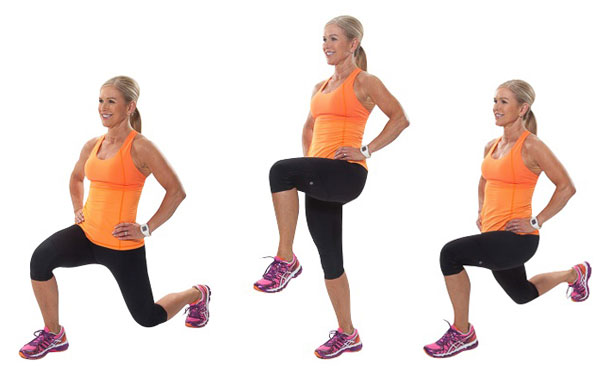
1. Pass-through Lunge
Pass-through Lunge
A. Stand with feet hip-distance apart. Step the right foot behind and lower slowly to a lunge until both legs are at a 90-degree angle.
B. Lift the right leg up and let it float slowly to the front, lowering again to 90-degrees.
C. Push the right foot up again and float it behind you as you did the first time.
Perform for one minute—30 seconds with the right leg, 30 seconds with the left leg; rest for 30 seconds.
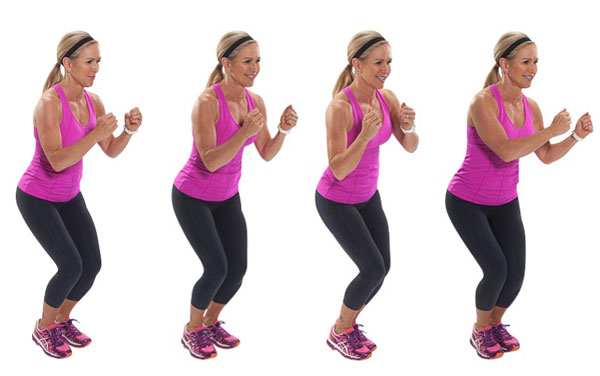
2. Globe Hops
Globe Hops
A. Start standing with feet a few inches apart, arms in guard position at the chest and knees slightly bent.
B. Jump forward, back, right and then left (like the directions on a globe: north, south, east, west). Continue jumping NSEW for 30 seconds and then switch directions to NSWE or front, back, left, right for the next 30 seconds.
Jump for one minute and then rest for 30 seconds.
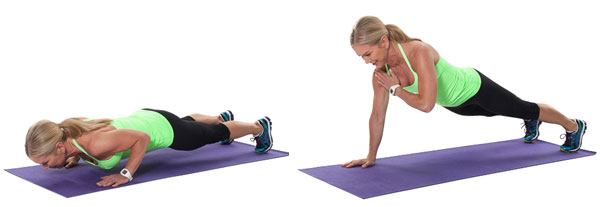
3. Shoulder Tap Push-up
Shoulder Tap Push-up
A. Begin in a plank position with the hands directly under the shoulders and feet hip-width apart. Keep the abdominals and legs tight as you slowly lower the chest toward the ground with the elbows bending and pointing behind you.
B. Exhale as you push back up to lengthen the arms into high-plank position. Lift the right hand to tap your left shoulder at the top and then repeat with the other arm.
Do as many repetitions as you can for one minute and then rest for 30 seconds.
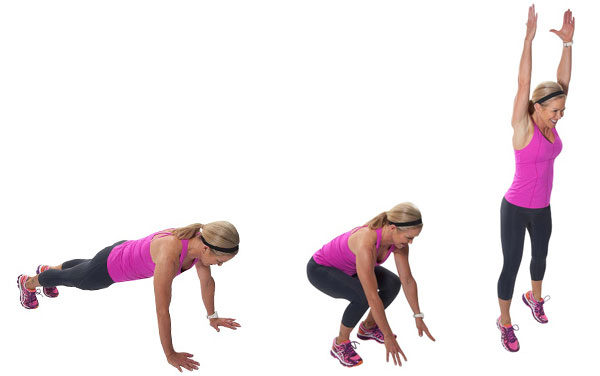
4. Burpees
Burpees
A. Start in a plank position with arms and legs long, and hands shoulder-distance apart.
B. Walk or jump both feet between your hands, coming into a low squat position. Jump straight up as high as possible, land, and come back to your plank position.
Do as many burpees as you can for one minute and then rest for 30 seconds.
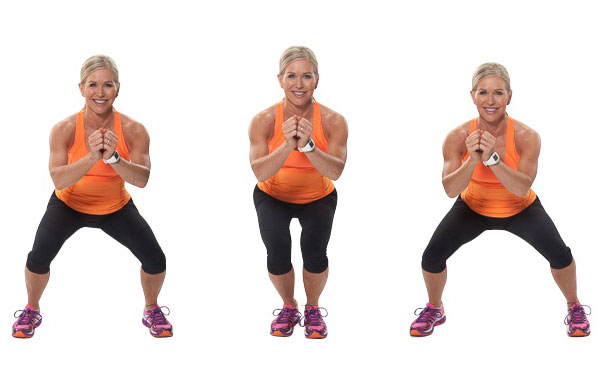
5. Side Squat
Side squat
A. Start standing with feet hip-distance apart and sit back into a squat position by bending the knees.
B. Keep your abs tight and back straight. Step to one side, staying in your squat position. Return to your starting position and then side squat in the other direction, using all your lower-body muscles.
Perform for one minute and then rest for 30 seconds.
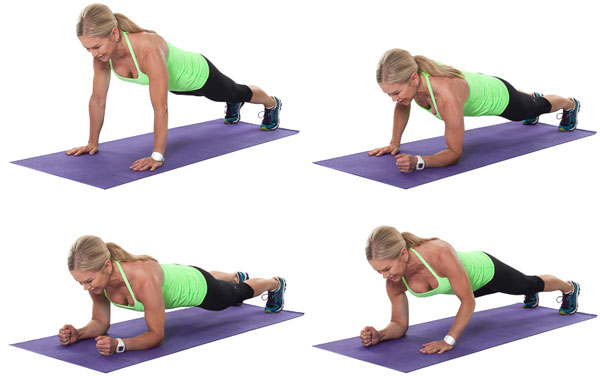
6. Army Crawl Plank
Army Crawl Plank
A. Begin in a plank position with your shoulders over your wrists, feet together and your body in a straight line.
B. Bend your left arm and then your right to assume forearm plank position.
C. Lift your left hand and place it on the mat directly below your shoulder as you push through your palm to lift back up into plank position.
D. As you reach the top, place your right palm on the floor under your right shoulder and push back into a full plank. Repeat, leading with the right arm. 
Perform for one minute, leading first with the left arm for 30 seconds and then with the right for the remaining 30 seconds. Rest for 30 seconds.

Source

Monday, 17 November 2014

What's the Difference Between Yoga and Pilates?


I have always thought of the combination of Pilates and yoga as the perfect marriage. Both are transformational, focused methods of movement that facilitate positive change in the body, mind and spirit. In my opinion, their differences complement one another in the best of ways. Pilates is known as a "workout," and yoga as a "practice"; however, the irony here is that, in order to improve at anything, we have to practice, and when we practice well both Pilates and yoga are can be exceptional workouts.  And as you will see, both are worthy of your time and attention for innumerable reasons.

Unless you're very familiar with both—or a trained instructor—it may be difficult to tell how these two programs are different. In truth, there is a lot of overlap and similarities between yoga and Pilates. And what better way to understand them both than with a little history lesson on each. 


Pilates
Born near Dusseldorf, Germany, in 1880, Joseph H. Pilates had his challenges as a child, suffering from asthma, rickets and rheumatic fever.  His determination to heal led to his study of Eastern and Western forms of exercise, including yoga and ancient Greek and Roman exercise regimens.

By the time he was 14, Pilates had quickly become a veritable renaissance man of exercise. Accomplished as a wrestler, diver, skier and a gymnast, he was even asked to pose as a model for anatomical charts. When World War I broke out, he was interned for a year in England, and while in the camp, he taught his fellow internees the physical fitness program he had developed, boasting that they would emerge stronger than they were before imprisonment. Those who followed his program are said to have resisted the influenza epidemic that killed thousands.

Always curious and compassionate, after encountering soldiers who were disabled as a result of wartime injuries, he began devising machines using the springs from old hospital beds to facilitate their rehabilitation. These machines were the very prototypes of the specialized equipment that is used in Pilates studios today, which utilize pulleys and springs as resistance to build strength and increase overall flexibility in the spine and limbs. These Pilates apparatus, which includes the Reformer, Cadillac (or Trapeze Table), Wunda Chair, and barrels, are still used today to create a body that is uniformly sculpted, powerful and bio-mechanically efficient.

Pilates fittingly called his method "Contrology," (the study of control) and believed that it would help people to develop the strength and fortitude in body and mind, not only to accomplish daily mundane tasks with ease, but to live life to the fullest.

"Contrology is complete coordination of body, mind, and spirit. Through Contrology you first purposefully acquire complete control of your own body and then through proper repetition of exercises you progressively acquire that natural rhythm and coordination associated with all your subconscious activities. It develops the body uniformly, corrects wrong postures, restores physical vitality, invigorates the mind, and elevates the spirit." – Joseph Pilates

Often called a "moving meditation," because of the incredible focus of mind on the body, Pilates is a non-impact exercise system that emphasizes alignment and body awareness. Done regularly, Pilates exercises can change people's bodies, helping them sculpt muscles and improving flexibility. It helps practitioners develop unmatched core strength, and optimal posture. It helps to improve breathing and increases efficiency of movement.

Pilates exercises focus on the "powerhouse," or the stabilizing muscles of the torso, which support the spine. True for exercises performed both on the mat and the apparatus, every movement one does in a Pilates workout emanates from the core, keeping practitioners "honest," by gently forcing them to use both sides of the body symmetrically. In order to successfully initiate and achieve a movement, both sides have to participate equally, giving the dominant, overused muscles a break, and demanding that the "weaker" underutilized muscles have an opportunity to participate, hence, literally balancing the body.


Pilates is based on six principles which enable you to learn to move with maximum efficiency while minimizing stress on the body:

  1. Centering: Strengthening the powerhouse and "corset" muscles of the body, which include the abdominals, pelvis, buttocks and back.
  2. Concentration: Bringing one's full attention to the form and execution of each exercise.
  3. Control: Engaging the mind to unite with the body to economize movement (i.e. learning to use only the muscles necessary to perform a task, while the rest of the body relaxes).
  4. Precision: Employing the notion that every movement has a purpose, resulting in a "less is more," and "quality over quantity" philosophy. When a movement is performed well a few times, there is no need to do more.
  5. Breath: Moving in tandem with the breath, resulting in enhanced lung capacity, overall coordination and facilitating a stronger mind-body connection.
  6. Flow: Every movement in a Pilates exercise is performed with the grace and ease of a dancer.

Because Pilates is gentle and challenging at the same time, it is safe and effective for nearly everyone, irrespective of age or fitness ability, from expectant mothers to the super fit. It is also a phenomenal cross-training tool, helping you to maximize the sports and activities you love the most. Many professional athletes turn to Pilates when they want to bring their best, and the world-renowned Cirque du Soleil regularly trains on the Pilates apparatus to perform their awe-inspiring feats.

The medical community also recognizes Pilates as a modality that assists with physical therapy. Pilates work is often incorporated into conventional therapy to facilitate healing and protect clients from future injury. It's so beneficial, in fact, that many people continue with a Pilates regime long after they have healed from their injuries. Pilates also offers tremendous benefit and relief for people who suffer from chronic conditions, such as arthritis and asthma. Because every exercise involves deep, diaphragmatic breathing, Pilates aids specifically in opening the lungs, helping shallow breathers learn how to breathe properly and build respiratory stamina. Pilates enhances circulatory function and builds the muscles that surround the joints, providing a new support, and simultaneously lubricating the joints, helping to reduce inflammation, which leads to arthritis.  Finally, through the development of a stronger core, and emphasis of neutral spinal alignment, Pilates helps people to correct postural imbalances, prevent and heal chronic back pain, and improve overall spine health.

"In 10 sessions you will feel the difference, in 20 sessions you will see the difference, and in 30 you will have a new body." – Joseph Pilates


Yoga
Yoga means "to yoke," or "to conjoin." This holistic practice is deeply rooted in ancient Indian culture that unites the mind, body and spirit through movement, breathing techniques and meditation.

Yoga's exact origin and history is uncertain; however, we do know that it is thousands of years old, the earliest signs of yoga postures having appeared as drawings on artifacts dating back to 3000 B.C. Yoga was introduced in the West during the early 19th century where it began as a movement for health and vegetarianism, and by the 1960s, there was an influx of Indian teachers who expounded on yoga and are responsible for the myriad styles we have available to us today. The yogi Swami Sivananda, a doctor in Malaysia, is best known for codifying the "Five Principles of Yoga" which are now taught in yoga classes all over the world and facilitate strength, balance, flexibility, anti-aging and the curing of illness and disease. These five principles include:

  1. Asanas (proper exercise)
  2. Pranayama (correct breathing)
  3. Saucha (proper diet)
  4. Dhyana (positive thinking and meditation)
  5. Savasana (complete relaxation)
The origin of yoga is a spiritual one. It was originally used as a means to move energy through the body in such a way that the student is left feeling calm enough to sit in meditation after the practice. While many schools of yoga still have these spiritual goals and components, many others focus on the physical aspects alone—using yoga as a form of exercise that builds strength, flexibility and balance.

On the physical level, yoga postures, called asanas, are designed to tone, strengthen, and align the body, increase flexibility, and promote blood flow to all the organs, glands, and tissues, keeping all the body's systems healthy and balanced. Sun salutations, warrior poses, standing balances, seated forward bends, twists, backbends, inversions and savasana are all standard poses that you will see in just about any yoga class, regardless of the style. Nearly every class generally follows a progression from standing to seated poses. While yoga is practiced by many with goals of spiritual union and improved health, make no mistake: It is quite a workout, too. Every muscle gets stretched, strengthened and challenged is a yoga class.

The yoga philosophy believes the breath to be the most important facet of health, because it is the largest source of prana, or life force, we have available to us, and when we learn to harness it, anything is possible. Hatha yoga, the primary influence in modern yoga, utilizes pranayama, which literally means "the science or control of breathing" to help the practitioner quiet the mind, embrace the present moment and manifest good health.

Achieving proper alignment in each yoga posture, and moving into greater ranges of motion while staying connected to one's breath, challenges your comfort level and leads to transformation from the inside out; practitioners of yoga often see improvements in patience, physical strength, balance, flexibility, stress, energy levels and more.

"Yoga is not a religion. It is a science, science of well-being, science of youthfulness, science of integrating body, mind and soul." – Amit Ray


Pilates vs. Yoga: Similarities & Differences
Many of the exercises you'll see in a Pilates workout are inspired by yoga, and the postures in yoga are incredibly similar to the shapes and positions used in Pilates exercises. At the same time, there are exercises that are completely unique to Pilates as well as those that are specific to yoga class alone. A major difference is that in yoga, one generally holds each pose for a longer period of time, while in Pilates, you move at a slightly faster pace. Rather than holding a pose longer the way you would in a typical yoga class, staying in one position and cajoling the body into stretching more deeply through the breath, in Pilates, the practitioner dynamically extends as far as possible within a limited amount of time using resistance, core awareness and breath.

Here are some additional similarities between yoga and Pilates.

  • Both are considered mind-body forms of exercise, intended to cultivate greater awareness and connection between the body and the mind.
  • Both tend to focus on the "journey" of moving, rather than the end goal, which can be anything from a stronger, well-toned body to peace of mind.
  • Both encourage you to focus on the present moment and the movement itself rather than the outcome.
  • Both mat-based programs tone and condition the muscles using body weight as a natural resistance tool. Pilates, however, does have the option to incorporate machines or "apparatus" to perform exercises. 
  • Both need little more than a sticky mat to be performed. Yoga also incorporates simple props used to enhance comfort and form (such as blocks, cushions and straps). Some Pilates mat exercises use props that can either increase the challenge (by adding resistance) or aid in form, such as the magic circle (a resistance ring), inflated balls, or resistance bands.
  • Both improve circulation and highly oxygenate the system.


A Few Key Differences between Yoga & Pilates
  • Yoga concentrates mostly on increasing strength and flexibility of the spine and limbs; Pilates focuses on building abdominal strength first, and then symmetrical musculature as well as overall flexibility.
  • In Pilates, every movement emanates from the center (core) and extending through the limbs. In yoga, it is the concentration on the breath, first, then focusing on deepening a pose.
  • In yoga, the primary goal (aside from proper alignment in the poses), is to stay connected to the breath; in Pilates, the first order of business is the precision of movement, and then, the coordination of that movement with the breath.
  • The breathing patterns are different in both. In yoga, for the bulk of the asana practice, the breath is either ujjayi, a smooth, heat-inducing breath that sounds like the ocean, or kapalabhati, a rapid breath that creates greater internal heat. In Pilates, the breath for most exercises is a slow, controlled, diaphragmatic breath, but a few exercises use a rapid, staccato-like breath (similar to kapalabhati breathing in yoga).
  • In Pilates, most of the exercises are performed lying down, either prone (on the stomach), supine (on the back), or side-lying. These movements aim to defy gravity the entire time, engaging the abdominal center in order to lift up from the ground to lengthen muscles. In yoga, most of the poses are done standing, and work with gravity by rooting down into the earth in order to lengthen the body away from the floor (with the exception of arm balances and inversions where one tries to defy gravity). Note that in yoga, there are a number of poses done on the floor as well, such as seated forward bends, twists, bow pose, and plow, and in Pilates, there is also standing series, such as the sculpting series or exercises that integrate the magic circle prop.
My love of Pilates and yoga began long before their popularity rose and has served as pillars of strength for me in all aspects of my professional, athletic and artistic life—conditioning my body, enlivening my spirit, reinforcing my self-esteem and overall sense of well-being.  I continue to be amazed and delighted every time I teach a class (or I take one!) at just how simple, yet powerfully transformational Pilates and yoga are and the positive impact they have on body, mind and spirit. They center and balance me, making me more aware of myself and my surroundings, so that I have greater reserves to share good feelings with others, reminding me of what is truly important in life. All differences aside, both practices make us into healthier, kinder, more generous, more connected, conscious people, which, in turn, makes the world a better place.

What's the best way to really learn how they're different? Try them for yourself and experience them live! As I've said, together, they are the perfect combination.

Source

hysical fitness is incredibly important to a person’s overall health, and there are a ton of different ways to make sure that you’re taking good care of your body. Sometimes, however, it seems like you can’t turn your head without hearing somebody proclaiming the many benefits of things like Yoga and Pilates. What’s interesting, however, is that these two different things can easily start to seem confusingly similar. While they do, in fact, share a few similarities, there are some very important differences between yoga and pilates that make the two forms of exercise distinct from one another.
Both Yoga and Pilates are considered forms of movement therapy, each seeking to help their practitioners achieve a sense of balance in mind, body, and spirit. Each goes about this through the practice of repeated controlled movements, so it’s perfectly understandable that the two can start seem very similar. In truth, Yoga is more focused on flexibility and peacefulness, while the alternative option puts a stronger emphasis on muscle development, strength, and precision.
One way of describing Yoga’s ultimate goal is the unity of the mind, body, and spirit. Ideally, when you practice Yoga, your body finds harmony and is able to heal itself. For these reasons, it is considered to be very therapeutic. It’s designed to help you connect with your physical self in a much more immediate way, helping you to improve things like your posture and alignment. Yoga also helps you to understand movement patterns and become more flexible. You will use various poses to reach these goals, and will learn to employ your body’s own weight as resistance.
Pilates is similar to Yoga in that it achieves its goals through a series of controlled movements, but it incorporates both matwork and work that is done on a machine. Specifically, Pilates has a tendency to focus on your abdominal muscles, your lower back, and your glutes. Together, these form your “powerhouse,” which is the center of movement in this form of exercise. One of the best things about Pilates is that, like Yoga, it’s a very low-impact form of exercise. For this reason, it is used in a lot of physical therapy courses. It strengthens your muscles and helps to build a focus on efficient movement with minimal impact upon the rest of your body. While doing this, it helps you to improve your concentration, control, and breathing in ways that will benefit you in your everyday life.
Both Yoga and Pilates are wonderful forms of exercise that will help you to build and experience a more intimate connection between your mind, body, and spirit. While each might employ a slightly different methodology, either will help you learn how to create and maintain a greater sense of inner balance. From free online resources to local classes, there are a ton of different ways that you can start learning either type of exercise, and get on the path to a more peaceful and physically fit lifestyle
- See more at: http://www.trainbodyandmind.com/2013/03/the-major-differences-between-yoga-and-pilates/#sthash.nqbtZRkP.dpuf
Physical fitness is incredibly important to a person’s overall health, and there are a ton of different ways to make sure that you’re taking good care of your body. Sometimes, however, it seems like you can’t turn your head without hearing somebody proclaiming the many benefits of things like Yoga and Pilates. What’s interesting, however, is that these two different things can easily start to seem confusingly similar. While they do, in fact, share a few similarities, there are some very important differences between yoga and pilates that make the two forms of exercise distinct from one another.
Both Yoga and Pilates are considered forms of movement therapy, each seeking to help their practitioners achieve a sense of balance in mind, body, and spirit. Each goes about this through the practice of repeated controlled movements, so it’s perfectly understandable that the two can start seem very similar. In truth, Yoga is more focused on flexibility and peacefulness, while the alternative option puts a stronger emphasis on muscle development, strength, and precision.
One way of describing Yoga’s ultimate goal is the unity of the mind, body, and spirit. Ideally, when you practice Yoga, your body finds harmony and is able to heal itself. For these reasons, it is considered to be very therapeutic. It’s designed to help you connect with your physical self in a much more immediate way, helping you to improve things like your posture and alignment. Yoga also helps you to understand movement patterns and become more flexible. You will use various poses to reach these goals, and will learn to employ your body’s own weight as resistance.
Pilates is similar to Yoga in that it achieves its goals through a series of controlled movements, but it incorporates both matwork and work that is done on a machine. Specifically, Pilates has a tendency to focus on your abdominal muscles, your lower back, and your glutes. Together, these form your “powerhouse,” which is the center of movement in this form of exercise. One of the best things about Pilates is that, like Yoga, it’s a very low-impact form of exercise. For this reason, it is used in a lot of physical therapy courses. It strengthens your muscles and helps to build a focus on efficient movement with minimal impact upon the rest of your body. While doing this, it helps you to improve your concentration, control, and breathing in ways that will benefit you in your everyday life.
Both Yoga and Pilates are wonderful forms of exercise that will help you to build and experience a more intimate connection between your mind, body, and spirit. While each might employ a slightly different methodology, either will help you learn how to create and maintain a greater sense of inner balance. From free online resources to local classes, there are a ton of different ways that you can start learning either type of exercise, and get on the path to a more peaceful and physically fit lifestyle.
- See more at: http://www.trainbodyandmind.com/2013/03/the-major-differences-between-yoga-and-pilates/#sthash.nqbtZRkP.dpuf
Physical fitness is incredibly important to a person’s overall health, and there are a ton of different ways to make sure that you’re taking good care of your body. Sometimes, however, it seems like you can’t turn your head without hearing somebody proclaiming the many benefits of things like Yoga and Pilates. What’s interesting, however, is that these two different things can easily start to seem confusingly similar. While they do, in fact, share a few similarities, there are some very important differences between yoga and pilates that make the two forms of exercise distinct from one another.
Both Yoga and Pilates are considered forms of movement therapy, each seeking to help their practitioners achieve a sense of balance in mind, body, and spirit. Each goes about this through the practice of repeated controlled movements, so it’s perfectly understandable that the two can start seem very similar. In truth, Yoga is more focused on flexibility and peacefulness, while the alternative option puts a stronger emphasis on muscle development, strength, and precision.
One way of describing Yoga’s ultimate goal is the unity of the mind, body, and spirit. Ideally, when you practice Yoga, your body finds harmony and is able to heal itself. For these reasons, it is considered to be very therapeutic. It’s designed to help you connect with your physical self in a much more immediate way, helping you to improve things like your posture and alignment. Yoga also helps you to understand movement patterns and become more flexible. You will use various poses to reach these goals, and will learn to employ your body’s own weight as resistance.
Pilates is similar to Yoga in that it achieves its goals through a series of controlled movements, but it incorporates both matwork and work that is done on a machine. Specifically, Pilates has a tendency to focus on your abdominal muscles, your lower back, and your glutes. Together, these form your “powerhouse,” which is the center of movement in this form of exercise. One of the best things about Pilates is that, like Yoga, it’s a very low-impact form of exercise. For this reason, it is used in a lot of physical therapy courses. It strengthens your muscles and helps to build a focus on efficient movement with minimal impact upon the rest of your body. While doing this, it helps you to improve your concentration, control, and breathing in ways that will benefit you in your everyday life.
Both Yoga and Pilates are wonderful forms of exercise that will help you to build and experience a more intimate connection between your mind, body, and spirit. While each might employ a slightly different methodology, either will help you learn how to create and maintain a greater sense of inner balance. From free online resources to local classes, there are a ton of different ways that you can start learning either type of exercise, and get on the path to a more peaceful and physically fit lifestyle.
- See more at: http://www.trainbodyandmind.com/2013/03/the-major-differences-between-yoga-and-pilates/#sthash.nqbtZRkP.dpuf
Physical fitness is incredibly important to a person’s overall health, and there are a ton of different ways to make sure that you’re taking good care of your body. Sometimes, however, it seems like you can’t turn your head without hearing somebody proclaiming the many benefits of things like Yoga and Pilates. What’s interesting, however, is that these two different things can easily start to seem confusingly similar. While they do, in fact, share a few similarities, there are some very important differences between yoga and pilates that make the two forms of exercise distinct from one another.
Both Yoga and Pilates are considered forms of movement therapy, each seeking to help their practitioners achieve a sense of balance in mind, body, and spirit. Each goes about this through the practice of repeated controlled movements, so it’s perfectly understandable that the two can start seem very similar. In truth, Yoga is more focused on flexibility and peacefulness, while the alternative option puts a stronger emphasis on muscle development, strength, and precision.
One way of describing Yoga’s ultimate goal is the unity of the mind, body, and spirit. Ideally, when you practice Yoga, your body finds harmony and is able to heal itself. For these reasons, it is considered to be very therapeutic. It’s designed to help you connect with your physical self in a much more immediate way, helping you to improve things like your posture and alignment. Yoga also helps you to understand movement patterns and become more flexible. You will use various poses to reach these goals, and will learn to employ your body’s own weight as resistance.
Pilates is similar to Yoga in that it achieves its goals through a series of controlled movements, but it incorporates both matwork and work that is done on a machine. Specifically, Pilates has a tendency to focus on your abdominal muscles, your lower back, and your glutes. Together, these form your “powerhouse,” which is the center of movement in this form of exercise. One of the best things about Pilates is that, like Yoga, it’s a very low-impact form of exercise. For this reason, it is used in a lot of physical therapy courses. It strengthens your muscles and helps to build a focus on efficient movement with minimal impact upon the rest of your body. While doing this, it helps you to improve your concentration, control, and breathing in ways that will benefit you in your everyday life.
Both Yoga and Pilates are wonderful forms of exercise that will help you to build and experience a more intimate connection between your mind, body, and spirit. While each might employ a slightly different methodology, either will help you learn how to create and maintain a greater sense of inner balance. From free online resources to local classes, there are a ton of different ways that you can start learning either type of exercise, and get on the path to a more peaceful and physically fit lifestyle.
- See more at: http://www.trainbodyandmind.com/2013/03/the-major-differences-between-yoga-and-pilates/#sthash.nqbtZRkP.dpuf
Physical fitness is incredibly important to a person’s overall health, and there are a ton of different ways to make sure that you’re taking good care of your body. Sometimes, however, it seems like you can’t turn your head without hearing somebody proclaiming the many benefits of things like Yoga and Pilates. What’s interesting, however, is that these two different things can easily start to seem confusingly similar. While they do, in fact, share a few similarities, there are some very important differences between yoga and pilates that make the two forms of exercise distinct from one another.
Both Yoga and Pilates are considered forms of movement therapy, each seeking to help their practitioners achieve a sense of balance in mind, body, and spirit. Each goes about this through the practice of repeated controlled movements, so it’s perfectly understandable that the two can start seem very similar. In truth, Yoga is more focused on flexibility and peacefulness, while the alternative option puts a stronger emphasis on muscle development, strength, and precision.
One way of describing Yoga’s ultimate goal is the unity of the mind, body, and spirit. Ideally, when you practice Yoga, your body finds harmony and is able to heal itself. For these reasons, it is considered to be very therapeutic. It’s designed to help you connect with your physical self in a much more immediate way, helping you to improve things like your posture and alignment. Yoga also helps you to understand movement patterns and become more flexible. You will use various poses to reach these goals, and will learn to employ your body’s own weight as resistance.
Pilates is similar to Yoga in that it achieves its goals through a series of controlled movements, but it incorporates both matwork and work that is done on a machine. Specifically, Pilates has a tendency to focus on your abdominal muscles, your lower back, and your glutes. Together, these form your “powerhouse,” which is the center of movement in this form of exercise. One of the best things about Pilates is that, like Yoga, it’s a very low-impact form of exercise. For this reason, it is used in a lot of physical therapy courses. It strengthens your muscles and helps to build a focus on efficient movement with minimal impact upon the rest of your body. While doing this, it helps you to improve your concentration, control, and breathing in ways that will benefit you in your everyday life.
Both Yoga and Pilates are wonderful forms of exercise that will help you to build and experience a more intimate connection between your mind, body, and spirit. While each might employ a slightly different methodology, either will help you learn how to create and maintain a greater sense of inner balance. From free online resources to local classes, there are a ton of different ways that you can start learning either type of exercise, and get on the path to a more peaceful and physically fit lifestyle.
- See more at: http://www.trainbodyandmind.com/2013/03/the-major-differences-between-yoga-and-pilates/#sthash.nfHMT2fM.dpuf
Physical fitness is incredibly important to a person’s overall health, and there are a ton of different ways to make sure that you’re taking good care of your body. Sometimes, however, it seems like you can’t turn your head without hearing somebody proclaiming the many benefits of things like Yoga and Pilates. What’s interesting, however, is that these two different things can easily start to seem confusingly similar. While they do, in fact, share a few similarities, there are some very important differences between yoga and pilates that make the two forms of exercise distinct from one another.
Both Yoga and Pilates are considered forms of movement therapy, each seeking to help their practitioners achieve a sense of balance in mind, body, and spirit. Each goes about this through the practice of repeated controlled movements, so it’s perfectly understandable that the two can start seem very similar. In truth, Yoga is more focused on flexibility and peacefulness, while the alternative option puts a stronger emphasis on muscle development, strength, and precision.
One way of describing Yoga’s ultimate goal is the unity of the mind, body, and spirit. Ideally, when you practice Yoga, your body finds harmony and is able to heal itself. For these reasons, it is considered to be very therapeutic. It’s designed to help you connect with your physical self in a much more immediate way, helping you to improve things like your posture and alignment. Yoga also helps you to understand movement patterns and become more flexible. You will use various poses to reach these goals, and will learn to employ your body’s own weight as resistance.
Pilates is similar to Yoga in that it achieves its goals through a series of controlled movements, but it incorporates both matwork and work that is done on a machine. Specifically, Pilates has a tendency to focus on your abdominal muscles, your lower back, and your glutes. Together, these form your “powerhouse,” which is the center of movement in this form of exercise. One of the best things about Pilates is that, like Yoga, it’s a very low-impact form of exercise. For this reason, it is used in a lot of physical therapy courses. It strengthens your muscles and helps to build a focus on efficient movement with minimal impact upon the rest of your body. While doing this, it helps you to improve your concentration, control, and breathing in ways that will benefit you in your everyday life.
Both Yoga and Pilates are wonderful forms of exercise that will help you to build and experience a more intimate connection between your mind, body, and spirit. While each might employ a slightly different methodology, either will help you learn how to create and maintain a greater sense of inner balance. From free online resources to local classes, there are a ton of different ways that you can start learning either type of exercise, and get on the path to a more peaceful and physically fit lifestyle.
- See more at: http://www.trainbodyandmind.com/2013/03/the-major-differences-between-yoga-and-pilates/#sthash.nfHMT2fM.dpuf