Saturday, 8 August 2015

Cardio Kickboxing Workout to Burn Fat at Home - 25 Minute Kickboxing Cardio Interval Workout

Workout Details

Blow off stress while burning off calories with this cardio kickboxing workout. Take out any frustration you might have on this kickboxing routine, and you'll feel relieved and accomplished by the time you're done.
I'm relatively new to kickboxing, and trying to learn my basics; keeping my hands up in a defensive position (even though I don't have an opponent), keeping a slight bend in my knees, and not holding my breath. I also tend to flex my wrists when I throw a punch, which would probably break my wrist in the unlikely event that I actually had to connect with something solid. To be clear, and before anyone considers ripping apart techniques pertaining to actual fighting, this is obviously not actual defense training, but instead purely for a little cardio, calorie burn, and fun.


Cardio Kickboxing Workout structure
Quick Cardio Warm Up
50 Seconds of a kickboxing interval
10 Seconds active rest
Groups of 2-3
Quick Cool Down & Stretch

Kickboxing Exercises
Jab + Cross + Kick
Repeat on opposite side
Upper Cut (R), Upper Cut (R), Hook (F), Hook (R), Knee (R)
Repeat on opposite side
Knee (r) + Knee (r) + 3 Uppercuts
Repeat on opposite side
Jab + Jab + Elbow + Elbow
Repeat on opposite side
2 Hooks + 2 Uppercuts + Stance Switch
Repeat  for second interval
Quick Burnout Cardio Round:
- High Knee Holds
- Lateral Lunge Pops
- 2 Jumping Jacks + 3 Uppercuts

This is the perfect routine to squeeze into a busy schedule. In a very short amount of time, you get in a cardio warm up, an incredibly effective bout of bodyweight cardio, and a cool down and stretch. Quick, no equipment, doesn't require a lot of space...it's the kind of workout that leaves you with absolutely no excuses not to try it.
If you're having trouble finding the motivation to workout, try to think ahead to how much better you're going to feel once your workout is over. If you're struggling with motivation, you're spending the energy worrying about it anyways - why not just stop worrying and get it over with? You'll not only feel less stressed, you're also going to give yourself a sense of accomplishment. As an added bonus, you will have burnt off a good number of calories, as well.
Another bonus is that because this is a workout that's easy to do at home in your own living room, you don't even have to get dressed to go to the gym. Workout in your pajamas, your favorite ratty old sweats, or your underwear. No one is going to see you, so who cares? That workout time is yours and yours alone, especially when you're working out in your own house! Realize that this is your "you time", and enjoy it.


Friday, 7 August 2015

3 Easy Full-Body Exercises, 1 Piece of Equipment

If you are looking for one very efficient piece of exercise, look no further than the kettlebell. Kettlebell workouts are famous for burning fat by increasing lean muscle while building balance and grace. Plus it is an amazing stress-reliever that relieves tension in both the muscles and the mind. The exercises are simple, yet effective.
When used correctly, kettleballs are wonderful conditioning tools. They can be used for various purposes such as:
  • Cardiovascular conditioning
  • Fat loss
  • Strength and stamina
  • Muscular endurance, especially the legs, buttocks and lower back
Choosing the Correctly Sized Kettlebell
When first starting out, choosing the correct size kettlebell to train with is very important. You need to pick a weight that is easy enough to handle but heavy enough to make you use your hips explosively to drive the kettlebell in to its correct position, depending upon the exercise that you are doing.
Most ladies would normally start with either a 5-10 pound kettlebell, while men would normally start with a 15-20 pound kettlebell. The size depends on the condition of the person exercising, so don't be afraid to drop down a size to keep proper form. Initially, more repetitions are better than more weight.

Kettlebell Basic Exercises
Before you can start on a basic routine, you must first master the three basic exercises with the kettlebell. These are:
  1. The Swing
  2. The Clean
  3. The Snatch
1. The Swing
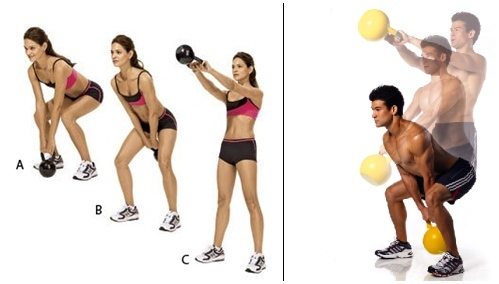
This is a simple exercise, but extremely effective using the whole body. Standing with your feet slightly more than shoulder width apart, hold a kettlebell with knees bent. Grip the kettlebell with both hands and lift to groin height. Ensure that your back is arched and that your head is upright. Keep the weight on your heels, bending at the knees, back straight and head looking up and forwards (as if you are going to sit down in a chair). Swing the kettlebell to the rear backwards, between the legs. The weight should remain on your heels and the shins should be vertical.
It is essential that you perfect this movement because without it, you will never have the leverage to get your hips into the movement. You should feel the kettlebell pulling you backwards and your hamstrings contracting. Pushing through your feet and legs, quickly snap/thrust the hips forward tightening the glutes and abs (This motion is similar to jumping up vertically.) Do this quick snap of the hips motion while at the same time projecting the kettlebell forwards and away from the body. Keep the arms relatively straight and bring the kettlebell to waist, chest or head height, then allow the kettlebell to freely return to the start position and repeat.


2. The Clean
Hold the kettlebell in one hand. Swing it through the legs, bring it forward, and push up through the legs from the feet. As the kettlebell comes over the top of your hand to hit your forearm, grip the handle tight and also dip at the knees. This will assist you in absorbing the impact of the kettlebell. The kettlebell should lie on the forearm with your elbow tucked into the side. The wrist should be flat, and your palm should be facing inwards towards the body.
The Swing will test your stamina, grip, and body coordination. The entire exercise can be carried out using one hand, switching at the top or bottom of the drill. It is important to keep core muscles tight to control the kettlebell at all times.

3. The 'One-Arm' Snatch
Swing the kettlebell back through the legs as you push through the feet and legs. Bring it up, snapping at the hips, sucking the floor up with your glutes. At this point, the body should be locked; the power of your drill should now have the kettlebell well on its way up. Remember: as the kettlebell comes over, dip at the knees and grip the handle to slow the kettlebell and avoid the impact on the forearm. The entire body should be locked with total tension that includes a strong core. 

Kettlebells can make a huge difference in your strength, core, muscle tone and stamina. The exercises are simple but effective. Losing weight is an added bonus! Enjoy!

Source  Sherry L. Granader is a Sports Nutritionist, National Speaker and Spokesperson, Author of 2 healthy cookbooks, Writer, Ghost Writer, Nationally Certified Fitness Instructor and Personal Trainer.

Thursday, 6 August 2015

Apple's iWatch and HealthKit: What They Mean for Health and Fitness Pros and Their Clients

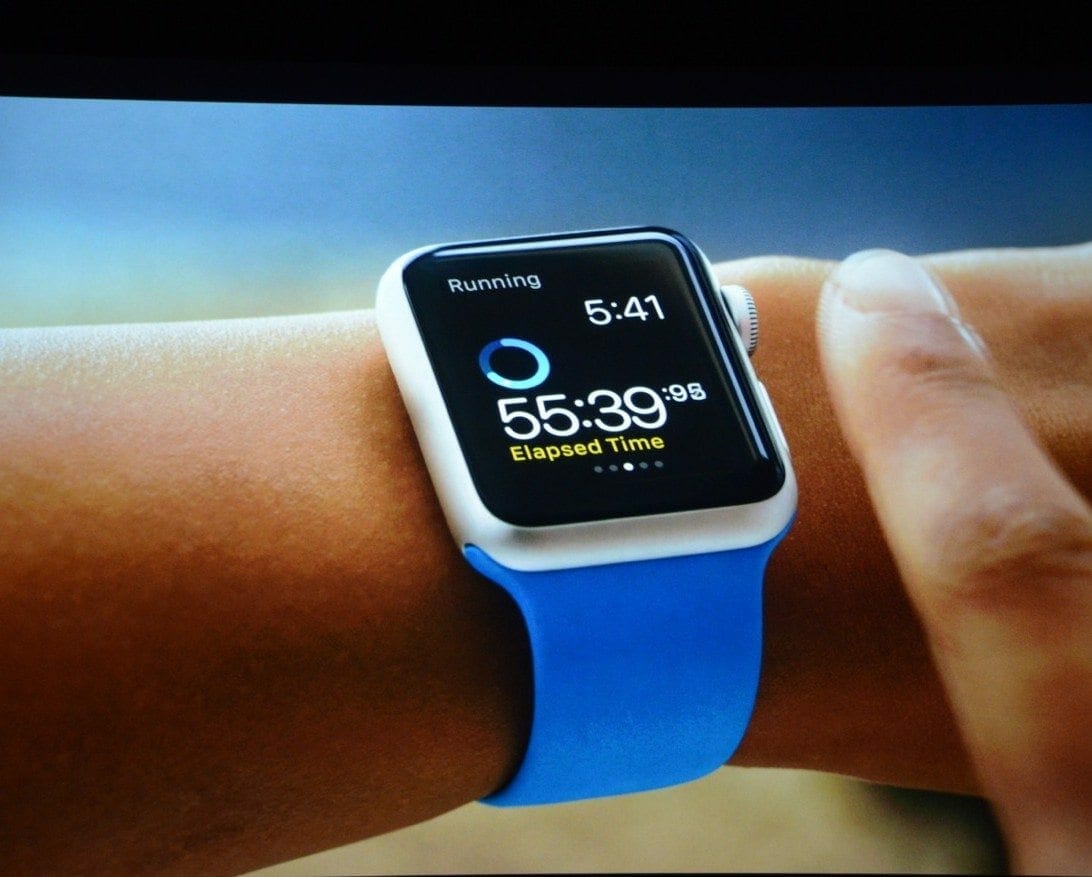
The fusion of technology and the fitness industry continues at warp speed. This brings both excitement and concern, with users around the world waiting for the release of the new iPhone 6, new iOS 8 and the closely guarded Apple iWatch. Rumors suggest the devices will be both fashionable and practical.
Wall Street has also been watching the buzz around the new Apple products, as this is the most significant event for Apple under the leadership of Tim Cook (and not Steve Jobs). With the introduction of HealthKit, it is also Apple’s attempt to make the iPhone not only the center of the user’s digital world, but also of his or her physical world as well.
The HealthKit framework within iOS 8 will offer more health and fitness functionality by linking devices with a user’s health information, using the iPhone as the central hub. Now users will be able to capture and monitor health and fitness information such as pulse, steps, blood pressure and sleep habits. These health measures offer a clear and current overview of a person’s overall well-being. While it is true that individual apps have been doing this for years, the new HealthKit will allow these health and fitness apps to sync data about the user’s health and fitness across a variety of wearables and apps, organizing them all into one dashboard application—the iPhone.
Within the fitness industry, excitement started a year ago when Apple hired fitness-industry expert and ACE Pro Jay Blahnik as one of the first of many hires specific to health and fitness. After years spent consulting with Gatorade, Nautilus, Schwinn and Nike, Blahnik was all in with Apple. In December 2013, Apple met with the Food and Drug Administration, the U.S. governing arm of the federal government for all things medical, to discuss mobile medical applications, likely to ensure that HealthKit would not cross a regulatory line.
This is exciting news for our industry, so how can personal trainers and health coaches benefit from such technology? Here are three things I will be watching for in the weeks and months that follow the announcement:
Being Connected. Our world continues to become even more connected. It is through being connected that trainers and health coaches can engage with their clients, keeping them on the path to wellness. Through the new iPhone platform, clients will be able to share with you integrated insights into their daily lives (activity, sleep, steps, food, pulse rate, etc.) that wasn’t previously possible. No longer will you need to guess what your clients did outside of training or if they took your advice—it will all be there with a click of a button. How’s that for accountability? New business models for training and coaching will be developed to take advantage of this technology and the job of a trainer or coach will no longer be limited to inside the four physical walls of a gym, opening up new markets not only down the street but around the world.
Deeper Collaboration. We’ve seen that it takes a team to make a real difference in the lives of our clients. From trainer to physician, coach to nutritionist, the power of collaboration, being in sync and in real time, is one highlight of the new HealthKit. It will take time for each team member to understand his or her place in the overall HealthKit matrix, but what is exciting is the possibility of overall health for our collective clients. More teamwork between practitioners allows trainers and coaches to stay within their scope of practice and seek partnerships with others in the healthcare industry.
Proceed with Caution. Apple is late to the game with regards to fitness tracking, but many expect it to succeed where others have not. While Jawbone and FitBit do a good job of tracking activity, many consumers still see wearables as “unstylish” and the buzz of the wearable soon wears off with a sharp decline in use after just six months. A device has yet to emerge with enough authority to encourage mass adoption (not good if you are relying on this data). Apple could change that perception with their historic strengths in design and new hires in fashion, which means more people will be more inclined to wear a device and thus more health data will be collected.
As we share more personal and confidential information across the cloud, there will be more debate surrounding security and privacy with this type of information. Apple has taken steps to ensure our privacy, with requirements that apps using HealthKit not store information on the cloud and not share information without user consent. Of course, there will always be a risk when sharing data through the cloud, but does the benefit of sharing outweigh the concern over privacy? Or vice versa?
Remember, Apple is not the only kid on the block using smartphones for health. In the US, there are nearly 170 million cellphone users, 70 percent of whom use smartphones. Within the smartphone category, the iPhone is by far the most popular, with 42 percent of users, followed by Samsung at 28 percent, 7 percent for LG, 6 percent Motorola and 5 percent for HTC. However, when looking at the operating systems of these smartphones, Android takes the lead with 52 percent, Apple at 42 percent, and Microsoft, BlackBerry and others making up the remaining 8 percent (ComScore, 2014). The takeaway? If you only work with Apple, you will be missing out on 58 percent of the population that uses a smartphone other than an iPhone.
I am a believer in effective uses of technology and am excited about the Apple announcement, as well as the upcoming announcements from Microsoft and Google within the health and fitness space. New technologies and innovations like the iPhone, the Apple iWatch and HealthKit are not a magic bullet, but they can be a very powerful tool that, when properly implemented into trainers’ and coaches’ businesses, can lead to new clients, new revenue streams and new partnerships. These technologies will never replace a qualified and certified personal trainer or health coach. After all, clients hire us for our knowledge and accountability, but they keep us for our personality and ability to connect with them.

Source : By Ted Vickey Ted Vickey Ted Vickey, M.S., is the Senior Consultant - Fitness Technology for ACE. He’s been an ACE Certified Personal Trainer since 1992

Wednesday, 5 August 2015

Get Rid of Stomach Flab and Get Flat Abs With This Secret


If you struggle to reduce your belly fat, so that you can uncover those elusive six pack abs, then I'm going to reveal in this article why you haven't been able to make progress with this area of your fitness.


A couple major problems I see as a fitness professional are that most people who are trying to lose stomach fat:


1. Most people spend way too much of their exercise efforts focusing on cardio based workouts, when in fact, a properly designed, high intensity strength training routine causes a much better hormonal response and metabolic rate increase than cardio based workout programs.


Also, as long as the strength training workout is designed with the right types of full body multi-joint exercises, and with the right types of rest intervals and intensity, you can actually burn as many calories (if not more calories) than with a typical cardio workout.


2. Another problem is that many people still think that they should be spending all of their workout time doing exercises that specifically target the stomach area and obliques. I think you should understand by now that spending all of your time doing exercises targeting the abs doesn't do much to burn the fat off of your stomach and love handles area.


Again, your time in your workouts could be much better spent by focusing on strategic strength training exercise combinations and full body training that will result in a much better decrease of body fat over time.


3. When it comes to diet, many people try to follow some sort of fad diet that restricts a certain macronutrient too much... like extremely low fat diets, or super low carb diets. The fact is that your body needs all of the macronutrients and food groups to maintain proper balance and build muscle and burn fat most effectively. Trying to eliminate certain food groups or macronutrients in general sets most people up for failure.


The main focus should be on avoiding processed foods, artificial ingredients, trans fats (hydrogenated oils), high fructose corn syrup, and other junk foods, while focusing on a whole-food organic diet full of variety and high nutrient density.


Many times when people get past the fads and gimmick diets and start to eat in a balanced whole food manner, a lot of the problems they were having start to take care of themselves, and the body fat starts to melt off, energy levels increase, and hormones are back in balance.

Source

Tuesday, 4 August 2015

Prenatal Workout Recommendations

In part 1 of this two-part series, prenatal precautions and specific exercises to counteract some of the common physical issues of pregnancy were presented. This second and final installment covers recommendations for cardio and the importance of social support. 

Prenatal Cardiovascular Fitness

What is comfortable during pregnancy varies from mother to mother. Water fitness is my personal favorite. Getting in the pool eases the aches and pains that come with increased weight and a shifted center of gravity. Exercises in these classes are also easily modified based on the amount of energy you have on any given day.
Other great cardiovascular options include:

Walking

Being a runner most of my life, I had to embrace the fact that walking can actually be a wonderful workout. If your client needs more of a challenge, encourage her add some hills to her route.

Group Indoor Cycling

Body weight does not play a major factor in this type of workout, which makes it a good option for those who want to continue exercising throughout the duration of their pregnancy. Others, however, may find the seat and positioning a little uncomfortable.

Swimming

Floating in the water can give the pregnant exerciser a sense of relief and freedom. If your client’s low back feels at all strained while swimming, recommend adding a pull buoy between the ankles to help keep the body aligned.

Cardiovascular Machines

The elliptical, stationary bike, Stairmaster and treadmill are all great options, particularly because they offer less impact on the body than other forms of cardiovascular exercise.  

Mind/Body

I cannot emphasize the importance of taking a prenatal yoga and/or meditation class during pregnancy. These classes can provide the expecting mother with many exercise options to alleviate pain and can help her become more comfortable with her changing body. Plus, the relaxation techniques will come in handy during labor and throughout stressful new-mom moments.

Putting it All Together

During pregnancy, a woman should aim for a minimum of three, 30- to 60-minute workouts per week, featuring a combination of cardiovascular fitness, strength training and mind/body exercise.

The Importance of Social Support

I love spending time chatting with other pregnant women, whether it is complaining about the latest pregnancy symptom, or reviewing which jogging stroller we like the best. Most communities have prenatal exercise classes, including prenatal water fitness, and prenatal yoga. Encourage your pregnant clients to sign up for at least one of these classes as a way to get some exercise and meet other women going through the same life-changing experience. On top of all of the support, many playgroups and lifelong friendships are formed in these classes.

Source

Monday, 3 August 2015

At Home Exercises - Crossfit Workouts At Home - Pro Trainer Live

At home exercises - Crossfit Workouts At Home - Pro Trainer Live. Do you want to go to the gym? Why not try the benefits of exercising at home. Visit the site for more home work out tips.
You've probably heard the newest craze in the athletic arena, it's called Crossfit and it is tough stuff. CrossFit was founded upon the strength and conditioning programs used by many government academies such as police, military and special ops units. However crossfit is not solely entitled to those in elite fields, in fact you could do your own Crossfit workouts at home by yourself and still achieve results.
CrossFit was designed to be used by elite athletes and elderly individuals alike. The only difference is the amount of load used in the workouts and the intensity. That's all that separates you from an elite athlete. Yes you could be essentially training with the same workout used by some of the fittest people on Earth. The only thing you would adjust is the amount of load and intensity that is right for your body and experience level.
Crossfit workouts at home are a great way to lose weight, gain lean muscle and improve cardiovascular health. So what kind of movements does Crossfit entail anyway? Well, it's a combination of plyometric exercises, Olympic style lifts and non-traditional lifts with equipment like kettlebells, bags of sand, pulley systems or weighted items filled with water. Sounds like fun right? Well it is if you have the right mind set. Although it can be fun it is considered a high impact workout. On a scale of 1 to 10 Crossfit would easily get an 8 - 10 rating on the list of high impact workouts.
The benefits of CrossFit are mainly due to the high intensity of the workouts. The intensity and power exercises are effective for burning up high number of calories in short periods of time. At the same time these high impact workouts are improving your aerobic fitness and producing the anabolic hormones such as testosterone, HGH and IGF-1 that are responsible directly for muscle growth. Here is the important thing to remember: CrossFit is an excellent workout program for any exercise enthusiast, however if you are just starting out with exercising then you need to take it slow. Use reduced volumes and intensities to build up a fitness base first and progress from there. The average Crossfit workout is not a recommended for people just starting to exercise or returning to exercise after a long break.
If you are starting out with Crossfit workouts at home to get into shape here are some great exercises you can employ at your own pace. You will need a couple of light dumbbells, or pop bottles filled with water, or any object that has a weight of 3 to 10 pounds.

Singe Arm Snach: Works the butt, back, shoulders and arms.
Single Arm Snatch For Crossfit Workouts at Home
Standing with your feet wide and toes turned€out slightly, place a dumbbell on the ground between your feet. Squat down low, and pick up the dumbbell with right hand. Move back up to a straight position onto the balls of your feet. As you move upwards pull the weight close to your body and over your head reaching for the sky. Bring the weight back down and repeat. You can do 10 reps on each arm and 3 - 6 sets of each.

Bear Crawl or Knee Tucks: Works the entire body.
Running Knee Tucks
This is one of the best Crossfit workouts you can do at home. Here you get down on all fours in a higher than normal push up position. From there you either do 30 reps or 30 seconds worth of knee tucks. Pretend you are racing an opponent and you need to move as fast as you can to beat your opponent. Drive one knee up to your chest and the other leg drives back to the ground. Doing 3 - 6 sets of these will work your entire body and leave you breathless.
Dumbell Swings: Works the butt, back, shoulders and arms.
These are perhaps the most fun and dynamic of the exercises. Simply stand with your feet wide and toes pointed out slightly. Hold onto your weight of choice starting with the weight on the ground between your legs. Move the weight dynamically from the ground all the way over your head reaching for the sky. Repeat 10 - 20 times maintaining a good rhythm and fluid movement. Do 3 - 6 sets of each.

The Sumo High Pull: Works the butt, back, shoulders and biceps.
Sumo High Pulls
Like doing cleans, stand with your feet wide, hold on to your dumbbells, either one in each hand or use a bar with light weights on it. Squat and lower the weights between your legs. Go back up to a standing position pulling the weights up to your shoulders focusing on keeping your elbows high. Repeat 10 - 15 times performing 3 - 6 sets.

Box Jump: Works the lower body.
Box Jumping for Crossfit Workouts at Home
Find a step or a box that is at least 8 inches off the ground. Simply jump off the box backwards to the ground. Focus on reacting quickly when your feet hit the ground to jump off again and land on the box. These are extremely high impact and should only be done if you are already in decent shape. Start with 3 sets of 6 - 10 reps and simply increase the number of sets up to a maximum of 6 as you progress.
Doing Crossfit workouts at home are a great way to get into shape at your own pace. Utilize some or all of the above exercises at your own pace and start the journey on getting the body you want on demand. For more information on at home workouts with a personal trainer online contact us.

Source 

Saturday, 1 August 2015

25 Minute Kettlebell HIIT Workout with Kettlebell Exercises for Strength...

This 25 minute full body kettlebell workout uses high intensity interval
training to keep the heart rate up for a great cardio workout, while
getting you strong and sculpted! A great workout full of kettlebell
exercises helping you lose fat and ton those abs. Options for all
levels.