Saturday, 17 January 2015

6 BOSU Exercises for the Core

BOSU Core exercises


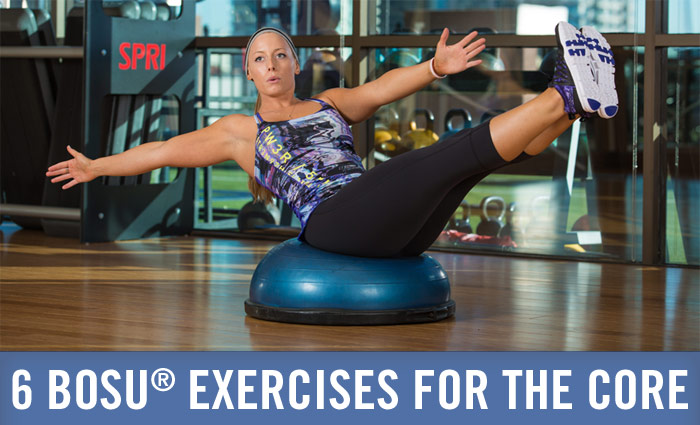
The BOSU—which stands for both sides up—is a unique piece of fitness equipment that allows you to perform exercises on top of an unstable surface. Among its many benefits include the ability to make exercises easier or more challenging. Here are six great core exercises that will add variety to your current exercise routine. Perform each exercise for 10-12 repetitions.
Saw
Saw
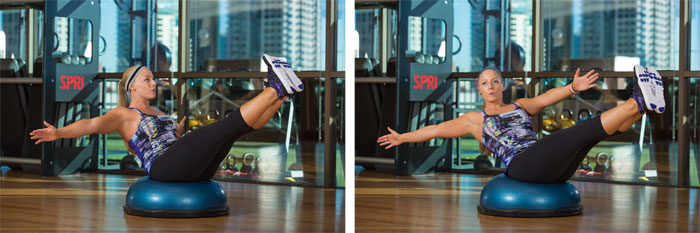
Place the flat side of the BOSU on the floor and sit on top of the dome side. Extend the legs, hip-distance apart, and flex the feet. Inhale and extend your arms out to the side, palms facing forward; draw in the abdominals. Exhale and rotate the spine toward the left leg, reaching the right hand toward the left foot. Inhale and slowly, with control, exhale and return to the starting position. Continue to alternate reaching toward the right and left leg.
Frogs
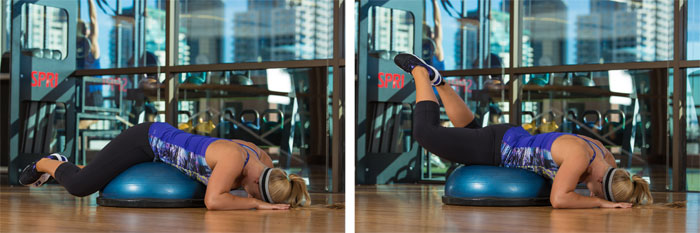
Frogs
Lie face down on the BOSU, with your hips toward the top’s center. Place your forearms on the floor at a diagonal; bring your fingertips together and rest your forehead on your hands. Contract your glutes and lift your legs upward, contracting the abdominals and bringing the heels and inner arches of your feet together. Inhale and lower the legs. Complete six repetitions.
Scissors
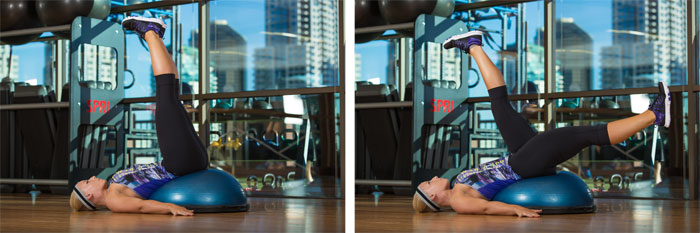
Scissors
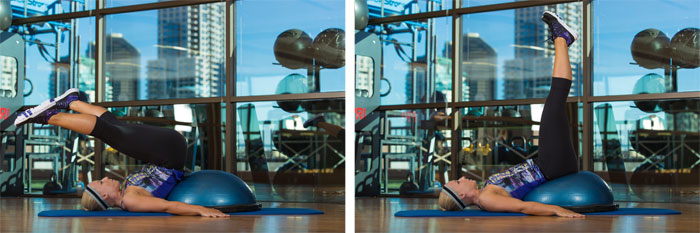
Sit on top of the dome and slowly lean back onto your forearms to rest your head, neck and shoulder blades on the floor. Your hips should be propped on top of the dome. Slowly lift your feet off the floor, extend your legs to the ceiling and point your toes. Inhale and externally rotate from the hips, reaching the right leg away and the left leg toward your torso. When your legs are fully extended, add a slight pulse. Inhale and return to center; exhale and repeat with the left leg moving away and the right leg coming toward your torso. Continue to repeat right and left.
Rollover
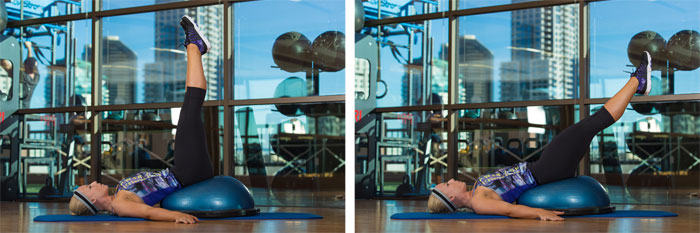
Rollover
Rollover
Sit on top of the dome and slowly lean back onto your forearms to rest your head, neck and shoulder blades on the floor. Your hips should be propped on top of the dome. Slowly lift your feet off the floor, extend your legs to the ceiling and point your toes. Exhale and lower your legs away from the body while maintaining core and inner thigh stabilization. Inhale and draw the legs back over your torso or head (your hips will lift off the dome). Exhale and, with control, flex your feet and slightly split the legs. Slowly lower the spine and hips back onto the dome. Once your legs are directly over the dome, bring the feet together and point the toes. Complete six to eight repetitions.
Single-leg Stretch
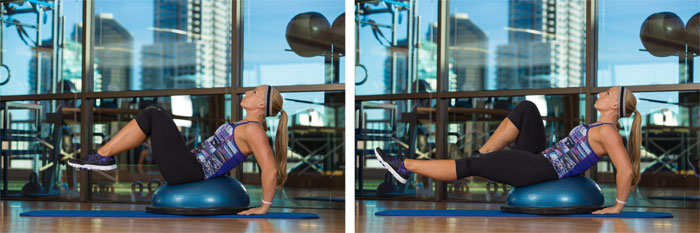
Single leg stretch
Sit with your hips slightly forward on the dome. Roll back so that your spine is on top of the dome and your body is in a neutral balanced position (your head and neck are not on the dome). Place one hand on the floor and the other hand behind the head. Lift and bend the knees to 90-degrees. Exhale and extend the right leg long; inhale and return to center. Exhale and extend the left leg long; inhale and return to center. Continue for six repetitions on each side.
Double BOSU Plank With Leg Pull
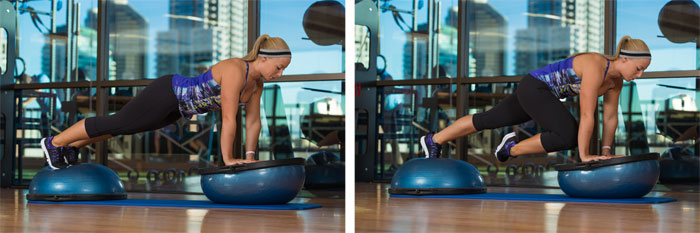
BOSU Plank
Position two BOSUs, dome side up, on the floor. Assume a plank position with your toes on one dome and your hands on the other.  If two domes are not available, place your hands on the floor. You can also place one BOSU with the dome side down and use this one for your hands. Inhale and contract the muscles of the core. Transfer your weight on to your right foot and bring your left knee in toward the dome. Return to center and repeat with the other leg. Alternate left and right for 12 total repetitions.

Source

Thursday, 15 January 2015

Benefits of Foam Rolling: What is it, and How Does it Help?


benefits of foam rollingThis past fall, I began attending a yoga class with a friend of mine who happened to be in the middle of getting her personal trainer certification.  As a result, she was often rushing into yoga class after already having worked out earlier in the day.  I was on the phone with her one evening, asking her how she felt, and she said that her legs were really sore.  I figured that meant she would not be in class that night, and understandably so!  When she came strolling in later, looking chipper as ever, I asked her if she was sure she was up for another class.  “Oh totally,” she said, “I foam rolled!”
At that moment, I had never heard of such a thing before.  We went over to her house after class so she could show me what she was talking about, and how on Earth it had helped her.  What she brought out was undoubtedly a foam roll -meaning a roll made of foam.  She then began showing me how she used it on her legs by a combination of balancing on it, and rolling it over her thighs.  She said it really helped take that post-workout soreness away.  I was sold immediately, and told my husband I wanted one for Christmas.  When I opened it that morning, he said “I still don’t know what that is, but I’m glad the sporting goods store had it”.  So was I.

What is Foam Rolling?

benefits of foam rollingThe fancy term for the process is “Self-myofascial release”.  Or, in other words, self massage to help with muscle soreness, tightness and overwork.  It has become a more popular trend in recent years.  The reason my husband and I had never heard of it before was because it was mainly reserved for physical therapists, coaches, and professional athletes.  Still, common sense says that if it is helpful to them, it can be helpful to you too!
You use the foam roller to apply pressure to specific areas of your body.  This helps reduce soreness, and promotes healing and elasticity. Technically speaking, you could also use a lacrosse ball, or a round cane to do the same thing, but you are probably going to need that aforementioned coach or physical therapist there to help you.  Foam rolling is something you do yourself, whenever you need it.

How Do I Know if I Need to Use One?

benefitsoffoamrollingThat depends on how you answer this question: How do you feel the day after a workout?  There’s that “good” kind of sore, which is not really soreness, but more of a feeling that your muscles were worked really well – and then there is the bad kind.  If you have ever limped into work after “leg day”, or watched your favorite TV show with pillows stuffed behind your back to make the chair bearable, then you are the bad kind of sore.
Another way to tell is by massaging the sore area.  What you probably feel are some points that are more tender than others.  We sometimes call these “knots” or “trigger points”. You will feel pain when these are pressed on, but not anything sharp or stabbing.  After rubbing the area for a few minutes, it should feel better.  If that is the case, then you are going to love your foam roller when you get it.

Why Are My Muscles So Sore in the First Place?

back pain between shoulder bladesWe really throw a lot at our bodies, don’t we?  We sit in desk chairs all day, we maybe don’t eat the healthiest foods all the time, we push our bedtimes back too far, and we can sometimes really overdo it at the gym to try and compensate for all that.  Our bodies are pretty incredible, and they can adapt to most situations, but when too many things stack up all at once (a sleep deprived, slightly dehydrated hour of CrossFit, for instance) our systems get overloaded.  Our bodies can not repair the damage fast enough, and we experience that “crash”.  Sore muscles, exhaustion, etc.
This is where foam rolling can really help you out.  By using a combination of strategic roll placement, and body weight, you can apply therapeutic pressure to your worn out muscles, and begin to feel better sooner.  The motions will help soothe any inflamed muscle tissue or tendons, while also promoting better blood circulation to the areas that need it most.

My Friend Says She Tried it, and it Kind of Hurt!  What the Heck?

If you have ever gone in for what they call a “deep tissue” or “sports” massage, you probably felt a similar level of pain in that too.  Remember that it is not really that the foam roller “hurt” you, it is more than your muscles are already hurt, and applying pressure, even good pressure, can be pretty uncomfortable.  Naturally, you always want to run new fitness routines by your doctor before you begin, so do let him or her know that you would like to begin foam rolling.  That way, if anything really troubling does turn up (again, a sharp or stabbing pain), you can bring it to your doctor’s attention right away.

benefits of foam rollingHow Do I Get Started?

With all this talk or soreness and injury, you might think that foam rollers are only beneficial on your worst days.  Actually, you can use them anytime, and still enjoy the benefits!  No need to reserve the foam roll for only the times when you are feeling sore.  Paying attention to your muscles regularly, stretching, foam rolling, massaging and proper hydration are all good things to do no matter what.  Foam rolling can be a great addition to your warm ups or cool downs, and you may begin to find that those “bad days” don’t really come around that often anymore.


Source 

Wednesday, 14 January 2015

The Mistakes You Might Be Making In Your Group Fitness Classes

yoga


If you love group fitness classes you’re probably already familiar with some of the golden rules of being a good student, such as arriving to class on-time and putting your equipment away when you’re done. However, there are some additional considerations that will help you maximize your results. Four of the country’s top group fitness instructors share the mistakes they commonly see students make in different group fitness classes and offer tips to help you get more out of your next sweat session.

Aquatic Fitness
The mistake: Going in too deep
One of the great benefits that a shallow water aquatic fitness class offers is a joint-friendly fitness experience. However, positioning your body too deeply in the water can actually lead to a less effective workout, shares Stephanie Thielen, certified aquatic instructor and training specialist with the Aquatic Exercise Association. “It’s very common to see participants in the water at shoulder depth. A body immersed to the waist bears approximately 50 percent of its bodyweight, whereas a body immersed to the chest bears approximately 25 to 35 percent of its bodyweight.” The downside to performing exercises at shoulder depth is that the body cannot maintain vertical alignment, which means the strength-based benefits begin to diminish.
The fix: Thielen recommends positioning yourself in waist- to chest-deep water to maximize effectiveness. “This will help to ensure you have control and strength to perform exercises at a moderate pace and that the buoyancy properties of the water do not take over, allowing you to experience the muscular strength benefits aquatic exercise classes offer.”

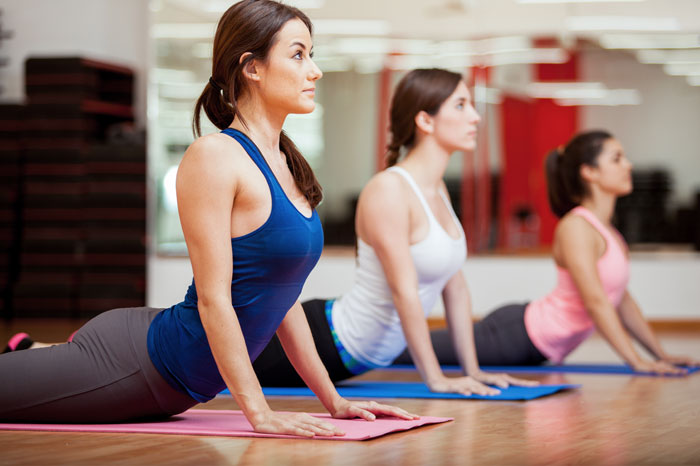
Yoga
The mistake: Waiting for instructions to become mindful
With a plethora of research-supported physiological and psychological benefits of mind-body exercise formats like yoga, it’s clear that there is much to be gained from a class experience. However, don’t wait for an invitation from the instructor to become more mindful or depend on mirrors to see where you are, urges Lawrence Biscontini, mindful movement specialist and award-winning international fitness educator based in Mykonos, Greece.
The fix: To get more out of the time spent on your mat, Biscontini recommends practicing closing your eyes at will throughout your yoga practice to heighten your own kinesthetic sense, without the need to wait for instructions to do so. “This improves balance, helps you to ‘work in’ and overall increases your self-awareness in time and space, enabling you to know where you are by feeling where you are instead of seeing where you are. This is one of the true goals of mindful disciplines.”

CrossFit
The mistake: Assuming the only approach to warming up is the one the instructor provides
Just as there is not a one-size fits all approach to exercise, there’s also no such thing as a perfect warm-up for all class participants, especially when it comes to CrossFit. While much thought and consideration goes into designing a warm-up for a WOD, it’s important that individuals spend time working to address their own personal needs, says Sabrena Merrill, ACE master trainer and CrossFit coach in Kansas City, Mo. “While I try to address everyone’s needs in a warm-up, some participants might need to take care and spend more time mobilizing an area than what is allotted for. In these instances, I want participants to not always do exactly what I say in the warm-up and instead modify the warm-up and spend time addressing their individual needs.”
The fix: Don’t feel obligated to follow the coach’s warm-up exactly. Instead, Merrill recommends respecting your uniqueness and approaching the warm-up—and the entire WOD for that matter—accordingly, as doing so will help to ensure a safe and effective CrossFit experience. “For example, someone with stiff ankles might need to spend more time foam rolling and stretching their calves. If that means the participant spends less time on the other mobility exercises that are programmed in the warm-up, then so be it.”

Indoor Cycling
The mistake: Pedaling too quickly without enough resistance
One of the most common mistakes people make when in the saddle is pedaling too fast with little-to-no resistance. Many people opt to ride without resistance because they mistakenly believe that too much resistance will result in big, bulky legs, which is completely untrue, according to Keli Roberts, Schwinn indoor cycling master trainer and competitive cyclist. “Riding with adequate resistance produces a higher level of wattage, and because wattage is most closely paralleled with caloric expenditure, adding resistance can help make your legs smaller, stronger and more well-defined.”
The fix: To maximize the benefits of this class format, Roberts recommends pedaling between 70 and 100 RPMs (revolutions per minute)—which equates to how many times one of your legs makes a complete pedal cycle per minute—using adequate resistance. “By using appropriate resistance you increase the wattage,” explains Roberts, “meaning you’ll burn more total calories.” 

Source

Tuesday, 13 January 2015

How to Stay Motivated to Work Out: Top 5 Ways to Stick It Out and Get It Done

It can be easy to start things, but even harder to follow them through to completion.  When it comes to working out, plenty of people make fitness goals for the New Year, the summer, or the month.  However, when hard work is involved and life gets in the way, it can be easy to get bored of a workout routine, especially if the results you want to see are coming too slowly.
If you need help sticking to a fitness routine, and are looking for ways to stay motivated to work out, we have 5 motivating steps that you can use to help you stick to your work out and stay motivated.

Step 1:  Motivate Your Inner Voice

  • Ask yourself this question: Why do you workout?  Are you doing it to lose weight, to make new friends in a fitness class, or to live longer?  Everyone has their own reasons, and it is up to you to find the one particular reason that is your workout motivation.  Once you find your reason, stick to it and keep focused.
  • Strengthen your inner voice:  If your inner voice is not strong, try to ignore the primary logic behind working out, or the things that make you not want to go to the gym.  Instead, focus on getting what you want.  Hone in on motivation and action, and your motivation will come easier to you.
  • Use positive self talk:  If you talk down to yourself or try to punish yourself verbally for not working out, then working out is not going to be any fun.  Do not think about what will happen if you do not exercise.  Instead, focus on the food that will come from it when you do make the time to stay fit and in shape.  If you focus on the negativity, you will never be able to appreciate what you do.  Think of the positives and say things like, “I will”, “I can”, and “I did”.  These little inner talks will help you get yourself motivated and stay motivated to work out.

Step 2:  Set a goal

  • Split it up:  It can be tough to motivate yourself to do anything if you do not have a goal in mind.  You can set up a goal for yourself at any point in this process, and it does not even have to be the end goal that you are looking to achieve.  In other words, you can simply set up a goal to achieve by the end of the day, week, or month.  For instance, if you want to lose 20 pounds altogether, and then make it a goal to lose 4 pounds by the end of the month.  This is 1 pound a week, and this will definitely seem a lot more manageable.  Your aim is to find ways to keep yourself motivated without getting overwhelmed.
  • Commit to something:  Signing up for a walk or run can be a motivation for you to work out.  Once you have something that you feel like you need to work towards, you will have more motivation to get there.  Plus, the feeling of accomplishment once your goal is achieved will be reward enough from the process.
  • Reward yourself:  Working out is tough, so if you have a goal then you might as well have a reward to make the end point seem more enticing.  Try to train your brain to want to work out.  For instance, after you complete a workout everyday for one week, treat yourself to a movie, a night out with friends, or to your favorite restaurant.  Basically, do what it takes to keep yourself going.
  • Cut yourself some slack:  When it comes to working out, it can be easy to compare yourself to others or beat yourself up if you start feeling tired.  The thing to remember here is that working out is hard and it requires a lot of energy.  Once you have your goal, take it slow and do not worry if you stumble, fall, or want to quit – that is all a part of the process.

Step 3:  Take care of your body

Working out requires your full body’s attention.  As such, you are going to want to take care and nurture your body as best you can during this time.
  • Eat healthy:  Regardless of whether you are working out or not, eating a healthy diet will help you stay motivated.  How can you work out if you do not feel good?  Working out and diet go hand in hand.  Remember that the healthier you eat, the healthier you will feel.  A good way to ensure that you have a healthy day is to start your day off with a healthy breakfast.  This will keep you energized throughout the day, help you maintain a healthy weight, and keep you feeling strong.
  • Look good:  Looking good and feeling good also go hand in hand.  Perhaps a new pair of workout shoes or pants will motivate you to workout.  However, you should not have to spend a load of money to try to motivate yourself.  Keep it simple and use some new workout gear as a reward or incentive to get active.
  • Change little things:  There are little things in our day that we can do to take care of our body.  For example, instead of sitting down to watch a show after your dinner, get up and go to the park for a brisk evening walk or talk a short jog around the block.  Little things like this can change how you feel about yourself and make you want to work out more.
how to stay motivated to work out

Step 4:  Change your routine

  • Go halfway:  If you find it hard to get up and work out, just get halfway there.  Usually, if you are already almost at the gym, park, or towards your fitness class, you are going to be less likely to turn around and head home.
  • Keep your work outs varied:  It can be easy to get tired of the same workout routine and lose motivation.  If you are walking everyday and taking the same route, consider trying something different to kill your boredom.  For instance, try taking a kick boxing class online such as this one, swim at the local pool, or invite some friends to go on a hike.
  • Invite some friends:  A great way to change up your routine and keep you wanting to work out is to get someone else to do it along with you.  This is going to help make you accountable and it will also motivate you to work out because doing it with someone else is usually a lot more fun than going at it alone.

Step 5:  Keep it positive

  • Write it down:  Keep yourself motivated and accountable also by writing in a journal.  Track your daily workout routines and count calories to record your progress.  At the end of the week, you can look back and use your journal as motivation to see how far you have gone.
  • Surround yourself with positivity:  When you need motivation, the worst thing that you can do is compare yourself to others or be around people who do not motivate you or put you down.  The good news is there are plenty of people who are looking for motivation as well.  Your job?  Find these people and work together to accomplish something.  Remember: strength in numbers is powerful

Kick Your Motivation Into Shape

Finding ways to stay motivated to work out can be tough.  We all have days where we do not what to do things that we know are good for us, but just remember that you are not alone in motivating struggles.  The great thing about working out is that you have the potential to feel amazing after a good work out.

Source

Monday, 12 January 2015

5 Keys to Making New Year’s Resolutions That Stick

Woman finishing race


As we turn the calendar to a new year, we often think of turning over a new leaf and starting or resuming healthy habits that may have been ignored during the past year or even just the past few months. While most successful change involves “resolve,” simply stating a few New Year’s resolutions may not be enough to ensure success. Here are the five keys to making New Year’s resolutions that you can actually stick with throughout the year and beyond.
1. New Results Require New Thinking
People often seek change when they are at their wits end. When problems loom, we look for ways to be and do better, but this desire is often rooted in frustration and fear. Judging past attempts and failures may actually sabotage our success. Therefore, a first step toward success is to release discontent as the impetus for change. When we begin to simply notice our thoughts and feelings (about current fitness level or weight, how we compare to others, our story about past successes or failures), we make room for new thoughts and new solutions to emerge. 
In a fast-paced world, we may be more accustomed to answering urgent demands for our immediate attention than waiting, watching and being in the present moment. With patience and practice, we can learn to still the busy mind chatter (mindlessness), be vulnerable rather than reactive, and be connected to ourselves rather than cut off (mindfulness). Instead of thinking and saying “I want to lose 20 pounds…but I said the same thing last year,” we think and say, “I am willing to learn how to accept myself, including my mistakes, as I move toward my goal.” Mindful change means completely approving of ourselves and being present with who, what and where we are and wish to be, as our next step is revealed with ease and clarity. 
Formal mindfulness practices include Zen meditation, mindfulness-based stress reduction and mindfulness-based cognitive therapy. However, those new to meditation and mindfulness can start with a simple, regular practice of observing the breath for a few moments. From a quiet mind, we give ourselves the option of making thoughtful decisions based on our inner wisdom. 
2. Connect Resolutions With Things You Value
“Your beliefs become your thoughts. Your thoughts become your words. Your words become your actions. Your actions become your habits. Your habits become your values. Your values become your destiny.”
—Mahatma Gandhi 
Do you wish to grow in awareness, develop a new skill, expand your knowledge, live a healthier lifestyle, master a sport, overcome a physical challenge or create a support network? So often, people begin with action rather than contemplation. However, after huffing and puffing, people often discover that activity disconnected from vision and values is short-lived.  
Awakening your own motivation for behavior change is best supported with an exploration of your values and vision for what the future may hold. What do you aspire to achieve? What drives and motivates you? What do you hope the future will hold in one year, five years and even 10 years?
Ask yourself: What’s my image of fitness and where did it come from? How am I being influenced by family, friends and the media? How have I allowed criteria from the past (e.g., my weight in school) to dictate what is right for me now? How will my life be different once I’ve made this lifestyle change? What new activities will I be able to enjoy? 
3. Break Them Down
Avoid the pitfall of vague, broad, general goals. Intentions that are specific, measureable, attainable, realistic and time-bound (SMART goals) are more likely to be achieved. Be sure goals and action steps are connected to your values; then ask how much, how many, how often, when, where and with whom. Hold onto your larger vision for the change you want to experience and then focus on each next step.
4. Build in Accountability
The best means of accountability is the one that you choose. Ask yourself: “How would you like to be accountable?” and then create an accountability process that will work for you. For example, keeping a food log or creating a weekly exercise plan may be helpful. While some people feel comfortable being accountable to friends, family members or smartphone apps, you might considering working with a health coach or personal trainer to help keep you accountable. The key is to find something that helps you gain awareness, perspective, wisdom, ideas or data that help you stay on the path to fulfillment and be able to check in with your intentions. 
5. Celebrate Efforts and Successes
Incorporating accountability provides a built-in opportunity to celebrate your efforts and progress. Seeing progress will give you the confidence and momentum you need to continue your efforts. Remember to encourage everything in the direction of your goals…all attainment, all attempts, all discoveries and even all set-backs. Awareness is curative!

Sunday, 11 January 2015

7 Fitness Tips for Busy Parents

Being a parent often means that every moment of your day is occupied with kids, worrying about the kids, thinking about activities to do with the kids, and wishing you could just have a few minutes away from the kids to take a nap. It's exhausting. The sad part is that you're too tired to get in a good workout.

Don't be one of the parents that are just too tired and busy to get in your workout. Accept no excuses, and let the tips below help you to fit in that workout.


1. Get Your Workout Over With

Having a hard time getting your workout in? Go to bed ready to workout in the morning--you can even try sleeping in your workout clothes--and jump out of bed in the morning ready for a quick workout before the little one is fully awake. You can even convince your partner to dress and feed the baby in the morning, or get the school kids ready. Get that workout in first thing, and it will be one less thing to cause stress in the morning.

2. Get Out of the House
Need to make it a bit easier on yourself to do a workout? Don't spend your day sitting with the baby in front of the TV, but make it a point to spend at least four or five hours of your day out of the house. Once you're done with shopping, go for a walk or run in the park. Take the sport stroller for a jog, or bring your light weights to do some exercise while the little one is running around.

3. Play with the Kids


One of the best ways to get exercise in is to play with your kids. Whether you're playing a game of backyard soccer or football, a game of basketball in the driveway, or tag in the park, you'll spend more time running and moving around. It may not be the awesome workout you want, but it will help to make up for the fact that you can only spend a small amount of time doing a focused workout.

4. Prepare Your Workouts

If you know you have a few moments in the day when you can work out--such as when baby is asleep or the older children have just been packed off to school--make sure to prepare your workouts beforehand. Have the weights ready to go, the DVD in the player, and your workout clothes already on. Make it a point to always be prepared to get in that workout, and organize your schedule around those workouts.

5. Trim the Workouts

Don't expect that you'll be able to fit an hour or so of exercise into the busy day of a parent, or you'll be in for a real disappointment. Instead, make sure that your workouts are no longer than 10 to 20 minutes, but make them count. Go for high-intensity exercises that combine cardio with muscle building, and you'll see the results in far less time.

6. Make them the Weights
Have you ever tried to jog while pushing a double stroller up a hill? It's incredibly intense exercise, and you'll be able to get in great shape if you make your children the weights. There are dozens of fun exercises you can do using your children as the weights, and it can keep them entertained as well. Whether you carry baby around for an hour or go for a hike with the little one on your back, it's a great workout!

7. Make it a Priority

Sometimes, you're going to have to be okay with sitting the kids in front of the TV just so you can get in that 20-minute workout, or serving them a quick meal instead of making an elaborate one. Be a bit more selfish with your workouts, and you won't regret it.